Weekly Paper Notes — Seminal Paper of the Week for the 2026-06-27 CS paper digest. Area: Distributed Computing.
Author: Satoshi Nakamoto Published: October 31, 2008 (cryptography mailing list) Canonical URL: bitcoin.org/bitcoin.pdf
This week’s digest had a fresh paper on transaction-fair ordering on DAGs without weak edges (Tilikum, 2606.27250) — a piece of work whose entire problem statement (DeFi, BEV, reordering attacks) only exists because of one nine-page document published seventeen-and-a-half years ago to a small cryptography mailing list. So this week’s seminal pick is the obvious one: Satoshi Nakamoto’s Bitcoin: A Peer-to-Peer Electronic Cash System.
It is worth re-reading the original, slowly, because the document has been buried under so much subsequent maximalist / nihilist / regulatory / VC noise that its actual technical contribution gets forgotten. It is a small, elegant systems paper.
Why the paper still matters
Three reasons:
- It solved a problem the distributed-systems community had treated as unsolvable in its original framing. Byzantine agreement without a known participant set, without synchrony assumptions, and without a trusted bootstrap. Before 2008, the answer to “how do mutually distrusting parties on the open internet agree on a global ledger?” was: you can’t, you need a quorum, the quorum needs to know each other, and you need partial synchrony (Castro-Liskov PBFT, 1999). Nakamoto sidestepped all three preconditions by trading exact agreement for probabilistic agreement weighted by economic cost.
- It is the substrate of an entire generation of follow-up systems work — Ethereum’s account model, Snow / Avalanche, HotStuff, Tendermint, Algorand, every L2 rollup, every MEV / BEV paper (including the Tilikum paper that ran on cs.DC this week), every state-channel construction, every threshold-signature multisig. The literature on transaction ordering as a first-class abstraction would not exist without the whitepaper having reframed transactions as a totally ordered, hash-linked log.
- It established a design pattern — incentive-compatible protocol design — that has since leaked back into traditional distributed systems. Storage protocols (Filecoin), bandwidth markets, and federated-learning incentive schemes all owe a structural debt to the “honest behavior is the unique Nash equilibrium of the protocol” framing the paper introduced casually in two paragraphs.
The setup
The problem statement is one paragraph long, and worth quoting in spirit: commerce on the internet relies on financial institutions as trusted third parties to process electronic payments; the cost of mediation increases transaction sizes, limits casual transactions, and forces a broader cost of payment reversibility onto merchants. What is needed is an electronic payment system based on cryptographic proof instead of trust.
The technical obstacle is the double-spend problem: in a digital token system without a trusted clearinghouse, what stops Alice from spending the same coin twice by sending two contradicting transactions to two different recipients? The standard answer (Chaum 1983, e-cash variants) was a central mint. Nakamoto’s contribution is showing how to replace the mint with a permissionless, append-only, hash-linked log whose canonical version is whichever fork has the most cumulative computational work behind it.

The N invariants
The whitepaper rests on a small set of invariants the protocol enforces:
- Transactions are signed chains of digital signatures. A coin is, recursively, the hash of the previous transaction together with the public key of the next owner, signed by the current owner. The receiver verifies the chain back to a coinbase.
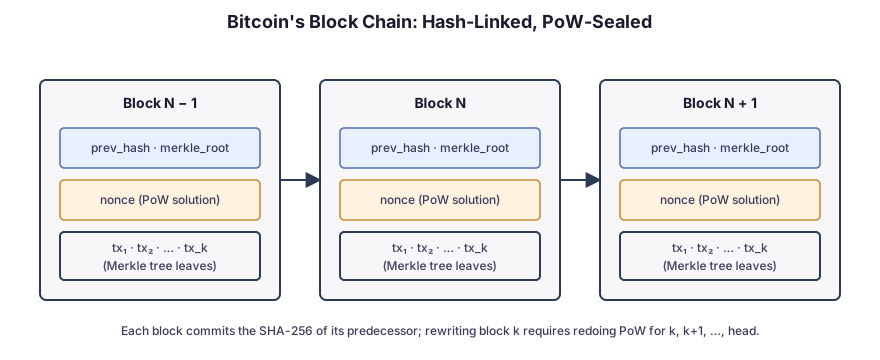
- The block is the unit of total ordering. Transactions are batched into blocks; blocks contain a Merkle root of their transactions, and each block contains the hash of its predecessor. This is the structure rendered in the diagram above.
- Proof-of-work seals each block. A block is only valid if its hash falls below a difficulty target, which requires the publisher to have done expected-O(2^D) hash trials. The economic cost is the security budget.
- The longest (most-work) chain is the canonical history. Nodes always extend the chain with the most accumulated work; ties break by first-seen. This rule, applied locally by every node, produces eventual consistency without any explicit agreement protocol.
- Incentives align nodes with honesty. Mining the block earns the coinbase reward and the transaction fees. An attacker with majority hash power could rewrite history, but extending the honest chain is more profitable than attacking it as long as the system has value — the famous Section 7 game-theoretic argument.
- Privacy comes from pseudonymity, not encryption. Identities are public keys; the ledger is fully public. Privacy is a function of address rotation, not of cryptographic concealment of transaction contents.
The algorithm in nine lines
The whole protocol fits in nine bullets in Section 5 of the paper, and the brevity is part of why it survived:
- New transactions are broadcast to all nodes.
- Each node collects new transactions into a candidate block.
- Each node works on finding a difficult proof-of-work for its block.
- When a node finds a proof-of-work, it broadcasts the block to all nodes.
- Nodes accept the block only if all transactions in it are valid and not already spent.
- Nodes express acceptance by working on creating the next block in the chain, using the hash of the accepted block as the previous hash.
Steps 7–9 handle conflict resolution: nodes always consider the longest chain to be the correct one and keep working on extending it; a tie resolves itself in the next block. The mining nodes function as the clock, the quorum, and the consensus engine simultaneously — a design economy that compilers researchers would call “fused passes.”
Why this design has outlasted everything around it
Most 2008–2012-era cryptocurrency proposals are forgotten: bit gold, b-money, hashcash-as-payment, RPOW. Bitcoin’s whitepaper outlasted them because it made three design choices the others got wrong:
- Open membership without identity. Earlier proposals required some kind of participant registry. Nakamoto explicitly designs for a churning, unidentifiable set of participants — that’s why the security argument is economic rather than cryptographic-quorum-based.
- A single global chain, not a DAG. Subsequent proposals (GHOST, IOTA, SPECTRE, the recent DAG-BFT family including Tilikum) have argued for DAGs to improve throughput. The whitepaper’s “longest chain wins” is provably simpler to reason about and probably the right starting point, even if production systems have since moved past it. Note how the cs.DC paper this week, Tilikum, is still framed as “transaction-fair ordering on a DAG without weak edges” — the absence of the weak-edge primitive is the headline contribution, which only makes sense against the historical-DAG backdrop that the whitepaper’s simpler linear chain was a deliberate alternative to.
- Probabilistic finality. PBFT and its descendants offer deterministic finality after one round-trip among a known committee. Nakamoto offers exponentially-decreasing reorg probability with confirmation depth. This is the design that scales to open membership; deterministic finality is what Ethereum and the BFT family have spent the subsequent decade trying to retrofit on top.
The paper is, in retrospect, a careful trade study: it gives up exact agreement and bounded latency in exchange for permissionlessness and Sybil-resistance, and pays for that with electricity. Whether one likes the trade or not, the clarity of the trade is what makes the paper foundational.
What to read next
- Castro & Liskov, Practical Byzantine Fault Tolerance (OSDI 1999) — the deterministic-finality counterpoint.
- Sompolinsky & Zohar, GHOST (2013) — the DAG-extension critique.
- Eyal & Sirer, Majority Is Not Enough: Bitcoin Mining is Vulnerable (FC 2014) — the selfish-mining critique of Nakamoto’s incentive analysis.
- Garay, Kiayias & Leonardos, The Bitcoin Backbone Protocol (Eurocrypt 2015) — the first rigorous formal model of the whitepaper’s security.
- Buterin, Ethereum Whitepaper (2013) — the smart-contract generalization.
- Yin et al., HotStuff (PODC 2019) — the BFT side’s response, used as the basis for Diem/Aptos consensus.
Links
📄 Original PDF (bitcoin.org) · 🗒️ Cryptography mailing list announcement, 31 Oct 2008
Part of the Weekly CS Paper Digest series. Seminal Paper of the Week is a rotating slot for foundational papers across CS — this week’s pick, Bitcoin, was prompted by Tilikum (2606.27250) appearing in the cs.DC area of the same digest.