Eleven years after delivery, “I See What You Mean” remains the single best talk on why distributed systems are hard as a language design problem, not as an engineering problem. Peter Alvaro — now a professor at UC Santa Cruz, then a Berkeley PhD finishing the BOOM project — walks through a decade of research on Dedalus and Bloom and ends with the CALM theorem: a precise, syntactic answer to the question “when does a distributed program need coordination, and when can we get away without it?”
If you build, debug, or operate distributed systems and have never watched this, fix that this week.
The big move: outcomes ≠ behaviors
Most program reasoning is about behaviors — the sequences of events a program produces. In a distributed system, the space of behaviors is astronomical: messages get dropped, reordered, retried, duplicated.
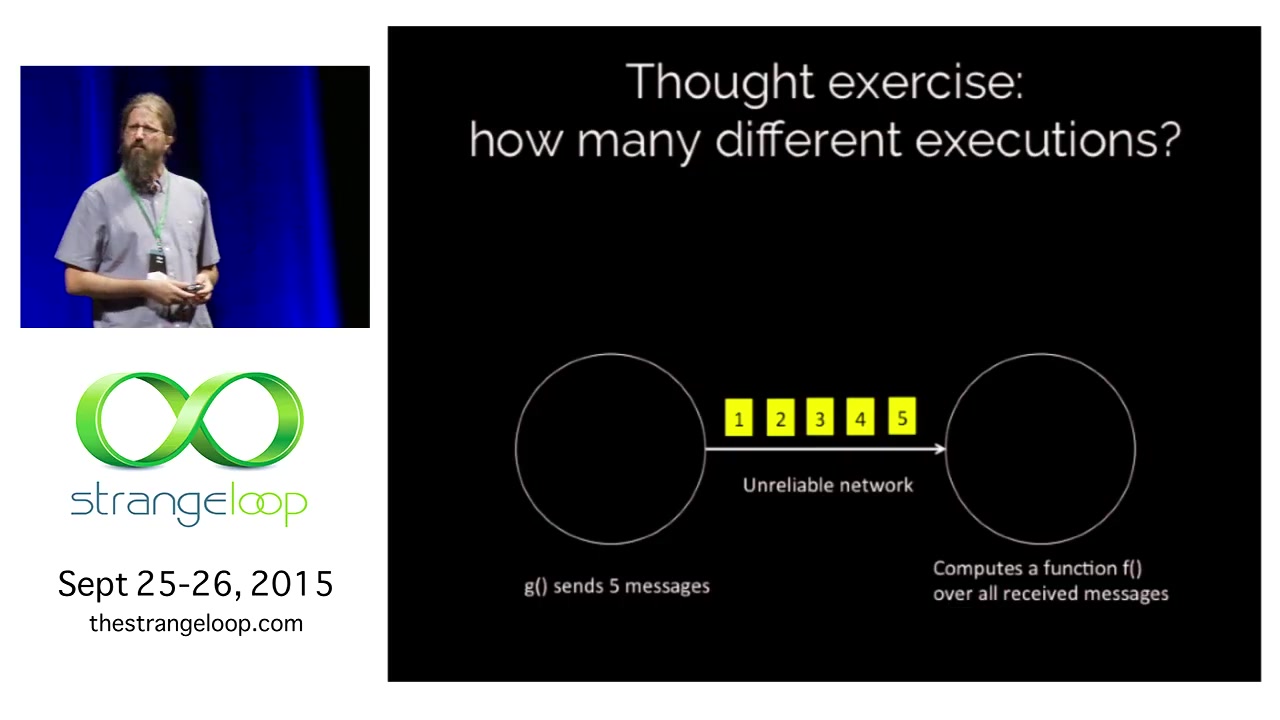
Alvaro’s reframe: don’t reason about behaviors, reason about outcomes. Two executions are equivalent if they produce the same observable end-state, regardless of what happened in the middle. A program is correct if every behavior in its enormous space of possible behaviors lands in the same outcome equivalence class.
This is the move that makes the rest of the talk possible. Once you give yourself permission to collapse behaviors into outcomes, you can ask sharper questions: which programs always produce one outcome? Which programs need coordination to produce one outcome?
Datalog as the substrate
Why a query language as the foundation for distributed-systems thinking? Because Datalog (and its relational ancestors) already separates what from how — execution order is irrelevant by construction.
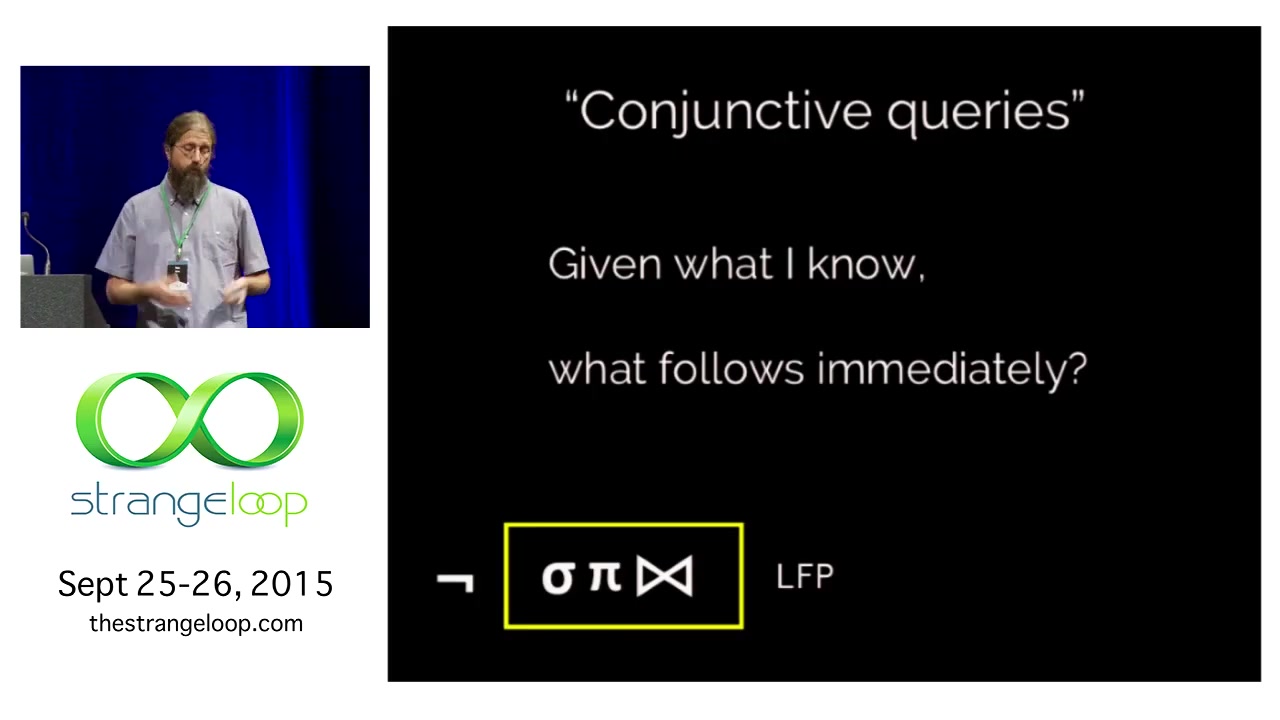
A Datalog rule fires whenever its premises become true. The order in which rules fire doesn’t matter. This is exactly the property you want when “order” is itself the source of uncertainty in your system. The classic transitive-closure example — path(X,Z) :- link(X,Y), path(Y,Z) — produces the same answer regardless of how the engine schedules the work.
The catch: pure Datalog has no notion of state changing over time, and no way to talk about asynchronous events. It’s too pure for distributed programming.
Disorder you can witness vs. disorder you can’t
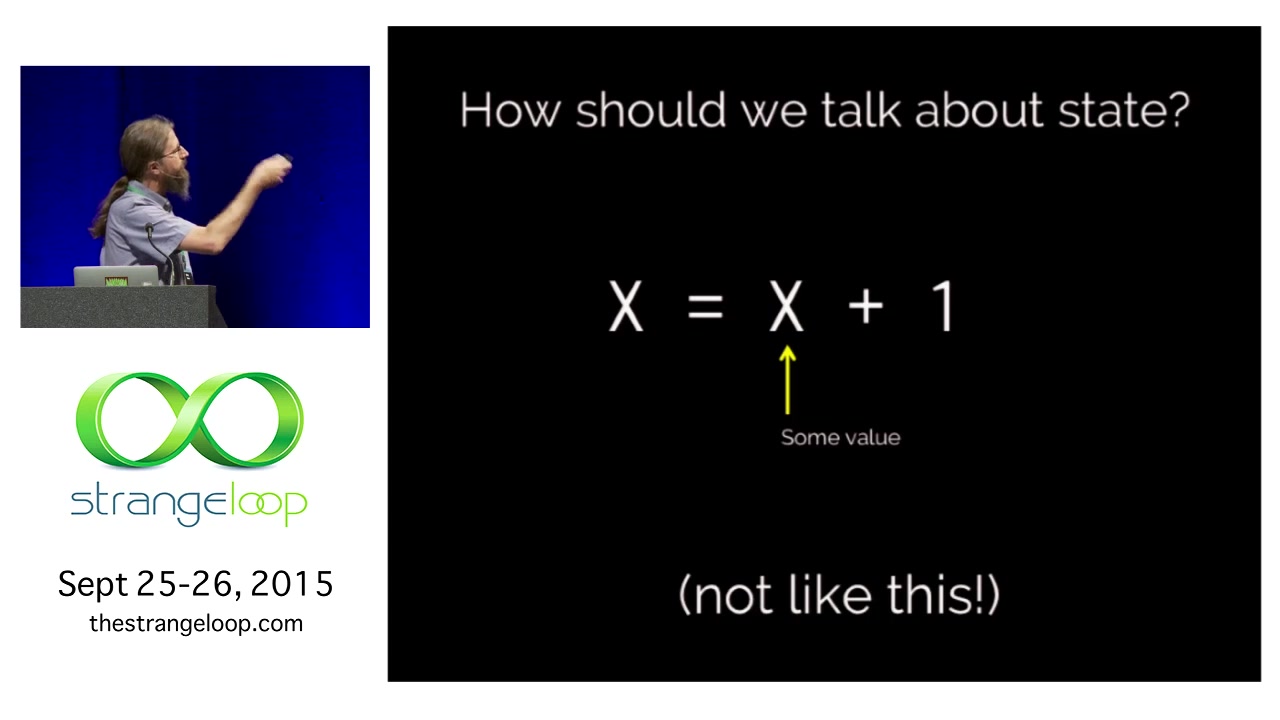
“Distributed systems are hard precisely because disorder happens, and then sometimes we witness the disorder, and it changes our behavior. Disorderly environments become disorderly behaviors.”
The killer combination is mutable state plus non-determinism in execution. Datalog gives you neither for free; you have to add them carefully and you have to add them honestly — admitting that your language can’t pretend to know about a global clock.
Models of time
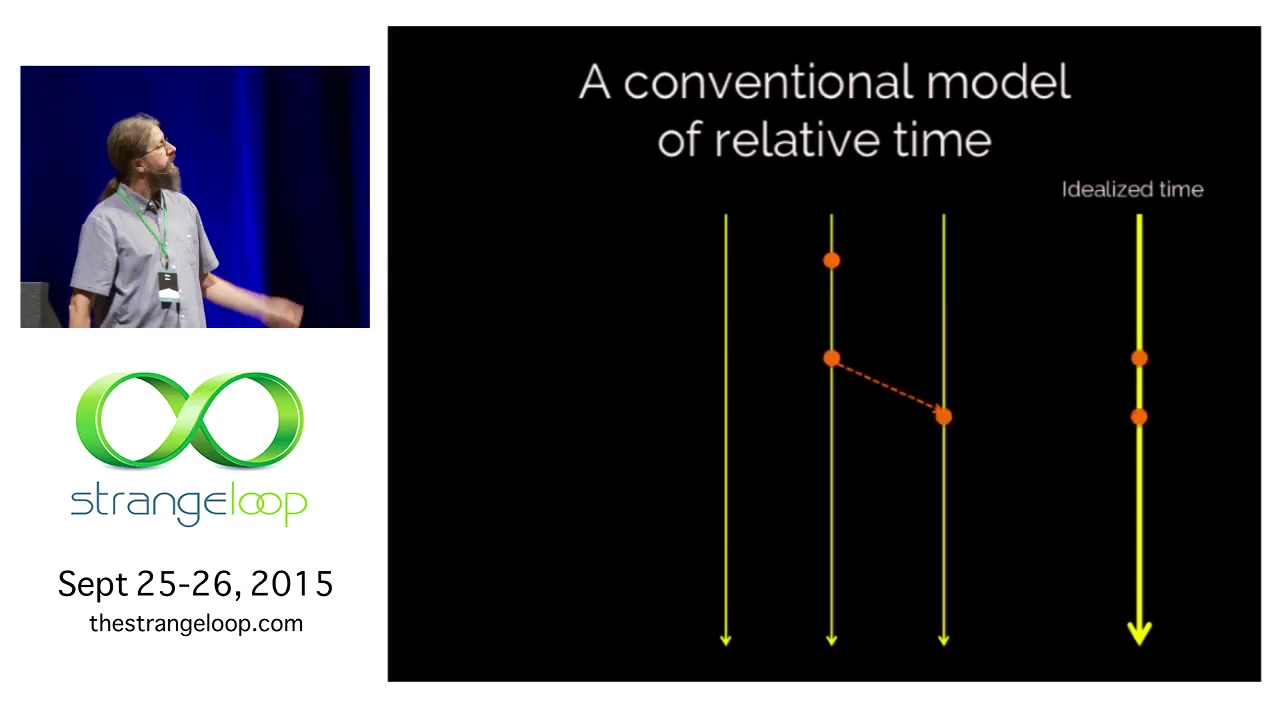
Three models of time on one slide:
- Conventional: a single timeline of discrete events. What humans assume.
- Database: concurrency exists but is linearized; query languages “query an eternal present.”
- Distributed (Lamport): each process has its own timeline; messages move forward through space and time relative to a god-line no process can observe.
A distributed-systems language must forget the god-line and reify per-process time as a first-class column. That move — adding a timestamp to every fact and a next operator that ticks state forward — is what turns Datalog into Dedalus.
“Eventually always true”
Dedalus programs have infinitely many models (one per dice-roll of message orderings), each infinitely large (programs run forever, every fact ticks). That’s not useful for reasoning.
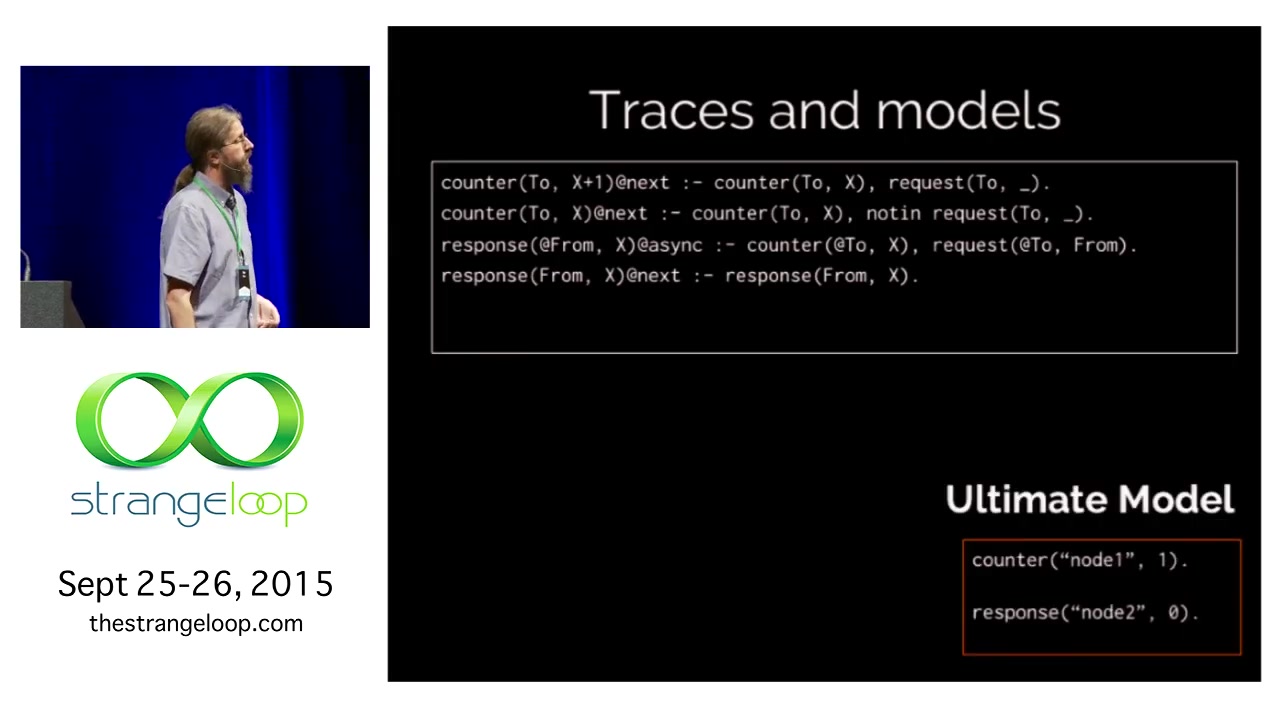
The trick: take a magnet to that haystack. Extract only the facts that, after some quiescence time, are permanently true and only differ in timestamp. Drop the timestamps. What remains is the meaning of the program — and if every dice roll yields the same magnet output, the program is confluent. Replicate it, reorder its messages, drop them on the floor: same answer.
CALM: a syntactic answer to “do I need coordination?”
Confluence is undecidable in general. But Alvaro shows the Goldilocks fragment:
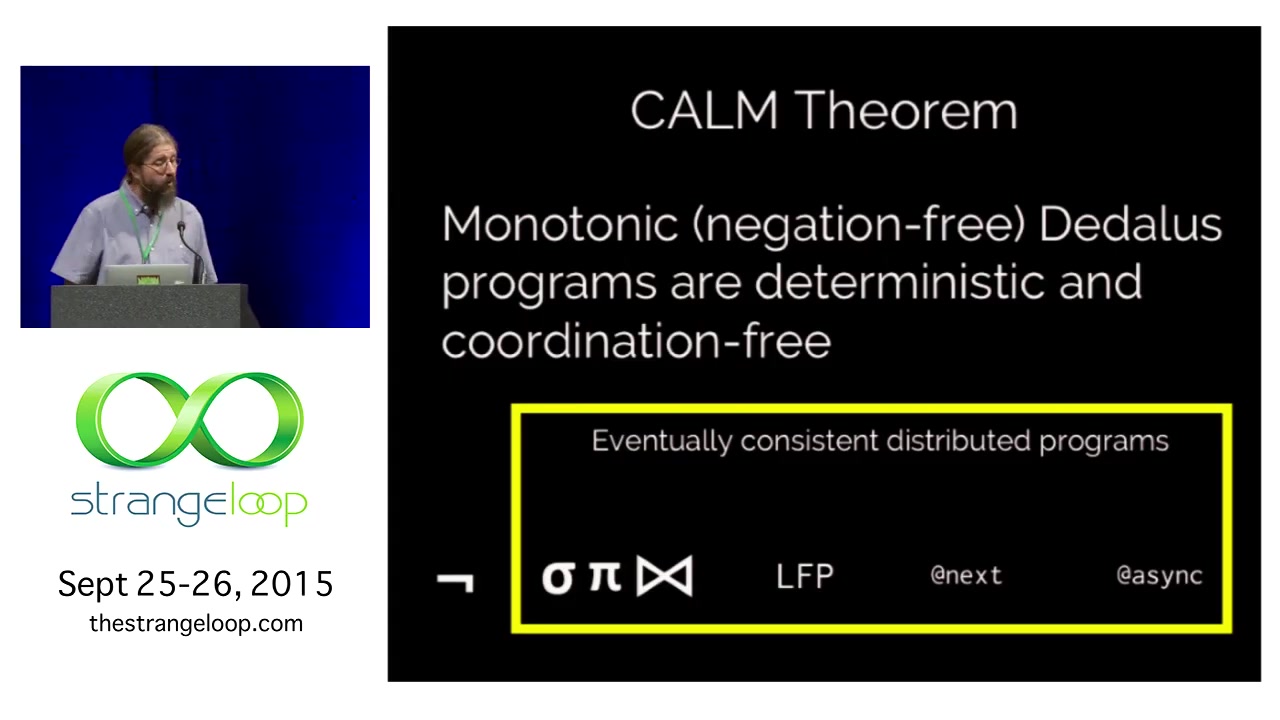
“Negation-free, or monotonic more broadly, Dedalus programs are confluent — they’re deterministic without coordination.”
This is CALM (Consistency As Logical Monotonicity), the theorem that gives the talk its punchline. Monotonic operations — set union, max, accumulating logs, append-only counters, transitive closure — can be replicated without coordination because adding more information can never invalidate a previous conclusion. The moment you reach for negation (“X is not in the set”) or non-monotonic aggregation, you’ve opened the door to coordination requirements.
CALM is also why CRDTs work and why event sourcing tends to compose: both are monotonic by design.
What grows on this: Bloom, Blazes, LDFI
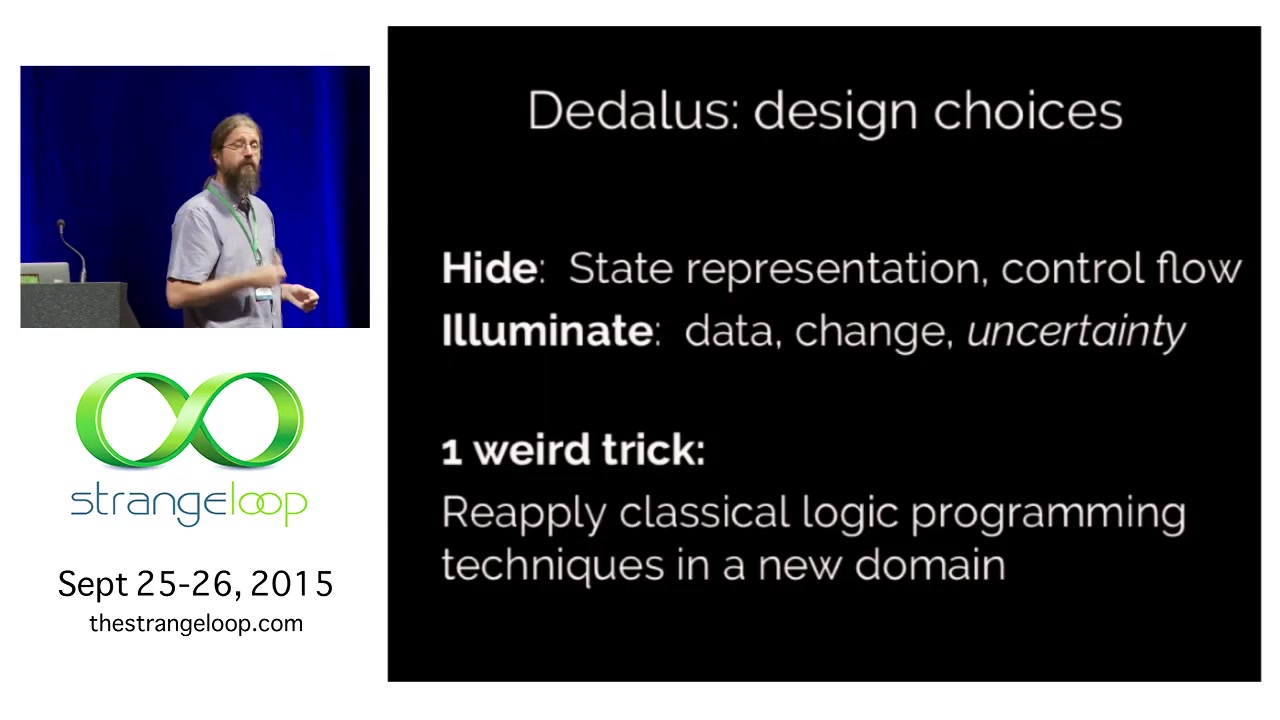
The research program built atop Dedalus:
- Bloom — a friendlier syntax over Dedalus semantics; statically tells you whether your program is deterministic and why it isn’t.
- Blazes — adds protocols automatically where ordering matters for the outcome (and nowhere else).
- Lineage-Driven Fault Injection (LDFI) — uses data lineage as a redundant-proof structure to find the minimal fault set that breaks an outcome. Now in production at Netflix as part of their chaos tooling.
Key takeaways
- Distinguish outcomes from behaviors. Most distributed-systems pain comes from reasoning at the wrong level.
- Disorderly environments produce disorderly behaviors only when you let state-changing decisions depend on observed order.
- Time is not a global resource. Languages that pretend it is lie to you about what’s implementable.
- CALM is the rule: monotonic ⇒ coordination-free. Non-monotonic ⇒ you owe the system a protocol.
- CRDTs and event-sourcing work because they are monotonic. Conflict resolution is what you do when you cheated on monotonicity.
- Lineage is structural redundancy — multiple independent proofs of an outcome let you reason about fault tolerance directly.
- Prefer nice semantics over nice syntax. Programs exist to mean something correctly; if forced to pick between the two, pick meaning.
Source
- Title: “I See What You Mean”
- Speaker: Peter Alvaro (UC Berkeley → UC Santa Cruz)
- Venue: Strange Loop 2015
- Duration: 52 minutes
- Link: https://www.youtube.com/watch?v=R2Aa4PivG0g