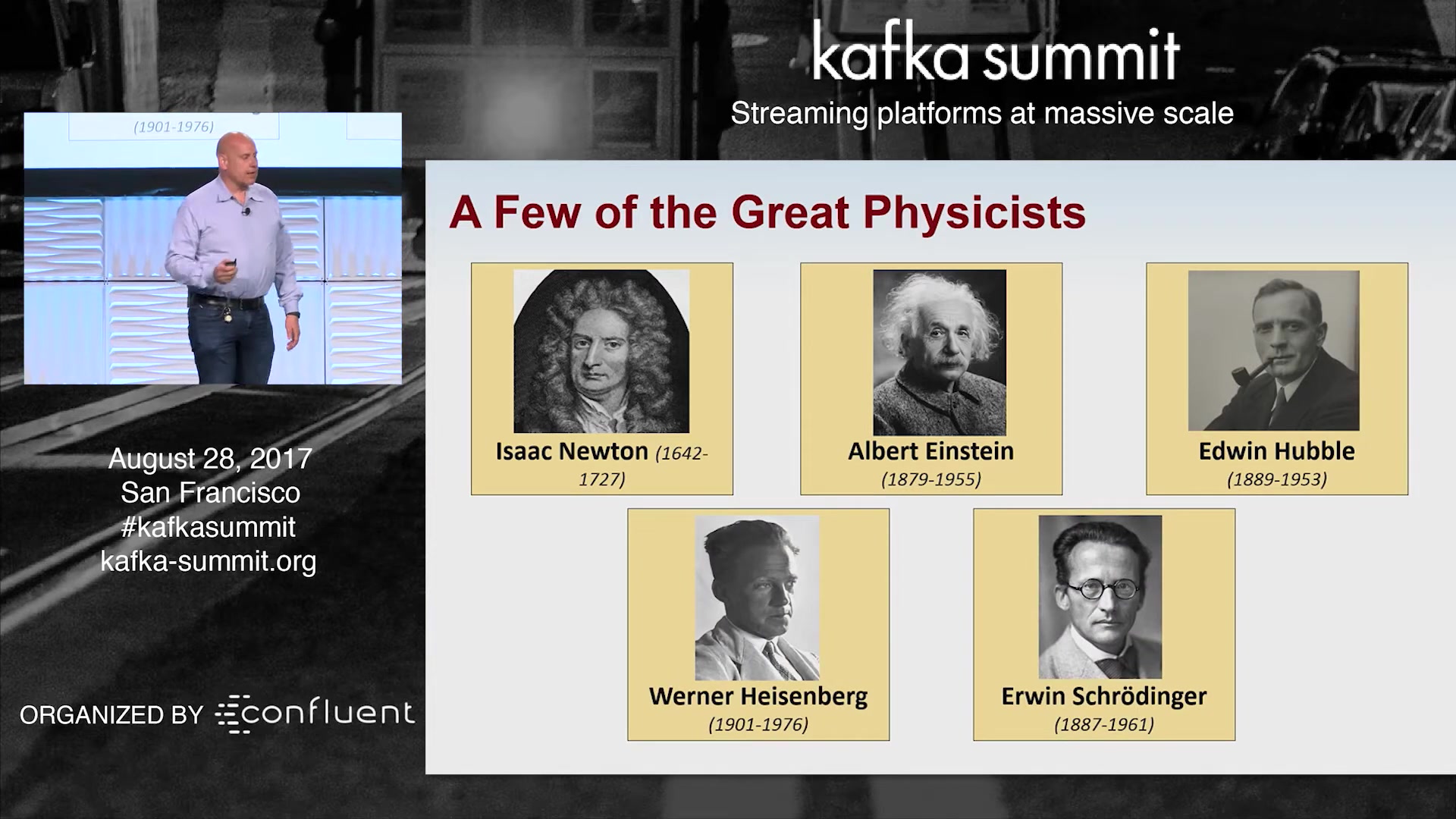
This week’s Classic of the Week is Pat Helland’s 2017 Kafka Summit keynote — a 20-minute tour that maps five great physicists onto the laws of distributed systems. It’s the rare classic talk that you can hand to a junior engineer to teach them what “eventual” really means, and to a senior engineer to remind them why their replication protocol keeps surprising them in production.
Helland has been building distributed systems since 1978 (Tandem, Microsoft, Amazon, Salesforce). The thesis: physicists in the 1700s–1900s already discovered the rules our systems have to obey — we just keep relearning them.
Newton: the single-computer universe
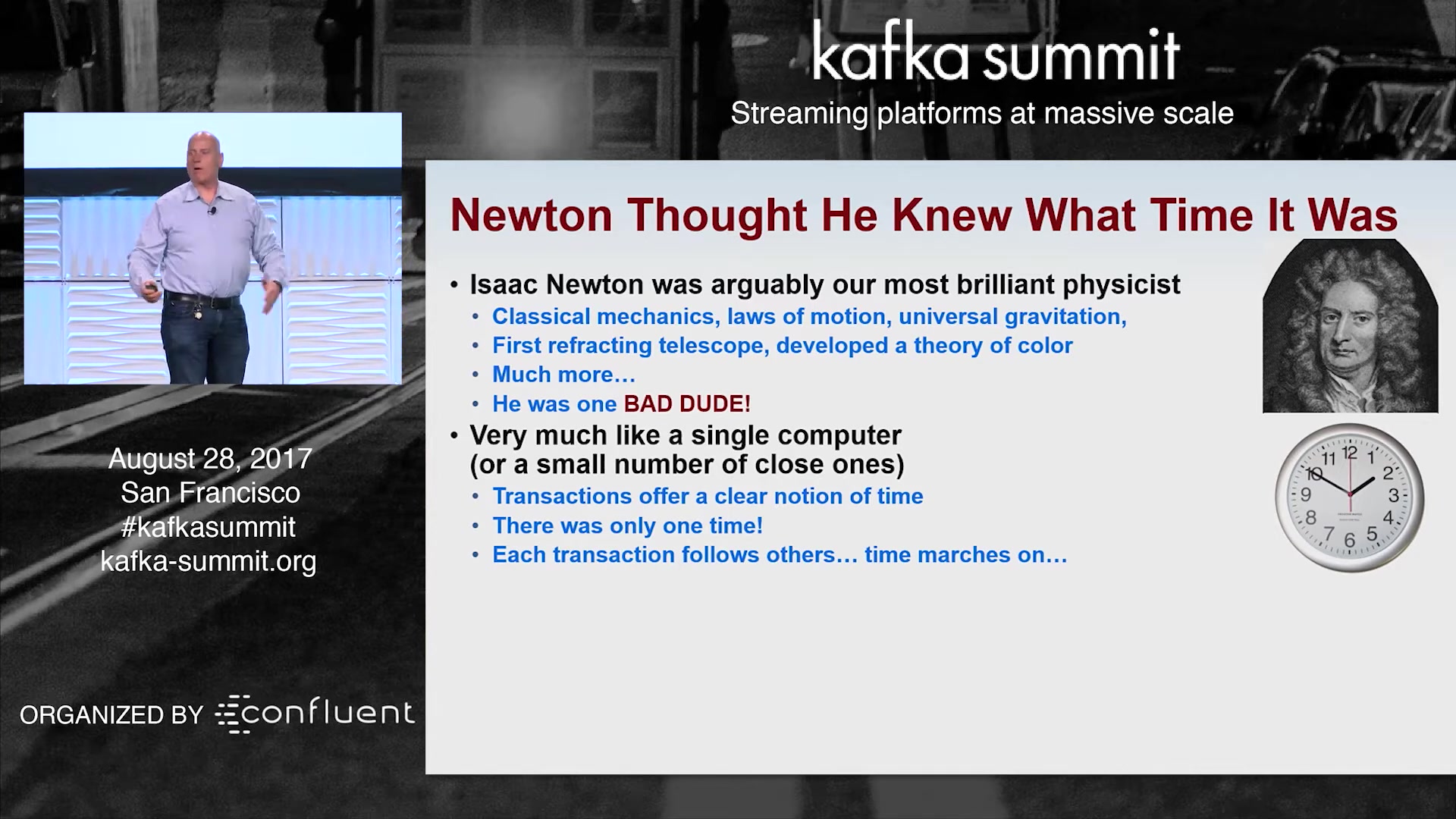
Newton assumed time marched forward universally — one clock, one truth, everywhere. That’s the single-computer model: classical mechanics, transactional databases with a global serial order, “the answer.” It worked for centuries because all the action happened in one place.
“Newton assumed time marched forward universally, everywhere, all the time — and that’s how it was.”
Einstein: the speed of light bounds your knowledge
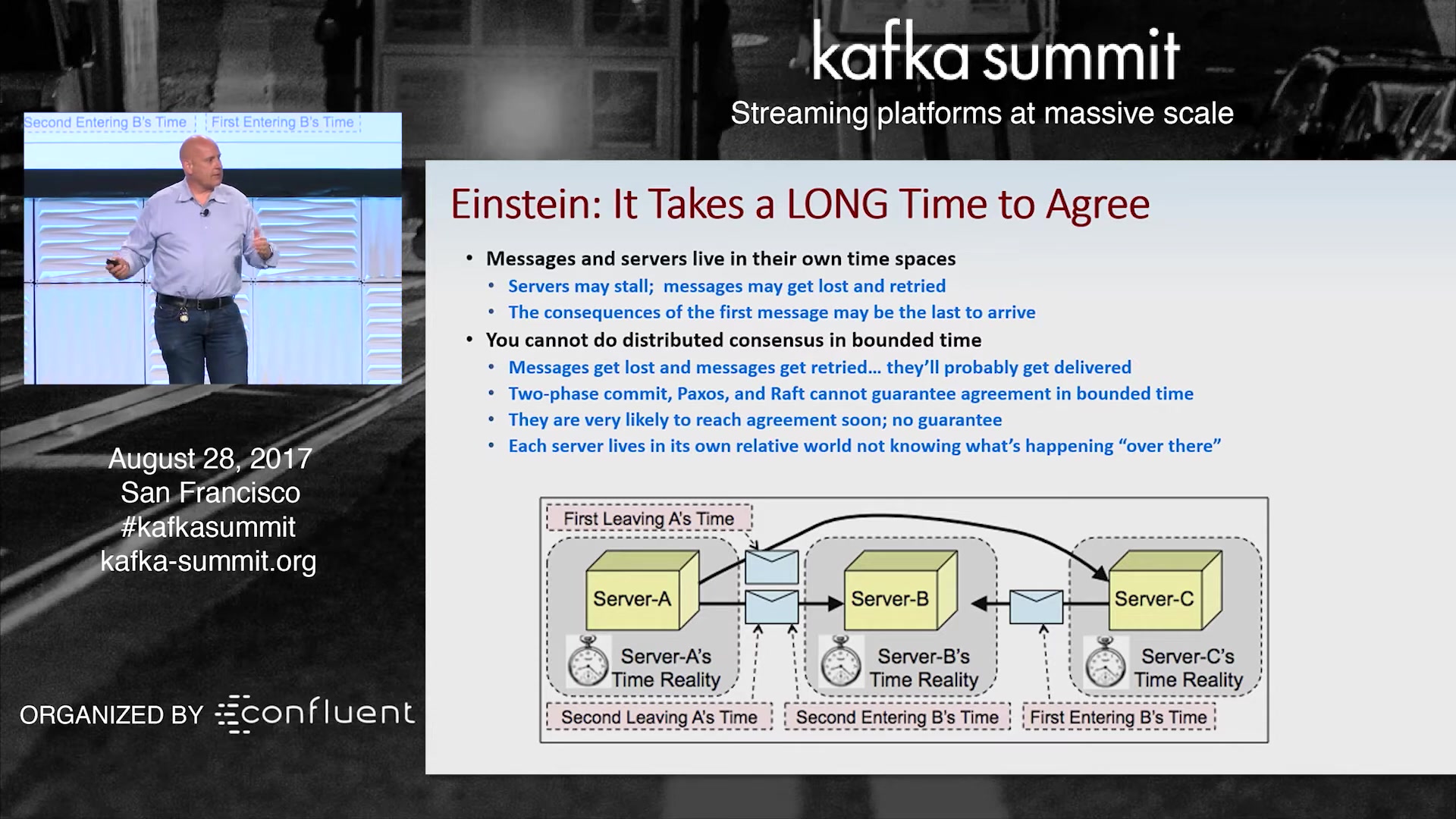
Einstein’s relativity ruined the universal-time party. Information cannot travel faster than light; the sender of the last message can never know it arrived. Helland’s distillation: you cannot know what you don’t know in a distributed system, in bounded time.
The corollary nobody likes: shared memory across multiple cores has the same physics. Cache coherence is just a tiny distributed system inside your CPU.
“Shared memory works great as long as you don’t share memory.”
Either bend the speed of light, or design around immutability, asynchrony, and concurrency. Helland’s pick is option two.
Hubble: the universe is expanding (and so is your fleet)
Hubble showed the universe is expanding — galaxies running away from each other. Same with our systems: the number of servers, datacenters, and edges keeps growing, and the latency between them keeps mattering. Architectures that assumed a fixed, dense topology don’t survive that expansion.
Heisenberg: you cannot observe everything at once
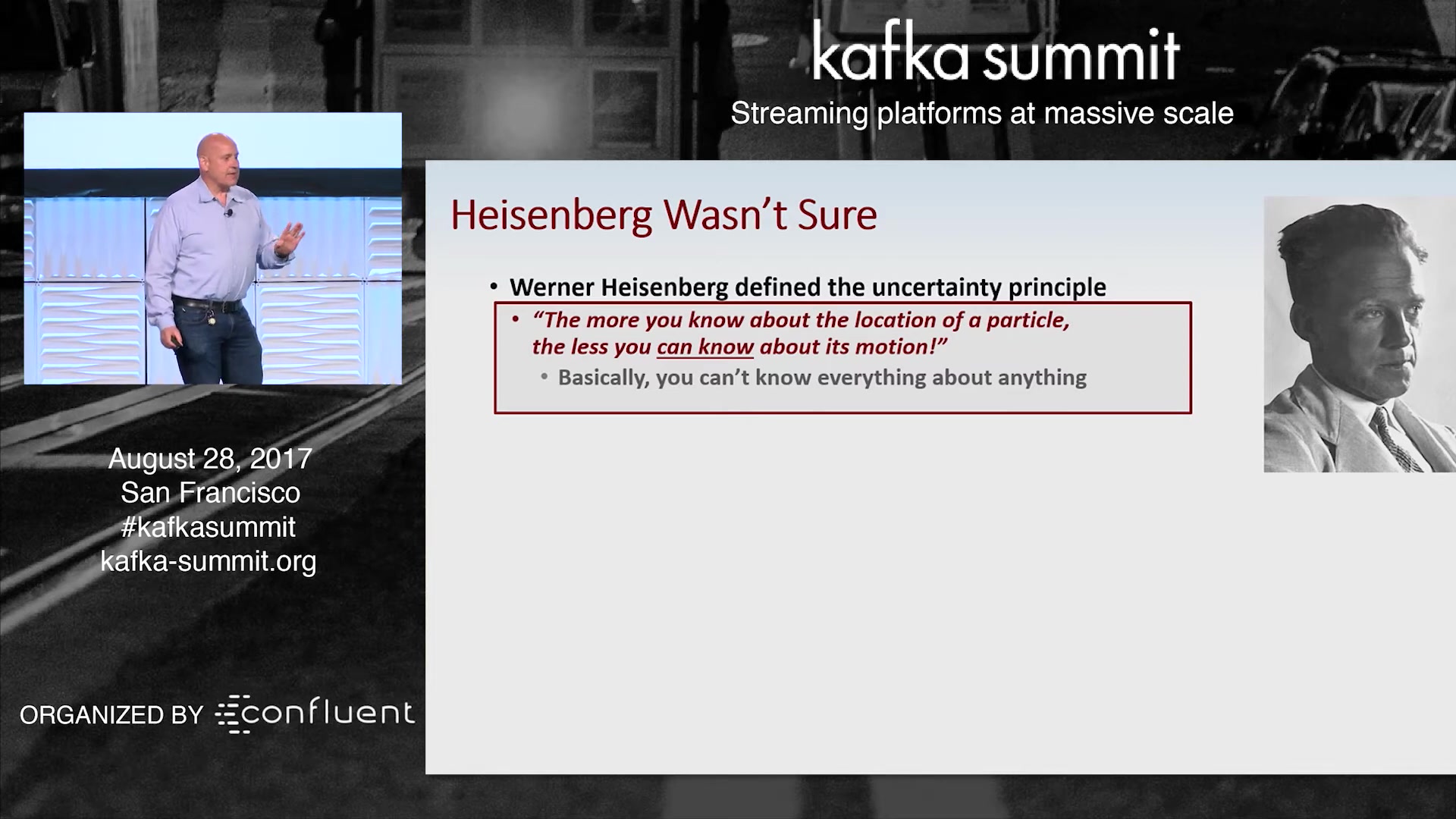
Heisenberg’s uncertainty principle: the more you know about a particle’s position, the less you can know about its motion. Helland’s mapping is exact: in a fleet of servers — “in various states of health, death, or garbage collection” — you can know where something was written, or when, but not both. Strongly consistent reads cost you availability and latency; available reads cost you certainty. CAP isn’t a configuration knob, it’s a physical law.
Schrödinger: state is a superposition until you look
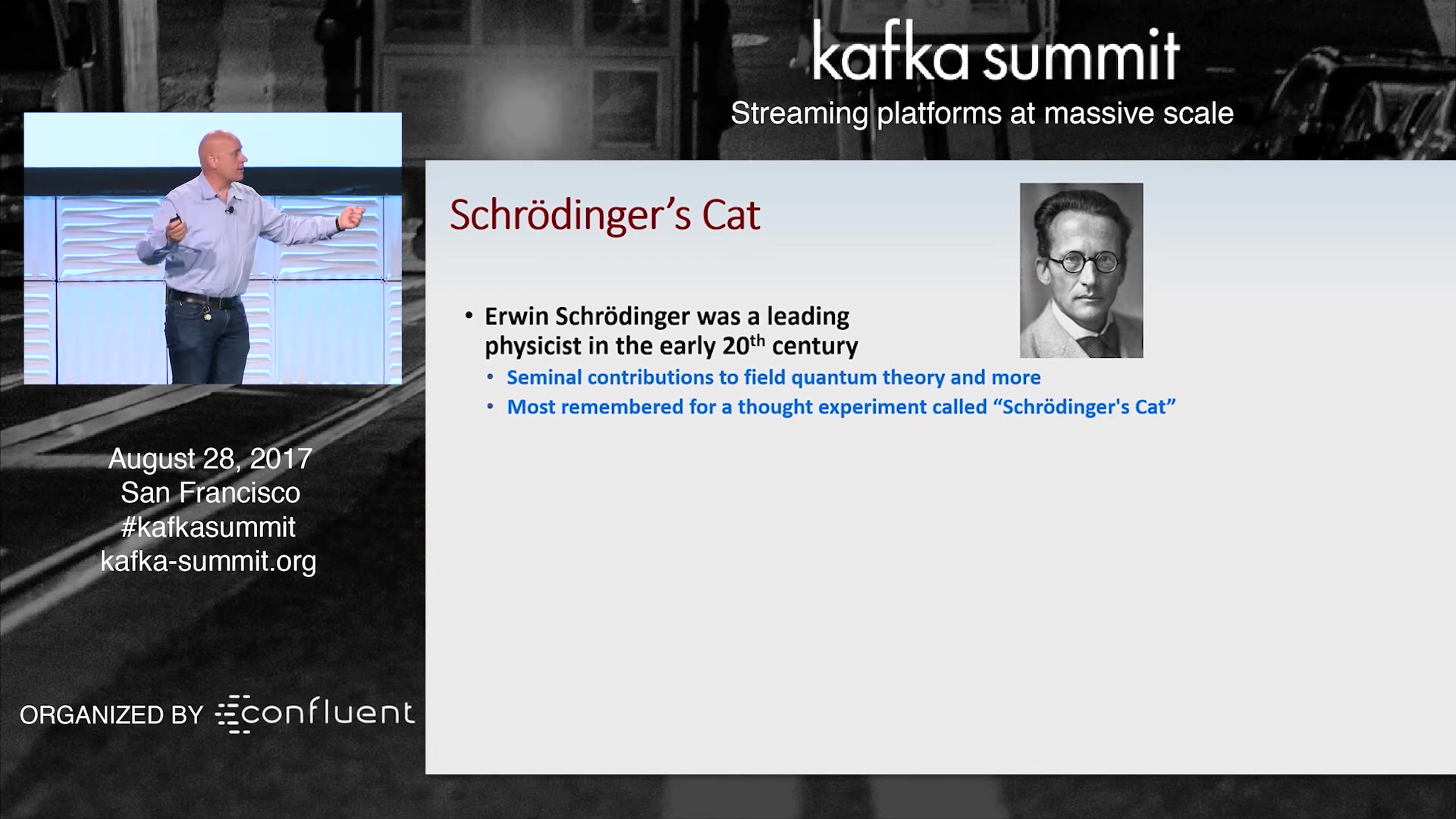
Schrödinger’s cat encoded the same idea for distributed state: a record may have been replicated, or not; a transaction may have committed, or not; until something observes it, your system is genuinely in superposition. This is the deep reason event sourcing, CRDTs, and idempotent retries work — they treat observation as the constructor of truth, not its discoverer.
Why this talk has aged extraordinarily well
Helland’s reframing was already foundational in 2017 — it predates the dominant streaming-as-database, log-as-source-of-truth, Kafka-style architectures by exactly the right amount of time to have shaped them. Eight years later, every modern distributed database (FoundationDB, Spanner, TigerBeetle, CockroachDB, the entire log-structured ecosystem) is downstream of these five physicists’ tradeoffs. And the talk lands in 20 minutes with no equations.
Key takeaways
- One time vs. many times. A single computer has Newton’s universal clock; a distributed system has Einstein’s relative one. Design accordingly.
- The last message problem. The sender cannot prove the final message arrived in bounded time. Build with idempotency and acknowledgement chains, not finality.
- Shared memory is a distributed system. Multi-core cache coherence is the same problem at smaller scale. Prefer immutability and message passing over locks.
- Pick: where or when. Strong consistency over a fleet costs you availability; eventual consistency costs you ordering. Heisenberg’s uncertainty in production form.
- State is constructed by observation. Treat reads as the moment truth collapses out of a superposition — and design protocols (logs, CRDTs, idempotent ops) that make that collapse safe.
- The classics are the mental models. Helland’s column in CACM and these talks have aged better than 90% of what was published about distributed systems in the last decade.
Source
- Talk: Standing on the Distributed Shoulders of Giants
- Speaker: Pat Helland (Salesforce; previously Tandem, Microsoft, Amazon)
- Venue: Kafka Summit 2017 Keynote (Confluent)
- Duration: ~20 minutes
- Source: Confluent / Kafka Summit (rotation key: Confluent / Kafka Summit)
- URL: https://www.youtube.com/watch?v=p9LBi11KR2c
- Companion paper: Standing on the Distributed Shoulders of Giants, Communications of the ACM, 2016