Weekly Paper Notes — 🔁 Seminal Paper of the Week for the 2026-07-25 CS paper digest. Area: Distributed Computing.
Authors: Leslie Lamport, Robert Shostak, Marshall Pease (SRI International) Venue: ACM Transactions on Programming Languages and Systems, Vol. 4, No. 3, July 1982, pp. 382–401. DOI: 10.1145/357172.357176 · PDF (SRI copy)
Why the paper still matters
Almost every distributed system in production today — Spanner, etcd, ZooKeeper, Kafka, every blockchain, every consensus protocol with a Greek letter in its name — is a descendant of the impossibility and possibility results in this 20-page paper. Before 1982 the community had informally understood that “some nodes can lie,” but there was no crisp model, no crisp bound, and no proof that the bound was tight. Lamport, Shostak, and Pease supplied all three. Forty-four years later, the paper is still what you cite when you want to justify a 3f + 1 replica count.
It is also the paper that named the problem. The “Byzantine” framing — a set of divisions of the Byzantine army camped around an enemy city, whose generals communicate by messenger and some of whom may be traitors — was Lamport’s, chosen (as he later explained) because he wanted a name that would not offend any then-living nation and because he liked the imagery. The name stuck to the fault model itself. “Byzantine failure” now denotes any arbitrary, adversarial, possibly-lying behavior of a node, as opposed to a mere crash or omission fault.
The setup
A commanding general must send an order (attack or retreat) to $n - 1$ lieutenant generals. Up to $f$ of the $n$ generals — including possibly the commander — may be traitors who send arbitrary, possibly-contradictory messages. Communication is by point-to-point channels that never lose messages and never forge sender identity. The goal is Interactive Consistency:
- IC1 — All loyal lieutenants obey the same order.
- IC2 — If the commander is loyal, every loyal lieutenant obeys the order he sent.
Note that IC1 does not require the agreed-upon order to be the commander’s if the commander is a traitor — the loyal lieutenants only have to agree on something.
The N invariants (or: why 3 is not enough)
The paper’s most celebrated result is a negative one: with only oral (unsigned) messages, no algorithm can solve the problem when $n \leq 3f$. In particular, three generals cannot tolerate one traitor.

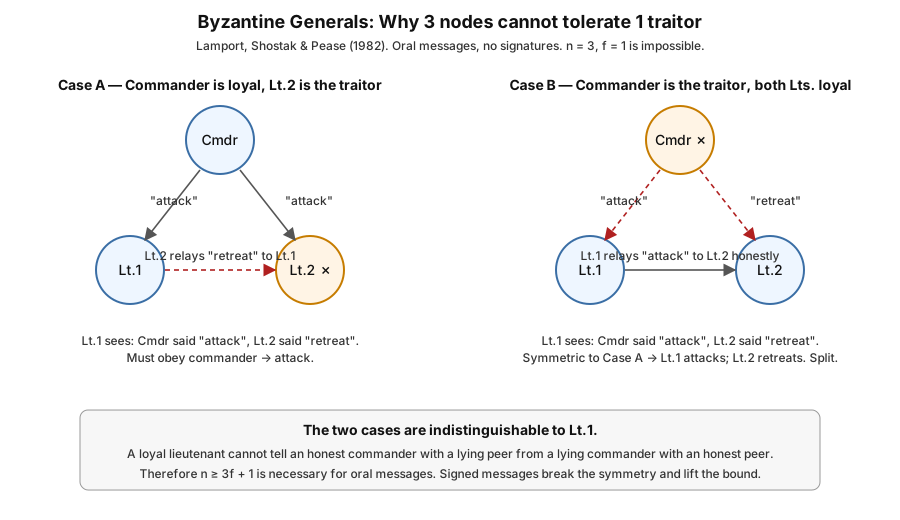
The proof is beautifully small. Consider $n = 3$, $f = 1$. In Case A the commander is loyal and sends “attack” to both lieutenants; the traitor lieutenant then tells the loyal lieutenant that the commander said “retreat.” In Case B the commander is a traitor: he sends “attack” to one lieutenant and “retreat” to the other; both lieutenants relay honestly. The loyal lieutenant in question sees the exact same pair of messages in both cases — an “attack” from the commander and a “retreat” from the peer — and yet in Case A he must obey and attack, while in Case B any agreement is acceptable but must match the other loyal lieutenant. No deterministic rule can produce the correct action in both cases simultaneously, because the two cases are informationally indistinguishable. Extend the argument by a reduction and you get the general bound: $n \geq 3f + 1$ is necessary.
The algorithm walk-through
The matching positive result is the recursive algorithm OM(f) — “Oral Messages” — which solves the problem whenever $n \geq 3f + 1$:
- OM(0): The commander sends his value to every lieutenant; each lieutenant uses whatever he receives (or a default if nothing arrives).
- OM(m), m > 0: The commander sends his value. Each lieutenant $i$, upon receiving value $v_i$, then acts as the commander in a new instance of OM(m − 1) with the other $n − 2$ lieutenants, sending them $v_i$. Every lieutenant collects the $n − 1$ values he obtains (one direct from the original commander, $n − 2$ via recursion) and takes the majority.
The recursion has depth $f + 1$ and message complexity exponential in $f$ — a real cost, but the paper’s point is that a solution exists at all when $n \geq 3f + 1$. The algorithm’s correctness proof is a careful induction that keeps track of which sub-instances have a loyal commander and shows that loyal lieutenants always outnumber traitors inside the majority vote at every level.
The paper’s second algorithm, SM(m) — “Signed Messages” — lifts the $3f + 1$ bound entirely by adding unforgeable digital signatures. With signatures, a traitor cannot lie about what the commander said without leaving cryptographic evidence, and the impossibility of Case B above evaporates. SM(m) tolerates any number of traitors as long as the commander plus at least one lieutenant are loyal — a dramatically weaker requirement. This is the theoretical origin of every signature-based consensus protocol that followed, from PBFT to Tendermint to HotStuff.
Why this design has outlasted everything around it
Three reasons.
First, the model is minimal. The paper assumes only reliable message delivery and unforgeable sender identity — no timing assumptions, no crypto beyond signatures, no shared clock. That minimality means the bounds transfer intact to almost any real system. Every time somebody proves a new consensus lower bound, they cite this paper because their model reduces to this one.
Second, the $3f + 1$ bound is a genuine architectural constraint, not a proof artifact. If you want to survive $f$ Byzantine failures, you must pay for at least $3f + 1$ replicas — and that pricing shows up in the operational cost of every BFT system in production. It is why PBFT clusters are typically sized at 4, 7, or 10 replicas; why Tendermint validator sets round to multiples of 3; why Solana’s stake-weighted quorum thresholds live at 2/3. You cannot argue with $3f + 1$; you can only decide whether to pay it or drop back to a crash-fault model like Raft that only needs $2f + 1$.
Third, the signature trick generalizes. The realization that cryptography can substitute for replication — that adding an unforgeable signature layer can move you from an impossible regime to a solvable one — is the intellectual root of the entire Byzantine-fault-tolerant blockchain field. Nakamoto consensus, HotStuff, Casper FFG, Narwhal & Bullshark: all of them, in the end, are elaborations of the observation that signed messages break the symmetry the 1982 paper identified.
What has been added since
- FLP (1985) — Fischer, Lynch, Paterson showed that even crash-fault consensus is impossible in a fully asynchronous system with one faulty process. Byzantine Generals assumed synchrony; FLP tightened the screws on asynchrony.
- PBFT (Castro & Liskov, 1999) — the first practical BFT protocol, three-phase commit over $3f + 1$ nodes, direct descendant of SM(m).
- HotStuff (2019), Tendermint, Casper, Narwhal/Bullshark — modern BFT variants optimizing for latency, throughput, or DAG structure, all still living inside the $3f + 1$ envelope for their unsigned components.
- Nakamoto consensus (2008) — a probabilistic escape from the deterministic $3f + 1$ bound via proof-of-work and eventual finality; it doesn’t violate the impossibility, it just relaxes the safety property.
Read alongside
- Lamport, “The Weak Byzantine Generals Problem” (1983) — the immediate follow-up, weakens IC1.
- Fischer, Lynch, Paterson, “Impossibility of Distributed Consensus with One Faulty Process” (1985) — the sister impossibility for asynchrony.
- Castro & Liskov, “Practical Byzantine Fault Tolerance” (1999) — the paper that made BFT deployable.
- Bracha & Toueg, “Asynchronous Consensus and Broadcast Protocols” (1985) — the $n \geq 3f + 1$ result generalized to reliable broadcast.
- Yin et al., “HotStuff” (2019) — the modern reference for linear-view-change BFT.
Links
📄 Lamport’s mirror of the paper (PDF) · 📄 ACM DL entry · 📝 Lamport’s own retrospective on the naming
Part of the Weekly CS Paper Digest series. Diagram authored inline as SVG; no figures reproduced from the original ACM paper.