Fourteen years on, this is still the talk that most reliably rewires how an engineer thinks about their own work. It is remembered for the live-coding demos — and those demos did seed a decade of tooling, from hot reload to Swift Playgrounds to every notebook environment you use. But the demos are the setup. The talk’s actual argument arrives in the last fifteen minutes, and it is not about programming at all.
The principle
Victor opens by declining the usual career advice. Not “follow your passion” — follow a principle: something you believe is important and necessary and right, used to guide what you do.

His own, arrived at over roughly a decade of building and using creative tools:
“Creators need an immediate connection to what they create.”
Which he defines operationally: when you make a change or a decision, you must see its effect immediately. No delay. Nothing hidden. That specificity is deliberate, and he returns to why at the end.
The body of the talk is then simply: here are places I noticed that principle being violated, and here is what I did about it.
Violation one: you write code blindly
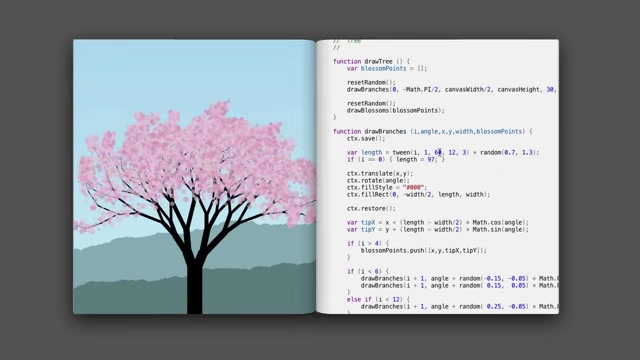
Normal coding: type into a text editor while imagining what each line does, compile, run, look, go back. “Most of my time is spent working in the code, working in a text editor, blindly.”
His alternative puts the picture beside the code with no compile step. Change a number, the scene changes. Then, since the connection exists, he can attack the input method itself — point at a numeric literal, hold a key, and scrub the value, watching the tree’s branch length converge on what feels artistically right. Changing the sky color to white produces something he didn’t intend and immediately recognizes: it’s now a moon, at night. “Having this immediate connection allows ideas to surface and develop in ways that would be impossible before.”
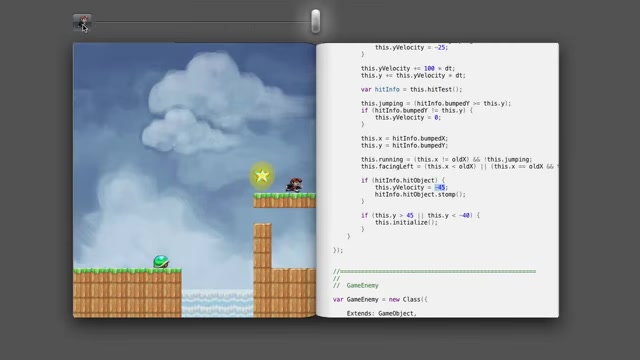
The game demo extends this to state and time. He pauses a jumping character and displays its trail — where it has been and, ahead of it, where it is going to be. Editing the code edits the character’s future. He tunes a jump until the sprite slips exactly into the gap, then discovers a new game mechanic mid-demo simply because trying ideas was cheap enough to be exploratory.
Violation two: you have to play computer in your head
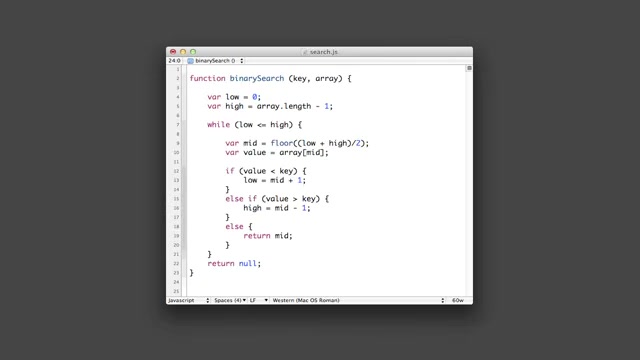
The strongest technical segment. Binary search, written normally: “I see the word array, but I don’t actually see an array.”
“To write code like this you have to imagine an array in your head and essentially play computer. And to a large extent, the people we consider to be skilled software engineers are just those people who are really good at playing computer. But if we’re writing our code on a computer, why are we simulating what a computer would do in our head? Why isn’t the computer just doing it and showing us?”
So he writes binary search with the array, the key, and the low/high bounds displayed live at every iteration. The off-by-one falls out visually — the range collapses, he sees the condition is wrong, changes < to <=, and watches the loop terminate correctly. “That’s what it might be like to write an algorithm without a blindfold on.”
The principle isn’t about programming
Victor is explicit that he only did coding demos “because this is a software engineering conference.”
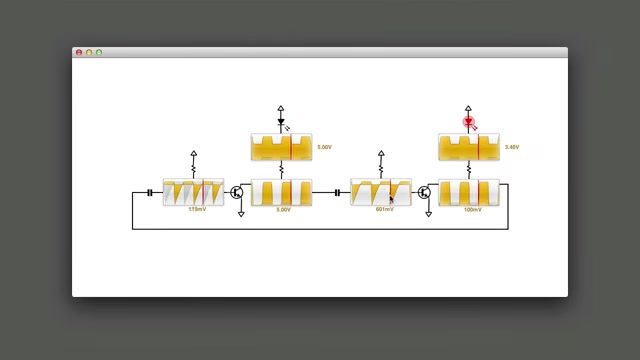
The circuit demo draws a schematic that simulates as you draw it. Drag a resistor value and the waveforms move — leaving behind a ghost of the previous waveform so you can compare. “Two golden rules of information design: show the data, show comparisons.”
He then asks a question worth sitting with: why do circuit diagrams use squiggly symbols at all? Because they were easy to draw with a pencil on paper. “This is not paper. When you have a new medium you have to rethink these things.” He turns the same blade on programming — a program as a list of textual definitions handed to a compiler is a direct inheritance from punch cards, and the REPL is what you could do on a teletype.
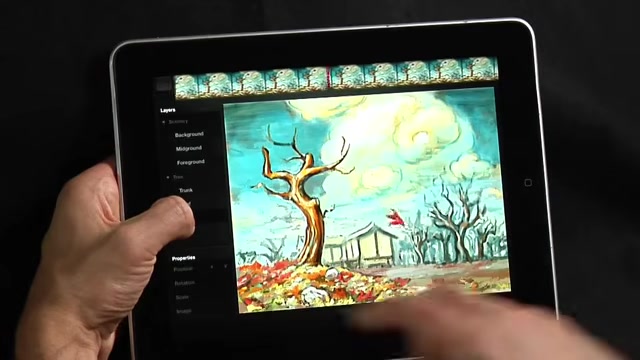
The animation demo abandons keyframes entirely: he performs the leaf’s drift with his hands, like an instrument, and composes a finished piece in two minutes. The story attached is the emotional core — years earlier he spent an entire day in Flash trying to keyframe that same leaf, failed, and abandoned the project. He still has the storyboards. He still plays the music he wrote for it. “The piece itself is locked in my head.”
“I always think about the millions of pieces that are locked in millions of heads — and not just animation, not just art, but all kinds of ideas. World-changing inventions. Life-saving scientific discoveries. Ideas that must be grown, and without an environment in which they can grow, many will not emerge — or will emerge stunted.”
The turn: technical work as activism
Here the talk becomes something else. When Victor sees his principle violated, he says, he does not think opportunity. Not an opportunity to make a product, start a business, do research, or contribute to a field.
“Ideas are very precious to me, and when I see ideas dying, it hurts. I see a tragedy. To me it feels like a moral wrong. It feels like an injustice. And if I think there’s anything I can do about it, I feel it’s my responsibility.”
Injustice. Responsibility. Moral wrong. These are words we reserve for social causes — censorship, discrimination, environmental destruction — and we recognize the activist lifestyle as legitimate there. Victor’s thesis is that it transfers:
“As a technologist you can recognize the wrong in the world, you can have a vision for what a better world could be, and you can dedicate yourself to fighting for a principle. Social activists typically fight by organizing. But you can fight by inventing.”
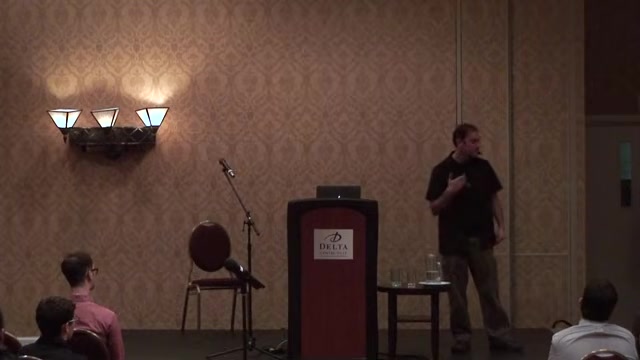
The exemplar is Larry Tesler. In the mid-70s at Xerox PARC, software was modal — in a text editor you pressed i to enter insert mode, escape to command mode, m to move. Tesler (who also pioneered software user studies) watched people fail to become comfortable with computers even after weeks, concluded modes were the barrier, and adopted a principle: no person should be trapped in a mode. Slogan: “Don’t mode me in.” He had it on a T-shirt. He has had it on his license plate for thirty years.
That principle produced Gypsy, and with it modeless text editing: an insertion point, click-and-drag selection, drag-to-move, and the commands he named cut/copy/paste. People who had never seen a computer were productive in half an hour.
Victor then makes the sharpest point in the talk — that the standard biography (“Larry Tesler invented cut/copy/paste”) is misleading in two ways. Unlike Edison stumbling onto audio recording and then listing applications, Tesler’s invention was entirely a reaction to a cultural context. And “he solved the problem of modeless text manipulation” is wrong too, because the problem existed only in his own head. To everyone else, modes were simply how computers worked — no more wrong than having two arms.
“The first thing Larry did was recognize a wrong that had been unacknowledged in the culture. And that’s how many great social changes began as well.”
The comparison he draws is to Elizabeth Cady Stanton, who in 1848 had to stand up and say women should vote while everyone else considered it absurd. Both recognized an invisible cultural wrong, envisioned a world without it, and dedicated themselves to a principle. “She fought by organizing. He fought by inventing.” Doug Engelbart and Richard Stallman get the same reading — Engelbart’s whole body of work following from a vision of interactive computing, Stallman from software must be free as in freedom.
What makes a principle usable
The closing is practical, and it is the part most often skipped in summary.
Finding a principle takes time — it is a form of self-discovery. It took Victor about a decade, through his twenties, of making many things of many types while getting only glimmers, and he describes the period as genuinely distressing.
And a principle cannot be any old thing you believe in. “I want to make software easier to use,” “I want to delight users,” “I want to make things simple” — nice thoughts, too vague to be actionable. Compare:
- Tesler liked simplicity, but his principle was the specific nugget: no person should be trapped in a mode. He could watch someone select text and ask: is this person in a mode? Yes or no. If yes, do something about it.
- Victor believes creators need powerful tools, but his principle is: creators need an immediate connection. He can watch you change a line of code and ask: did you immediately see the effect? Yes or no. If no, do something about it.
A usable principle embodies a specific insight, and therefore divides the world into right and wrong fairly objectively. That is what makes it a compass rather than a slogan. Every demo in the talk, he says, came from nothing more than applying that test and following where it pointed.
“There are many ways to live your life. Maybe the most important thing you can realize is that every aspect of your life is a choice. There are default choices. You can choose to sleepwalk through your life and accept the path that’s been laid out for you. You can choose to accept the world as it is. But you don’t have to.”
Key takeaways
- A principle is a compass, not a slogan. It must be specific enough to yield a yes/no verdict on any concrete situation you observe.
- “Creators need an immediate connection to what they create.” Any delay or hidden state between a decision and its visible effect is a defect in the medium.
- Skilled engineering should not require playing computer in your head. If you are running the code on a computer, the computer should show you the state.
- Live feedback changes what ideas are thinkable, not just how fast you work — Victor discovers a game mechanic and an unintended night scene mid-demo, purely because trying things was cheap.
- Notation is inherited from dead media. Circuit squiggles come from pencil and paper; textual source files come from punch cards; the REPL comes from teletypes. New media deserve rethought representations.
- Tools that lose ideas are the real cost. The animation he could not keyframe in Flash is still locked in his head — multiply by millions of people.
- You can fight for a cause by inventing rather than organizing. Tesler, Engelbart, and Stallman are read here as activists whose medium happened to be software.
- The hardest step is recognizing an unacknowledged wrong. Tesler’s problem existed only in his own head until he made everyone else see it.
Source
- Talk: Inventing on Principle
- Speaker: Bret Victor
- Event: CUSEC 2012 (Canadian University Software Engineering Conference)
- Duration: 54:20
- URL: https://www.youtube.com/watch?v=PUv66718DII
Note: only 360p sources exist for this 2012 archival upload, so the screenshots in this article are lower resolution than the series standard.