Weekly Paper Notes — the Seminal Paper of the Week for the 2026-08-29 digest. Area: Operating Systems.
Authors: Dennis M. Ritchie and Ken Thompson (Bell Laboratories) Published: Communications of the ACM, Vol. 17, No. 7, July 1974, pp. 365–375. DOI: 10.1145/361011.361061
Why the paper still matters
Most influential systems papers describe something large. This one describes something conspicuously small, and the smallness is the argument. The system it presents ran on a PDP-11/45 with 144K bytes of core, of which the resident kernel occupied roughly 42K — about 16K words of code and data. It supported multiple simultaneous users, a hierarchical file system, removable volumes, device independence, and asynchronous processes. The authors say plainly that the constraint was not incidental: the hardware was small, so the software had to be, and that pressure produced abstractions general enough to be reused rather than features specific enough to be enumerated.
The paper is worth rereading now because almost every interface it introduced is still the interface. When a container runtime bind-mounts a path, when a Kubernetes pod writes logs to stdout for a sidecar to collect, when a CI job pipes one tool’s output into another’s input, when a Go program calls os/exec — all of that is running on decisions made in this paper. And the reasoning behind those decisions is stated more explicitly here than in most of what came after, because Ritchie and Thompson were arguing against alternatives that were mainstream in 1974 and are invisible now precisely because they lost.
The setup
The system as described is the fifth edition, running on a PDP-11/45 with 144K bytes of core memory, split between user and system. Disk storage was a pair of RP03 drives with 40M bytes total and RK05 packs of 2.5M bytes each. Around 100 installations existed at the time of writing, doing document preparation, real-time signal processing, patient monitoring, and general research computing.
The authors are careful to say what they did not have and did not want. The system provides no facilities for real-time scheduling guarantees, no support for a database model, no record-oriented I/O, and — a point they return to — no attempt at guaranteed reliability or fault tolerance. Their framing is that they were building for a research environment where users are cooperative and the cost of a wrong choice is a reboot, not a lawsuit. It is an unusually clear statement of scope, and it explains why so many of the abstractions are permissive rather than defensive.
Almost everything about the system is written in C. That was still a novel enough decision in 1974 that the paper makes an argument for it: the kernel is comprehensible, portable in principle, and modifiable by people other than its authors. The historical consequence is larger than the paper’s own claim — a portable kernel is what let UNIX outlive the PDP-11 — but the immediate consequence they cared about was that the system could be maintained by a small group.
The invariants
Four commitments carry most of the design, and they are all reductive: each one collapses a category distinction that other systems of the era maintained.
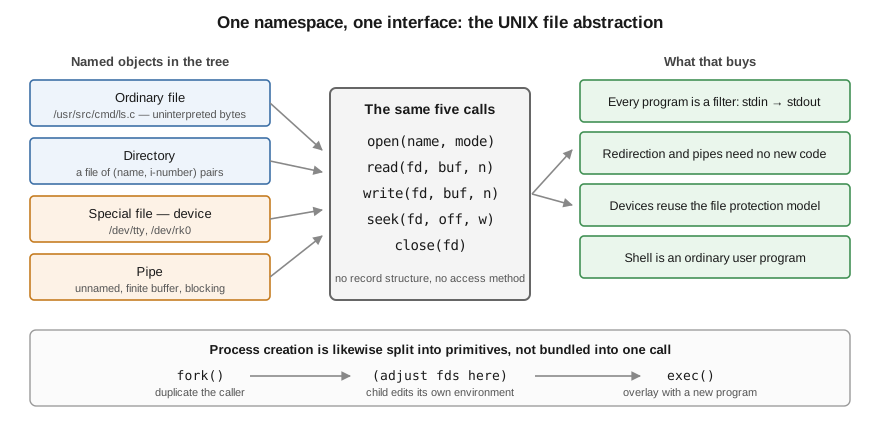
A file is an uninterpreted sequence of bytes. No records, no blocks, no access methods, no file types known to the system. This was the contentious one. Contemporary operating systems — OS/360 most prominently — offered a catalog of dataset organizations and access methods, and choosing among them was part of writing a program. UNIX offers nothing, and pushes all structure into user code. The payoff is that a program written to consume bytes consumes bytes from anywhere, forever, which is the precondition for everything in the third invariant.
Directories are files. A directory is an ordinary file whose contents happen to be pairs of a name and an i-number. The system enforces that only the kernel writes them, but their storage, protection, and traversal are the same machinery as any other file. The naming graph that results is a tree with the qualification that links let the same file appear under multiple names — a file is not owned by a directory entry; it is referenced by one, and the reference count in the i-node decides when it dies. Path resolution has no special case for the root: / is simply a directory the kernel knows the i-number of, and a path is a walk. Removable volumes are grafted in with mount, which replaces one directory’s identity with a device’s root, so a mounted volume is not a separate namespace with its own drive letter but an indistinguishable subtree.
Devices are files. Special files in /dev are opened, read, written, and closed like anything else, and they inherit the same owner/group/other permission bits. A program that writes to a terminal and a program that writes to a disk file are the same program. This one decision eliminates an entire class of API — the parallel device-control interface that other systems required — and makes protection uniform, since restricting access to a disk is the same operation as restricting access to a file.
Pipes complete the composition story. A pipe is a file with no name, a finite buffer, and blocking semantics at both ends: a writer that fills the buffer waits, a reader that empties it waits, a reader whose writers have all closed sees end-of-file. Because a pipe presents the file interface, every program that reads standard input and writes standard output composes with every other one, with no cooperation between their authors and no code in either to support it. This is where the byte-stream decision pays off in full, and it is the reason the shell’s | needed no new kernel concept.
Process creation is factored, not bundled. fork duplicates the calling process; exec overlays a process with a new program. Other systems offered a single “run this program with these parameters” call, which meant every property a child might inherit differently — open files, working directory, environment — had to become a parameter of that call. UNIX instead gives the child a window between fork and exec during which it is an ordinary process that can rearrange its own environment using ordinary system calls. Redirection is implemented in this window: the shell forks, the child closes descriptor 1 and opens the target file (which lands in descriptor 1 because the system always assigns the lowest free one), and then execs. No kernel support for redirection exists, because none is needed.
The consequence Ritchie and Thompson emphasize is that the shell is an ordinary user program. It has no privileges, uses no interfaces unavailable to anything else, and can be replaced by any user. In 1974, when the command interpreter was typically part of the operating system, this was a real claim about system structure and not a throwaway.
The algorithm walk-through: what a path lookup actually does
The paper’s implementation section is worth following once concretely, because it shows how few mechanisms are doing the work.
Each file is represented by an i-node — a fixed-size record in a known area of the volume holding the owner, protection bits, size, timestamps, a link count, and the addresses of the data blocks. Small files list their blocks directly; larger files use indirect blocks, then double-indirect. The i-node contains no name. Names live only in directories, which is what makes multiple links to one file natural rather than exceptional.
Resolving /usr/src/cmd/ls.c starts at the root i-node, reads its data blocks as a sequence of (name, i-number) entries, finds usr, fetches that i-node, repeats for src, then cmd, then ls.c. If a directory along the way is a mount point, the kernel substitutes the mounted volume’s root i-node and continues — the walk does not know or care that it crossed a device boundary. Each step checks execute permission on the directory, so protection is enforced incrementally along the path rather than by a separate access-control subsystem.
open returns a small integer, the file descriptor, indexing a per-process table. Because descriptors are just indices into a table the process can manipulate, and because the kernel always allocates the lowest available one, the whole redirection idiom emerges from two properties that were not designed for it.
Removing a file is unlink, which deletes a directory entry and decrements the i-node’s link count. The file’s storage is reclaimed when the count reaches zero and no process holds it open. This gives you the idiom, still used constantly, of creating a temp file and immediately unlinking it — the data survives as long as the descriptor does and vanishes on exit without cleanup code.
Why this design has outlasted everything around it
The uncharitable reading is that UNIX won for non-technical reasons: it was cheap, it came with source, it spread through universities, and it happened to be portable when the PDP-11 died. All true. But the design has a property that explains why it survived contact with problems its authors never imagined.
Each of the four invariants removes a distinction rather than adding a capability. Files have no types, so the type system cannot fail to cover a case. Directories are files, so there is no second storage mechanism to keep consistent. Devices are files, so there is no second protection model to audit. fork and exec are separate, so there is no parameter list to extend when a new inheritable property appears. Systems built by adding features accumulate special cases at the intersections; this one accumulates almost none, because the intersections were designed away at the start.
That said, the compromises are visible from here. fork is expensive on machines with virtual memory and large address spaces — copy-on-write is a mitigation for a primitive whose semantics assume copying is cheap, and posix_spawn and vfork exist because the elegant factoring became a performance problem. The permissive protection model, adequate for a cooperative research lab, has needed decades of retrofits: ACLs, capabilities, namespaces, seccomp, mandatory access control. “Everything is a file” was never quite true and got less true as the interface strained — ioctl is the escape hatch where all the device semantics the file abstraction could not express went to live, and it is a well-known mess. Plan 9 was Bell Labs’ own attempt to take the idea further and to fix what UNIX had left half-done, and its influence today runs mostly through Linux namespaces and the /proc filesystem rather than through adoption.
None of that undermines the paper. What is striking on a reread is how much of it is an argument about what to leave out, made by people whose hardware left them no choice, and how well that argument aged relative to the systems that had room to say yes. The lesson transfers cleanly to anyone designing an interface today: the file abstraction survived fifty years of unanticipated use because it committed to almost nothing about what a file contains.
Read alongside
- Ritchie and Thompson, “The UNIX Time-Sharing System”, Bell System Technical Journal 57(6), 1978 — the expanded revision, with more implementation detail than the CACM version.
- Corbató and Vyssotsky, “Introduction and Overview of the Multics System” (FJCC 1965) — the system UNIX was a deliberate reaction against; reading them together makes the reductive choices legible.
- Ritchie, “The Evolution of the Unix Time-sharing System” (1984) — a retrospective on what was actually invented when, and what was borrowed.
- Pike et al., “Plan 9 from Bell Labs” (1990) — the same authors’ attempt to carry “everything is a file” all the way, including the network.
- Rosenblum and Ousterhout, “The Design and Implementation of a Log-Structured File System” (1991) — covered as an earlier seminal pick; a direct engagement with the on-disk layout UNIX established.
- Pike and Kernighan, “Program Design in the UNIX Environment” (1984) — the composition philosophy stated as an explicit design discipline rather than a side effect.
Links
📄 ACM Digital Library (CACM 17:7, 1974) · 📄 Bell Labs BSTJ version (1978)
Part of the Weekly CS Paper Digest series. Seminal picks are written from background knowledge and a reread of the original; diagram is original work.