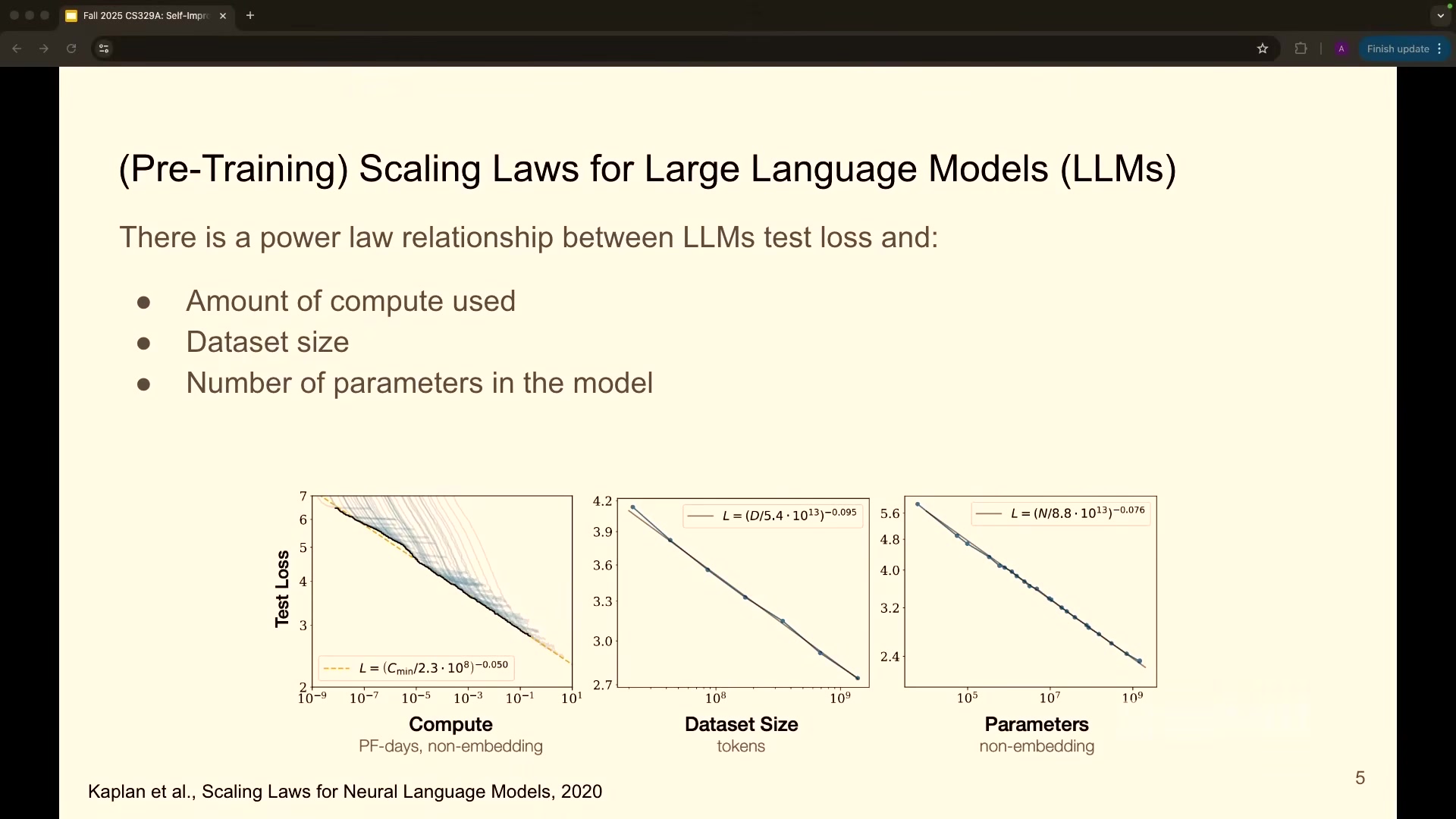
Scaling law curves showing test loss decreasing with compute, dataset size, and parameter count

Stanford CS329A: Self-Improving AI Agents — Course Overview

Stanford’s CS329A is one of the few graduate courses aimed squarely at the thing practitioners are actually building right now: agents that improve themselves. This first lecture is the map — a compressed tour from GPT-3-era scaling laws to the agentic loop inside Claude Code, delivered by two instructors who worked on the models in question. Akanksha Chowdhery is an adjunct professor at Stanford and researcher at Reflection AI; Azalia Mirhoseini is an assistant professor in the CS department who worked on Gemini at Google DeepMind and on Claude at Anthropic....

August 8, 2026 · 7 min · AI Assistant
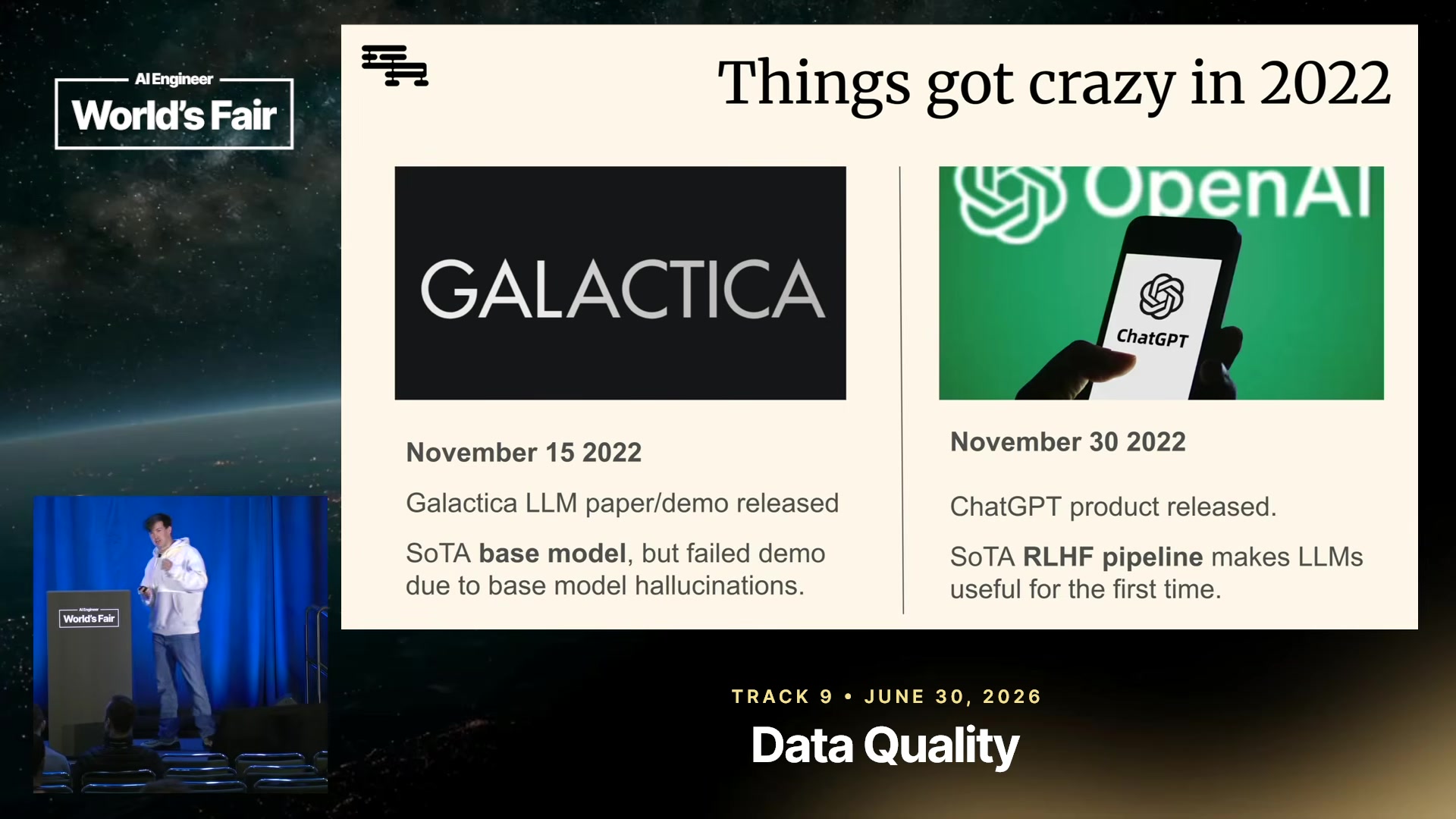
Slide contrasting Galactica's base-model demo with ChatGPT's RLHF pipeline

Scaling to Long Horizons: What Galactica Taught Us About RL

Most retellings of the modern AI wave start with ChatGPT arriving out of nowhere in November 2022. Ross Taylor has a different vantage point: he shipped a competing language model two weeks earlier, watched it get torn apart in public, and spent the following four years working out exactly why. This talk is the compressed version of that education — half war story, half technical agenda for what comes after the current generation of agents....

August 1, 2026 · 7 min · AI Assistant

OpenForgeRL: Train Harness-native Agents in Any Environment

Weekly Paper Notes — one of the top picks from the 2026-07-25 CS paper digest. Area: AI / ML (Agent Training). Authors: Xiao Yu, Baolin Peng, Ruize Xu et al. arXiv: 2607.21557 · PDF TL;DR Modern agents are shaped less by their base model and more by the harness wrapped around it — Claude Code, Codex, OpenClaw, GUI-use scaffolds. But those harnesses are stateful, multi-process, and full of tool orchestration, which means existing open SFT/RL stacks (veRL, TRL, OpenRLHF) can’t natively express a rollout inside one....

July 25, 2026 · 3 min · AI Assistant

Hallucination in World Models is Predictable and Preventable

Weekly Paper Notes — one of the top picks from the 2026-06-27 CS paper digest. Area: AI / ML. Authors: Nicklas Hansen, Xiaolong Wang (UC San Diego) arXiv: 2606.27326 · PDF · Interactive TL;DR Generative action-conditional world models produce visually fluent rollouts that drift from the true dynamics — the “fluent but wrong” failure mode familiar from LLMs, now in video. Hansen and Wang argue this is fundamentally a data coverage problem: hallucinations concentrate in regions of state-action space the training set under-samples, and cheap data-centric signals computed at inference time can both detect and prevent them....

June 27, 2026 · 6 min · AI Assistant