Weekly Video Notes — a short article distilling one talk from the weekly digest. Source video and key frames embedded throughout.
Sara Hooker has done the full tour — PhD, DeepMind, several frontier labs, a research career built on efficiency at scale. Which is what makes this talk land: it’s an insider arguing that the system that produced her is an unreasonably narrow filter, and that the economics of the current moment are finally prying it open. The vehicle is Adaption Labs’ Auto Scientist, but the argument underneath is about compute, and it’s the more interesting half.
The unreasonably narrow path
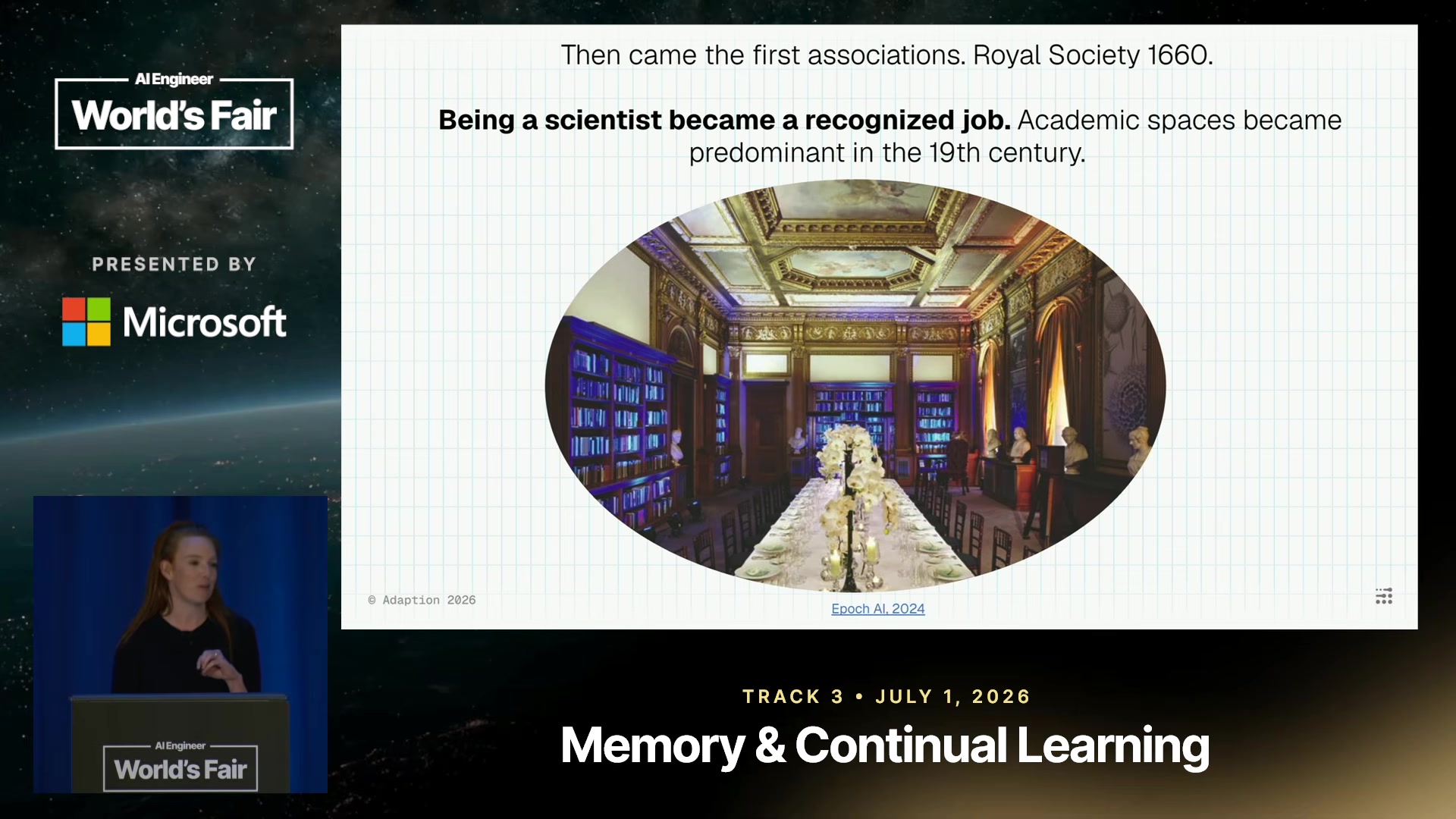
Modern computer science is 77 years old — roughly two generations of people working on these tools. Hooker opens by tracing how discovery itself has been organized across that span: the gentleman scientist of the pre-modern era, wealthy enough to dabble; then the Royal Society in the 1600s making “scientist” a full-time job; then the full professionalization of science.

That professionalization produced what her colleague Rosanne Liu calls the unreasonably narrow path. To contribute at the AI frontier you needed the right PhD program, then the right industry lab, then sufficiently interesting work — and only then did you get to touch the frontier. Famous advisor, one or two important internships, and an aggressively filtered pipeline at every stage. Miss a rung, or be curious about the wrong problem at the wrong time, and there was simply no place to play.
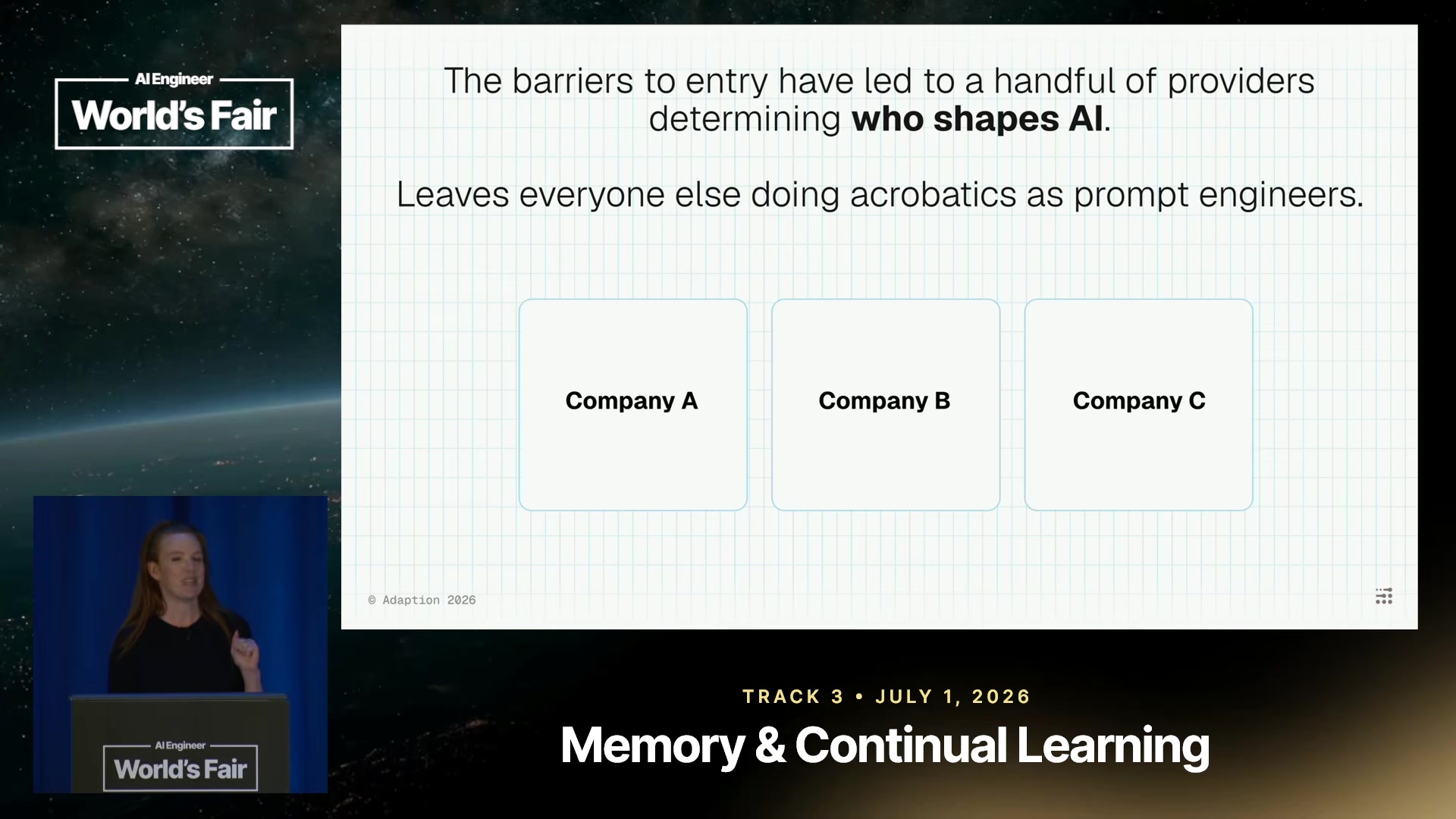
Her framing of the loss is sharp: most people got into computer science because of a question — how do you represent the world. The narrow path means years spent learning to build the tools before you’re allowed anywhere near the question.
Auto Scientist: automating the training of models
Adaption Labs’ answer, released weeks before this talk, is Auto Scientist — a system that automates the training of models themselves. Given a domain and a data type, it selects and self-evolves the recipe, searching across model architectures, model sizes, and dense vs. mixture-of-experts configurations.
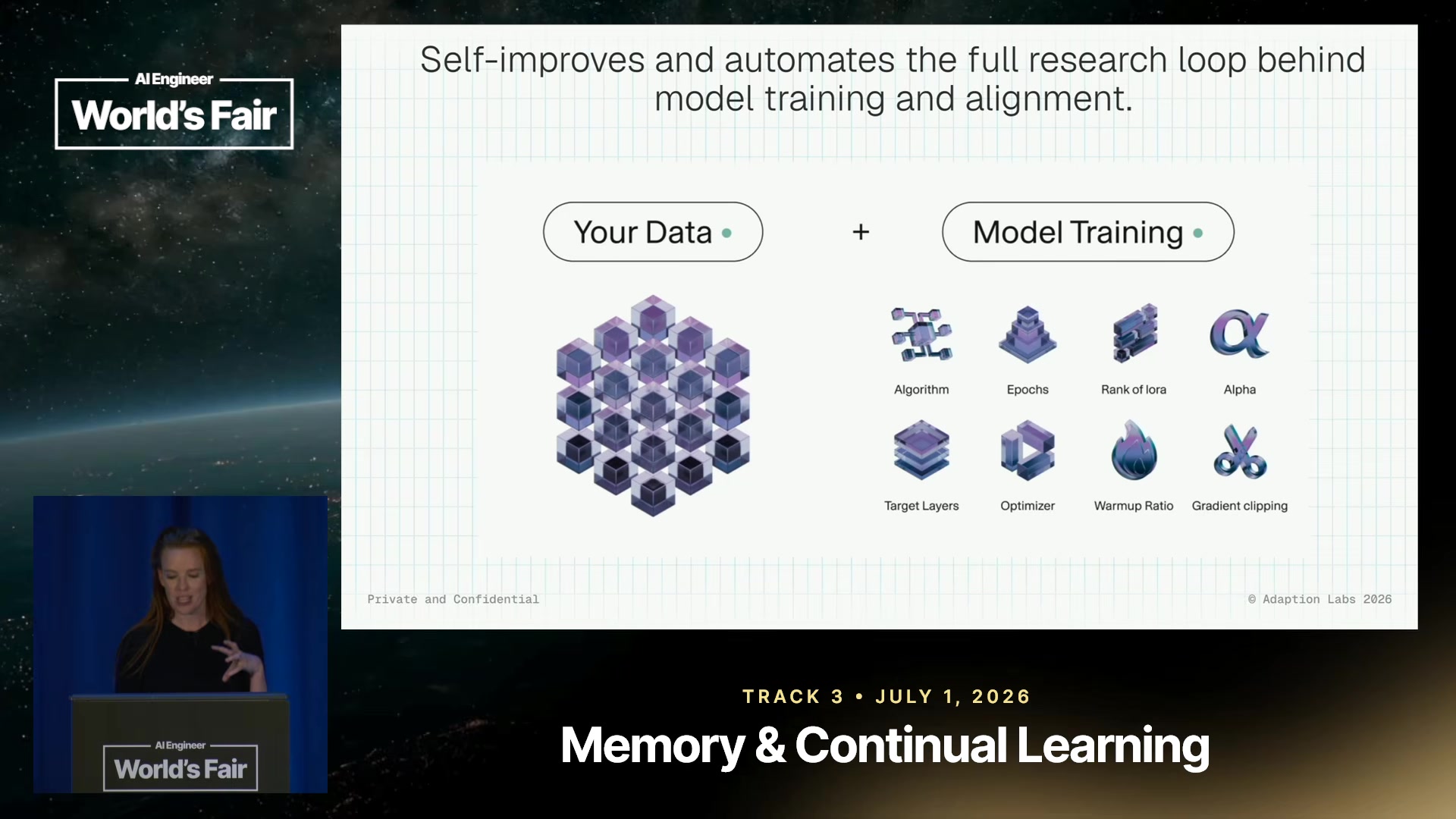
The finding Hooker flags as most interesting is a warning to everyone else building auto-research systems: it only worked when data was co-optimized with the model. A lot of current auto-research treats data as something the agent optionally decides to generate. Adaption didn’t get real returns on performance until they controlled for data quality and applied the same adaptive search to the data that they applied to the model.
“It speaks to the need to control the entire flow.”
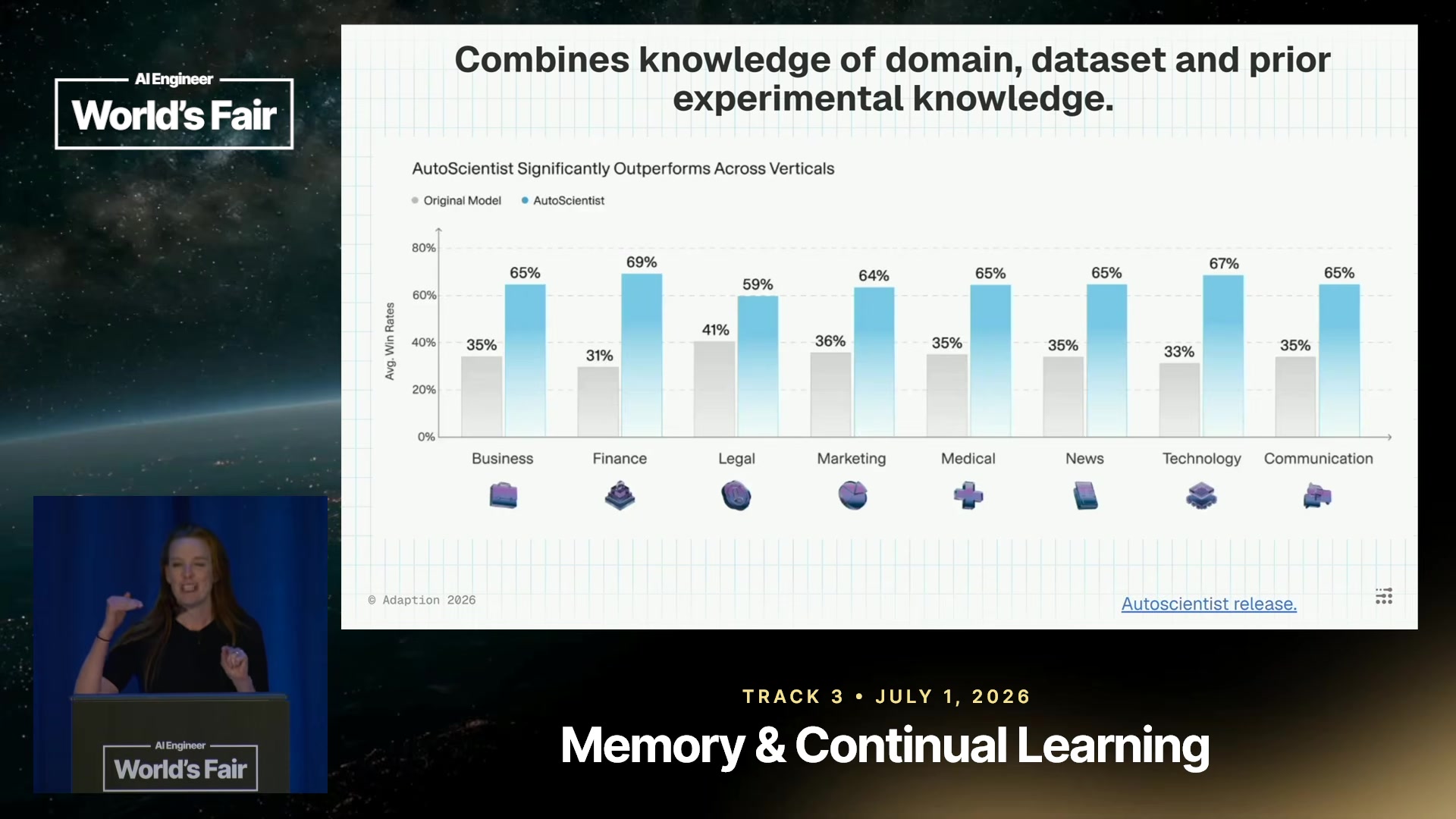
Demand in the beta has been most acute in medical, sciences, legal and code — precisely the domains where the last mile of customization matters most and general models fall short. Hooker’s stated benefit isn’t a benchmark number; it’s that automating the recipe increases your innovation cycle and raises the probability that any given compute spend succeeds. Those two compound.
A related design commitment: 242 languages covered from day one, on the argument that everyday tasks — not benchmark tasks — are where the interesting progress lives.

The real argument: compute is changing shape
The strongest section is the one about why now. Hooker’s claim is that the returns on compute are being redistributed, and that redistribution is what actually democratizes access.
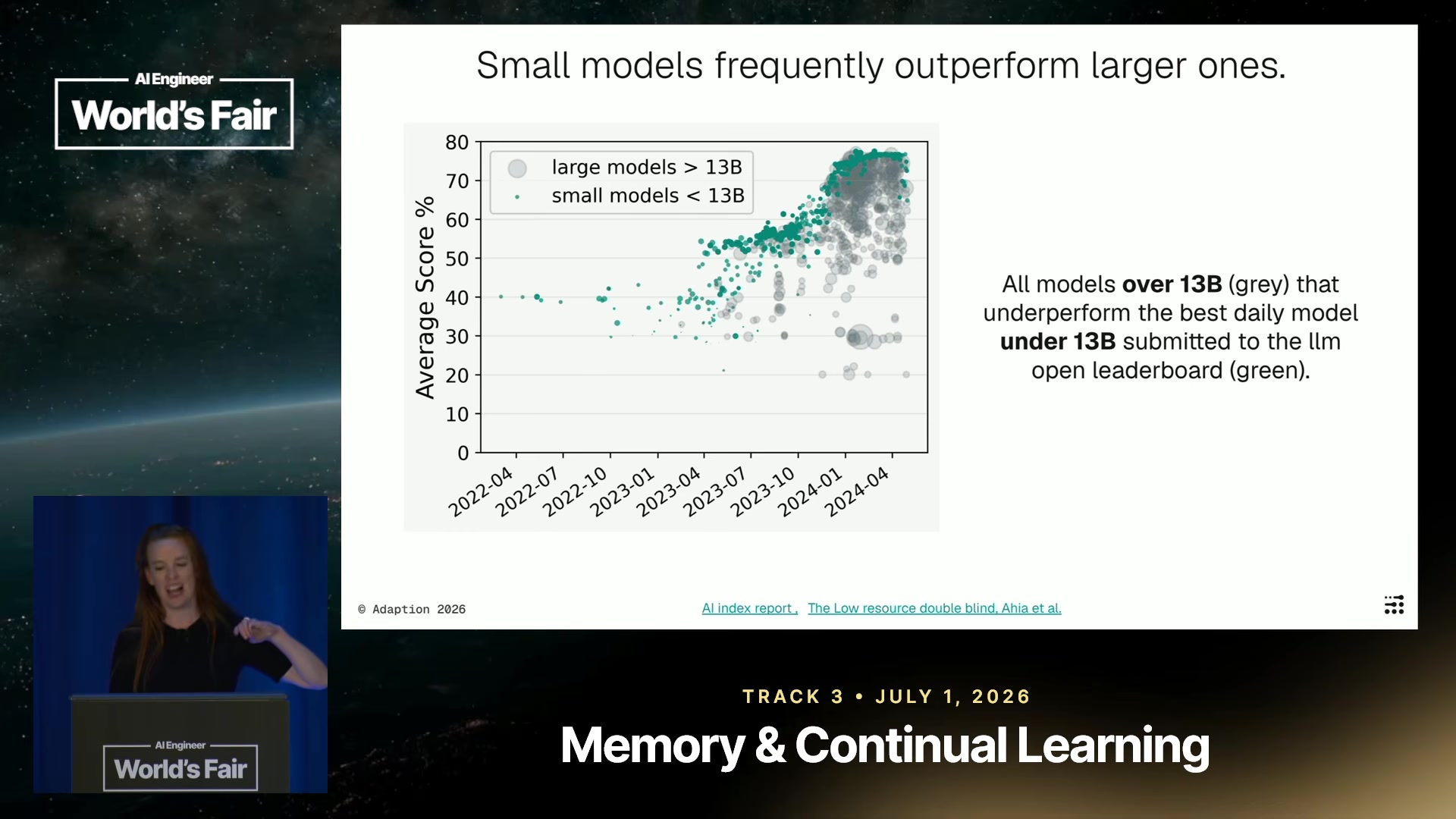
Two supporting observations. First, the daily Open LLM leaderboard submissions of the best sub-13B model versus all larger models: that ratio flips over time. Second, her “grumpy assessment” that recent models leaning primarily on increased size haven’t delivered the stepwise change their predecessors did.
If pre-training scale no longer dominates performance, the action moves to post-training, agentic compute, inference-time compute — an expanded optimization space where recipe, algorithm and research matter again, and where barriers to entry are far more nimble. Crucially, this is a different compute-purchasing dynamic. As she put it in Q&A, it “does not require the same type of — dare I say — hoarding of GPUs.” The person with the best idea has a higher chance of winning.
Her second democratization argument is about tacit knowledge: realistically fewer than 5,000 people in the world know how to train frontier models at scale, and much of that is secret knowledge passed apprentice-style. That’s a highly exploitable search space for automation — and humans were never especially good at picking those configurations anyway.
And a subtle point worth pausing on:
“The cost of asking something informs what is asked.”
Cheaper experiments don’t just run faster, they change which questions get asked at all.
On safety and open access
Asked about the safety counterargument to democratization, Hooker refuses the binary. She’s explicitly not in the camp that says open access carries no risk — making a tool more available carries a risk profile. But she separates two questions that usually get conflated: Auto Scientist is about letting people customize and own their own intelligence, locally or privately or inside their own company, which is a different question from whether the weights are open source. Restricting access is itself a choice with a cost: it limits who can participate. “A delicate balance,” and a deliberately nuanced answer.
On smaller models still depending on larger ones for distillation, her position is narrower than it first appears: she isn’t claiming frontier models will stop being large. She’s claiming no frontier lab will keep re-running full pre-training — the leverage has moved downstream.
Key takeaways
- The path to frontier AI research has been an aggressively filtered funnel — right PhD, right lab, right problem, right time — and that filter costs the field questions, not just people.
- Auto Scientist automates the model-training recipe itself: architecture, size, dense vs. MoE, self-evolving per domain and data type.
- Co-optimize data with the model. Auto-research systems that treat data as an afterthought leave most of the performance on the table.
- The real payoff is cycle time, not a single benchmark win: faster iterations plus higher probability that a given compute spend succeeds.
- Pre-training scale is showing diminishing stepwise returns; post-training, agentic and inference-time compute are where the expanded optimization space now lives.
- Different compute shape means different competitive dynamics — less GPU hoarding, more advantage to the best idea.
- Fewer than 5,000 people worldwide know how to train frontier models, and that tacit knowledge is an exploitable search space for automation.
- Cheaper questions change which questions get asked — the cost of asking is upstream of the research agenda itself.
Source
- Talk: Adaption Labs: Gradient-Free Continual Learning
- Speaker: Sara Hooker (Adaption Labs)
- Origin: AI Engineer
- Duration: 20m 51s
- URL: https://www.youtube.com/watch?v=XEd_SRVHBgU