Weekly Paper Notes — one of the top picks from the 2026-08-15 CS paper digest. Area: Operating Systems / Systems.
Authors: Yuan Si (University of Waterloo), Yufeng Lin (Independent), Daming Li (Independent), Jialu Zhang (University of Waterloo, corresponding)
arXiv: 2608.12103 · PDF
TL;DR
A trillion-parameter mixture-of-experts model routes each token through a small, input-dependent slice of its weights — in the production model studied here, an accepted token costs on average 1585 expert reads of 17.5 MB each, 27.8 GB drawn from a 1.45 TB pool. No single node holds that pool in DRAM, so every serving system for this regime contains a cache whether or not its authors call it one. The field has converged on one shape for that cache: a user-space tier that ranks experts by observed activation frequency, pins the hottest ones whole, and streams the rest with unbuffered I/O. The engine the authors instrument shipped the most extreme version of this consensus — F_NOCACHE applied to the entire expert stream, on the theory that a cache smaller than the working set only churns.
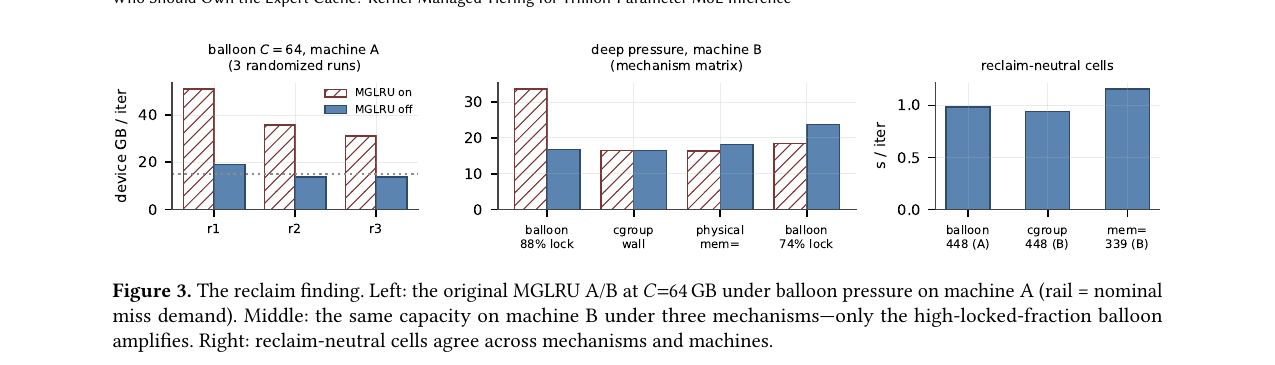
This paper characterizes the alternative that requires no code at all: mmap the expert pool and let the kernel page cache be the tier. Router traces from three MoE models spanning 128 to 896 experts per layer are replayed natively against the full 1.45 TB pool on GH200 nodes, three randomized runs per point, block-layer instrumentation throughout, with capacity enforced by three independent mechanisms (balloon, cgroup-v2 wall, boot-time mem=). Four findings: capacity is a smooth, measurable knob (run spread 0.5–4.0%); the frightening deep-pressure amplification knee is a two-ingredient artifact of MGLRU plus balloon-shaped mostly-mlocked memory, absent under cgroup walls and physical mem= boots, meaning balloon-based sizing studies overstate pressured-end device traffic by ~2×; at host-tier budgets untuned kernel recency serves as much demand as a same-domain oracle frequency table (75.3% vs 74.6% at C=256 GB) and beats it badly off-domain (70–71% vs 21–34%); and the residual mechanism edge of the pinned arena is 1.09×, not the 1.5× a broken measurement once suggested.
What problem is the paper actually attacking?
The MoE serving literature — MoE-Infinity, PowerInfer, LLM in a Flash, DeepSpeed-MoE, Mixtral-offloading, SiDA-MoE, Pre-gated MoE, Fiddler, EdgeMoE — is essentially a decade of caching theory rediscovered in user space. Each system embeds three assumptions, usually without testing them:
- Expert popularity is stable enough to rank. Build a frequency table offline, trust it online.
- The expert is the right granule. Pin whole experts; a partially resident expert is not useful.
- The OS page cache would only interfere. Hence direct I/O,
O_DIRECT,F_NOCACHE.
Assumption 3 is the one that has never been measured honestly at this scale, because measuring it requires a 1.45 TB pool, a coherent-memory node, and the discipline to enforce capacity in a way that does not itself distort the result. The database community’s canonical warning against mmap for buffer management (Crotty et al.’s “Are You Sure You Want to Use MMAP in Your Database Management System?”) looms over the whole question — and the paper takes it seriously rather than dismissing it, noting that the MoE expert workload sits at the opposite pole from a DBMS buffer pool: read-only, sequential within an expert, shared across processes, no dirty pages, no write-back, no transactional durability requirement.
The motivating observation is blunt: if the OS already ships a tier that handles this access pattern, the entire user-space cache is engineering debt whose price nobody has priced.
The mechanism: measure the kernel tier honestly, or not at all
There is no new algorithm here. The contribution is the evidence chain, and the paper is explicit that this is what it considers most transferable. Four pieces:
A canonical trace parser. Speculative decoding makes “one token” a treacherous unit — an engine iteration may carry two positions (a 32-index record on speculation success) or route a layer twice (a failed speculation plus its fallback). The trace JSONL carries no event tag, so the parser reconstructs each record’s type from record width and per-layer duplication, then validates the reconstruction: across all four domains the typed accounting reconstructs exactly 299 accepted tokens per trace against the engine’s requested 300. The authors’ first parser silently collapsed these cases and contaminated every denominator downstream — a failure they report rather than hide.
Capacity as a control target, kept distinct from what it controls. “Capacity C” is the nominal target handed to a mechanism. Separately recorded: MemAvailable, file-backed resident pages (what the replay actually hits), locked anonymous pages (VmLck), block-device reads from /proc/diskstats, and logical expert accesses from trace demand. Three independent mechanisms enforce C, and where they disagree, the disagreement is treated as a finding rather than averaged away.
Per-run accounting proofs. Each measurement cell runs warm-up and measurement in one cgroup scope (a dead scope’s file pages reparent uncharged), snapshots diskstats/meminfo/VmLck at loop entry so preload is excluded, and accepts the cell only if VmLck matches the request, the OOM flag is empty, and the scope stayed alive throughout. mlock failure is fail-stop, not a warning.
Shallow capture. Both trace hooks are minimal — a hook in the production engine, a 40-line eval callback in llama.cpp — and replay runs against the same per-expert files the engine reads, so replay I/O is the engine’s I/O. Two hygiene rules mattered: decode records only (batched prefill mixes positions), and discarding llama.cpp’s scheduler dry-run, which emits a plausible-looking synthetic first pass — caught because four different prompts produced bit-identical “step 0” coverage.
Results
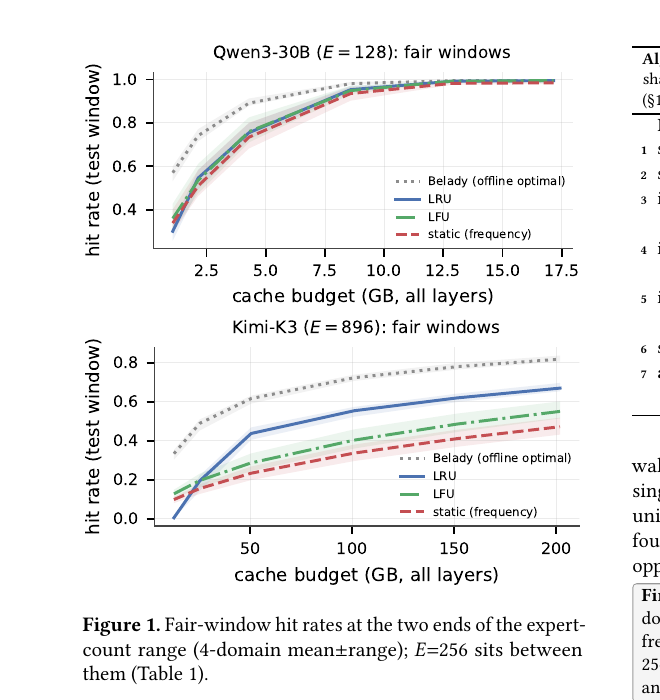
Routing structure, and where the policy verdict flips. At trillion scale routing is flat (Zipf α ≈ 1), recency-dominated (a 64-step window covers 80–82% of accesses), domain-drifting, and depth-graded. Under fair train/test windows, plain LRU matches or beats a same-domain oracle frequency table from B=32 experts per layer upward, reaching ~75% of Belady’s offline optimum; below roughly 2k per layer the ranking inverts and LRU thrashes. The frequency-versus-recency crossover sits between E=128 and E=256 — which means the architectural trend of widening expert counts at constant activated compute has been silently walking the field across a caching-policy boundary. Global-pool and per-layer allocation simulations agree to within 2.7 percentage points, so the per-layer panels transfer.

The reclaim knee is an artifact — and this is the most useful result in the paper. The deep-pressure amplification that makes practitioners afraid of the page cache requires two ingredients simultaneously: MGLRU enabled and a balloon-style mostly-mlocked host. At 88% locked the amplification appears; at 74% it does not. cgroup-v2 walls and boot-time physical mem= show none at any tested capacity. The finding is doubly replicated across two machines, and the direct consequence is that balloon-based capacity studies on default kernels overstate pressured-end device traffic by roughly 2×. Anyone who has read a memory-sizing study for accelerator workloads in the last few years should re-read it with this in mind.
Ownership’s true price is single-digit. Under an enforced equal-memory wall — mlock fail-stop, VmLck recorded, warm state charged to the same budget — the oracle-pinned arena’s edge over the page cache is 1.09× at C=256 GB, with near-identical device traffic. The residue is kernel lookup and reclaim work. And note the concession the authors make to the incumbent: the pinned tier’s frequency table is computed from the very trace being replayed, an upper bound no deployed system reaches. Every mechanism number reported for pinning is generous to it, which makes the off-domain collapse (oracle to 21–34% while LRU holds 70–71%) a conservative statement of frequency’s fragility.
Advice works; advisors must not do I/O. The router’s own lookahead predictor — measured at 64.7% recall, replayed from the predictor’s dumped plan rather than an oracle stand-in — buys 0.3% as fadvise readahead hints and nothing as synchronous prefetch. Belady bounds the remaining advice-addressable headroom at roughly a quarter of misses. The lesson generalizes past MoE: learned-advice caching theory abstracts away the delivery interface, and here the delivery interface dominated the outcome.
It composes into a placement rule. Measured bandwidth constants yield closed-form admission and promotion rules — ownership pays after k* = 1.06 reuses on a coherent link; adopt and stream tie within 5.6%. The end-to-end engine A/B, with a strict backend gate, token-identical outputs, and nine balanced pairs, prices cache admission at 1.09–1.10×.
Why this matters
The design consequence the authors draw is a good one-liner: in this regime the kernel tier is never the wrong configuration — let it own eviction, and spend model knowledge on admission and advice. That is a direct instruction to redirect engineering effort. Frequency tables and pinned arenas buy 9% and cost you drift-fragility, an entire subsystem to maintain, and a policy that collapses when the workload’s domain shifts. Router-derived knowledge is still valuable, just at a different layer: deciding what to admit and what to hint, not what to evict.
There is a second contribution that will outlive the specific numbers: the methodological one. The paper states that its evidence survived two adversarial audits — the first exposed a Python-era harness, the second a balloon whose arithmetic could not sum — and that both times the repaired measurement moved the number and sharpened the claim. Publishing the 1.5× that turned out to be 1.09× is worth more to the field than the 1.09× itself. Capacity-enforcement mechanism is a confound, not a detail; if your study picks one and does not triangulate, you may be measuring your ballooning setup.
Limitations are stated honestly: two machines, one kernel line (6.8), one NVMe class each. The two-ingredient localization of the reclaim knee is behavioral, not mechanistic — the MGLRU generation-counter audit that would explain why aging misbehaves behind a giant unevictable region is left as future work.
Read alongside
- Are You Sure You Want to Use MMAP in Your DBMS? (Crotty, Leis & Pavlo, 2022) — the standing counterargument; §6 hands that camp a quantified exhibit in the 1.09× residual.
- MoE-Infinity, Mixtral-offloading, Fiddler, Pre-gated MoE — the user-space expert-cache lineage this paper is measuring against.
- LLM in a Flash (Alizadeh et al.) and PowerInfer — frequency-based flash/GPU co-design, the strongest form of assumption #1.
- Belady (1966) and Denning’s working set (1968) — the offline optimum and the recency framing the hit-rate curves are located against.
- The Five-Minute Rule (Gray & Putzolu, 1987) — direct ancestor of the closed-form admission calculus in §8.
- MGLRU — the reclaim generation whose interaction with
mlocked regions produces the knee.
Links
📄 arXiv abstract · 📄 PDF
Part of the Weekly CS Paper Digest series. Summary written from a close read of the preprint; figures cropped from the arXiv PDF and reproduced here under fair use for educational commentary.