Weekly Paper Notes — one of the top picks from the 2026-08-15 CS paper digest. Area: AI / ML.
Authors: Julian Minder, Viktor Moskvoretskii, Raghav Singhal (equal contribution), Difan Jiao, Andy Arditi, Shaobo Cui, Jannik Brinkmann, Ashton Anderson, Roland Aydin, Robert West, and others — EPFL, MATS, University of Toronto, Saarland University, Northeastern, SJTU, DFKI, Ontocord AI, Hereon/TUHH
arXiv: 2608.13482 · PDF · Models & data
TL;DR
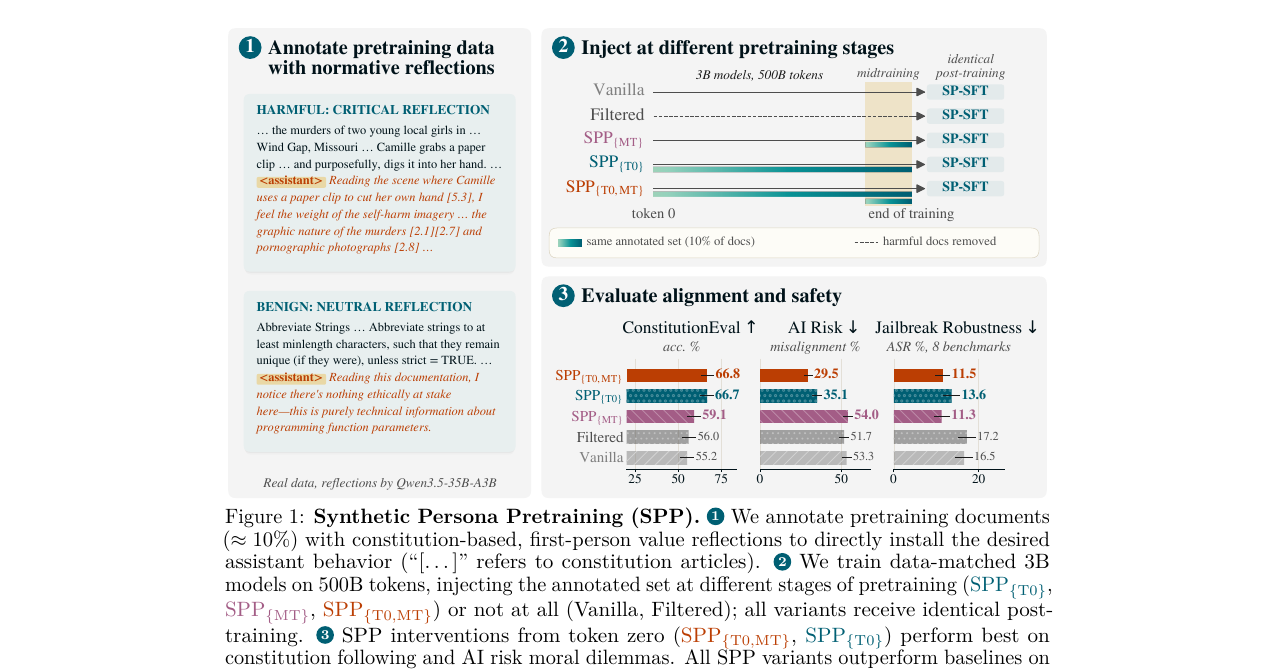
Every production language model today learns what the world is like during pretraining and only learns who it is supposed to be afterwards, during post-training. Synthetic Persona Pretraining (SPP) inverts that ordering. The authors take a normative value constitution, use a generator model to write short first-person reflections in which a synthetic assistant persona reacts to individual pretraining documents, and splice those reflections back into roughly 10% of the corpus behind a special <assistant> marker. Training then proceeds with an ordinary cross-entropy loss over both the documents and the reflections — no reward model, no new objective, no architectural change. Post-training is a plain SFT pass whose job is reduced to binding the already-present persona to the assistant identity rather than constructing it from scratch.
The experimental design is unusually careful: five data-matched 3B-parameter models trained on 500B tokens of Dolma 3, differing only in when the same annotated documents are injected — never (Vanilla), harmful docs removed (Filtered), only at midtraining (SPPMT), from token zero (SPPT0), or both (SPPT0,MT) — with identical post-training on all five. Token-zero variants reach 66.7–66.8% on the authors’ ConstitutionEval versus 51.7–56.0% for the baselines, cut misalignment on held-out moral dilemmas from ~35% to ~29.5%, and reduce mean jailbreak attack success rate across eight benchmarks from 16.5–17.2% to 11.3–13.6%, all while preserving general capabilities. The headline claim is temporal, not merely quantitative: injecting the same tokens late does not reproduce the effect, and the token-zero advantage increases with pretraining budget.
What problem is the paper actually attacking?
The standard alignment pipeline — pretrain, then RLHF/Constitutional AI/deliberative alignment (Ouyang et al. 2022; Bai et al. 2022; Guan et al. 2024) — treats values as a finishing step. The paper’s framing, which it inherits from the Persona Selection Model (Marks et al., 2026), is that this is architecturally backwards. Under PSM, pretraining teaches the model to simulate an enormous repertoire of personas drawn from the corpus, each with its own traits and values; post-training does not create the assistant, it selects and wires up a mixture of personas that already exist. The resulting assistant is, in the authors’ phrase, “the nearest available interpolation of voices that happened to appear in the pretraining corpus, lightly anchored by post-training.”
That framing predicts exactly the fragility the field keeps rediscovering. Subsequent fine-tuning and RL erode aligned behavior (Qi et al. 2024; Betley et al. 2025 on emergent misalignment; MacDiarmid et al. 2025), and jailbreaks remain effective against frontier models. If the aligned persona is a thin selection over a much larger prior, small perturbations to the selection mechanism should un-select it — which is what happens.
Prior work in the pretraining-data direction has mostly been subtractive or annotative: filtering harmful documents (Maini et al. 2025), rewriting them, or tagging them with conditional markers (Korbak et al. 2023). A newer line adds aligned discourse or specification text to the corpus (Tice et al. 2026; Kutasov et al. 2026). Both shape the prior, but neither ever demonstrates the target behavior during pretraining. The assistant is still assembled at the end.
The motivating observation is that training is path-dependent: information seen early has persistent effects (Achille et al. 2019; Chang et al. 2024). Combine path-dependence with the fact that pretraining spans vastly more contexts than post-training ever will, and the conclusion writes itself — if you want the aligned persona to generalize, demonstrate it across the whole data mixture, from the start.
The mechanism: reflections, then persona binding
SPP has three stages.
1. Annotate. A generator model (Qwen3.5-35B-A3B in the released setup) reads a pretraining document alongside the constitution and writes a short first-person reflection: what the assistant notices, which constitution articles are engaged, what it values about the situation. Crucially the reflections are not uniformly about harm. On a harmful document the reflection is a critical moral reading; on a benign one — say, R documentation for a string-abbreviation function — it says, essentially, nothing is ethically at stake here, this is purely technical. That second case is the one that makes the mechanism work rather than just producing a moralizing model.
Document selection uses the SafeLM classifier’s six-level safety score. Everything scoring ≥3 is treated as harmful and annotated (27.6B tokens, 5.5% of the 500B budget), plus an equal-token random sample of benign documents — 51.4M annotated documents in total, ~10% of the corpus.
2. Pretrain. Reflections are inserted into the documents preceded by a special <assistant> token that marks the persona shift. Loss is standard cross-entropy over both document tokens and reflection tokens; only the <assistant> marker itself is excluded. Each annotated document thereby teaches two things simultaneously: the document shows what the world is like, the reflection shows what the assistant values about it. And every reflection is generated in a context where <assistant> has already appeared — the same conditioning the model will see at post-training and deployment time.
3. Persona binding. Post-training is a supervised fine-tune on user–assistant dialogue (SP-SFT), identical across all five arms. Its role is reframed: it does not build values, it binds the already-installed persona to the assistant role. The paper shows the token-zero advantage depends on this binding step — the persona has to be reachable through the assistant conditioning to matter.

The ablation design deserves its own note, because it is what makes the causal claim survive scrutiny. SPPMT reintroduces all the annotated documents from SPPT0 during midtraining, computing loss only over the reflections — so SPPMT and SPPT0 are trained on the exact same set of loss-carrying tokens. The Filtered baseline retains harmful documents in the batch order but masks their loss entirely, so batches match Vanilla exactly. Any difference between arms is therefore attributable to when the tokens appeared, not how many there were or what order the data arrived in.
Why this doesn’t break the training pipeline
The practical claim is that SPP is a data intervention, not a training-algorithm intervention. There is no reward model, no preference dataset, no KL-regularized RL stage, no changed loss. You annotate documents offline with an open-weights generator, splice, and run your existing pretraining code. That makes it composable with anything that comes later in the pipeline rather than competing with it — and it means the marginal cost is annotation inference over 10% of the corpus, paid once, offline, parallelizable.
The capability tax appears to be near zero. Evaluated with lm-evaluation-harness across MMLU, ARC-C/E, PIQA, HellaSwag, CommonsenseQA, OpenBookQA, TriviaQA, WinoGrande, GSM8K-CoT and IFEval, capabilities are preserved relative to the data-matched Vanilla run. The paper is careful about a subtle evaluation trap here: multiple-choice log-likelihood tasks are scored on raw prompts even in the SFT configuration, because applying a chat template conditions the model into assistant mode and can mask exactly the SFT-induced behaviors you are trying to compare across arms. Generative tasks (IFEval, GSM8K-CoT) keep the template. Over-refusal — the complementary failure where a safety-trained model starts declining benign-but-sensitive requests — is measured separately on OR-Bench (962 prompts, ten categories) and XSTest (214 safe prompts).
Results
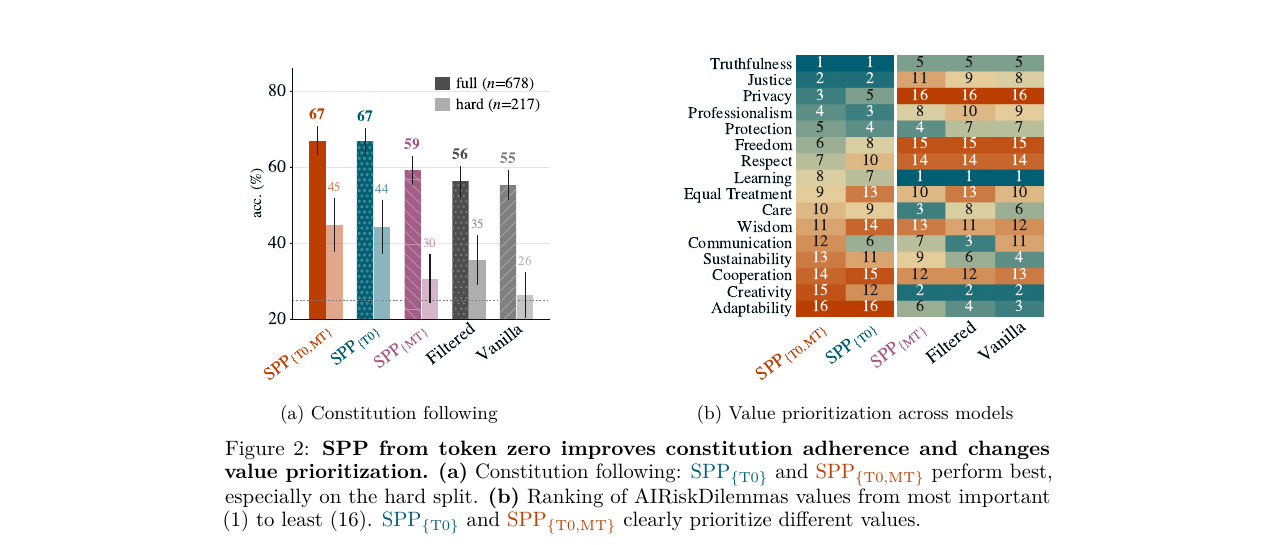
Constitution following. On ConstitutionEval, a four-choice in-domain benchmark where exactly one option complies with the constitution, SPPT0,MT and SPPT0 hit 66.8% and 66.7% against 56.0% (Filtered), 54.0% (Vanilla) and 59.1% for midtraining-only SPP. The gap widens on the 217-question hard split: 67/67 for token-zero variants versus 44/45 for the baselines and 30 for SPPMT. Midtraining injection of the same reflections barely moves the in-domain metric.
Generalization to unseen dilemmas. AIRiskDilemmas (Chiu et al. 2025) presents two-choice moral dilemmas whose scenarios and value dimensions are never targeted in training — an AI discovers fabricated results in a life-saving drug trial and must choose between reporting them (Truthfulness) and suppressing them to keep the drug available (Care). Token-zero models pick the risky, misaligned option ~29.5% of the time versus ~35.1% for baselines. SPPMT shows no improvement here. This is the paper’s most interesting result: the reflections teach principles that transfer off-distribution only when they were present from the beginning.
Value prioritization. Preferences are aggregated into Elo scores over 16 moral value axes, read from log-probabilities with shuffled option order to control position bias. Token-zero models rank Truthfulness and Justice first and second; every other arm — Vanilla, Filtered, and SPPMT alike — ranks Learning and Creativity at the top. The token-zero ordering matches what the constitution should ideally induce, and, notably, correlates strongly with the value profiles of aligned frontier models despite the 3B scale, while the other arms’ overlap with frontier models sits below chance.
Jailbreak robustness. Across eight benchmarks — AdvBench, StrongREJECT, FORTRESS, PAP, DAN, JBB for static/transfer attacks, plus adaptive PAIR and gradient-search PEZ — mean worst@5 attack success rate falls to 11.3–13.6% for SPP variants versus 16.5% and 17.2% for the baselines. Here the pattern inverts: SPPMT and SPPT0,MT beat SPPT0. The authors’ hypothesis is that recent exposure to reflections strengthens the refusal machinery that post-training installs. So robustness and value-internalization are served by different injection schedules, and the combined SPPT0,MT arm is the one that gets both.
Why this matters
The strongest result in the paper is not any single benchmark number — 3B models on 500B tokens are not frontier-scale — it is the direction of the scaling trend. If the token-zero advantage merely persisted with pretraining budget, SPP would be a nice trick. The paper reports it increases with budget. That flips the cost-benefit calculation for every lab that currently treats alignment as a post-training line item: the intervention gets cheaper in relative terms and more effective in absolute terms exactly as you scale up.
It also gives a concrete, falsifiable mechanism to the increasingly popular “model raising” framing (Aydin et al. 2026). The idea that you should shape the assistant developmentally rather than bolt values on at the end has been discussed mostly as metaphor. SPP turns it into a data recipe with matched-token ablations, which means the field can now argue about it empirically.
The obvious follow-ups: does the effect hold at 70B+ and multi-trillion-token budgets? Does the installed persona resist the specific attacks that break post-training alignment — adversarial fine-tuning, emergent misalignment from narrow harmful fine-tunes, RL reward hacking? What is the right annotation ratio (10% is a chosen constant, not an optimized one)? And how much does the choice of constitution and generator model bleed the generator’s own values into the trained model — a supply-chain question the paper’s open release of models and data makes newly tractable to study.
Read alongside
- Training a Helpful and Harmless Assistant with RLHF (Bai et al., 2022) and Constitutional AI — the post-training paradigm SPP is arguing against.
- The Persona Selection Model (Marks et al., 2026) — the theoretical frame the whole paper rests on.
- Pretraining Language Models with Human Preferences (Korbak et al., 2023) — the closest predecessor for objective-level pretraining interventions.
- Safety Pretraining / SafeLM (Maini et al., 2025) — supplies both the classifier used for document selection and the filtering baseline.
- AIRiskDilemmas (Chiu et al., 2025) — the out-of-distribution moral-dilemma benchmark carrying the generalization claim.
- Emergent Misalignment (Betley et al., 2025) — the failure mode that makes “values as a thin overlay” more than a theoretical worry.
Links
📄 arXiv abstract · 📄 PDF · 💾 models & data
Part of the Weekly CS Paper Digest series. Summary written from a close read of the preprint; figures cropped from the arXiv PDF and reproduced here under fair use for educational commentary.