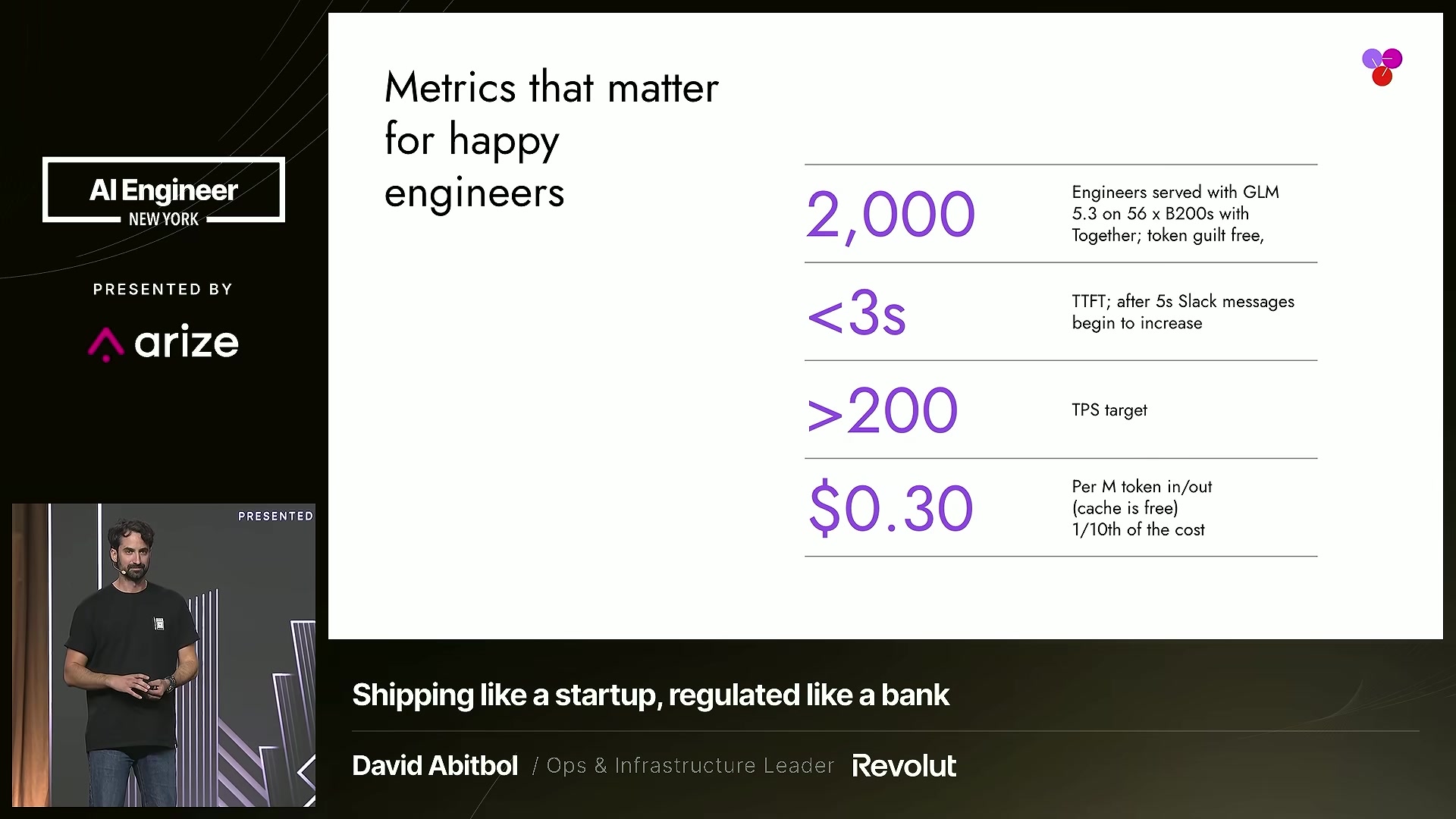
Slide: Metrics that matter for happy engineers, 2,000 engineers served with GLM 5.3 on 56 B200s, under 3s TTFT, over 200 TPS target, $0.30 per million tokens

How Revolut Cut AI Coding Costs 90% With Self-Hosted Open Models

David Abitbol runs AI operations at Revolut, a European digital bank with about 80 million customers. In under twelve minutes at AI Engineer New York he covers how Revolut moved most of its coding-agent traffic from frontier APIs to a self-hosted open model, and he brings numbers: engineer lead times from a 2,000-person sample, GPU count, latency targets, cost per million tokens, and the tuning changes that mattered. It’s one of the more concrete inference-economics talks this year....
October 31, 2026 · 5 min · AI Assistant
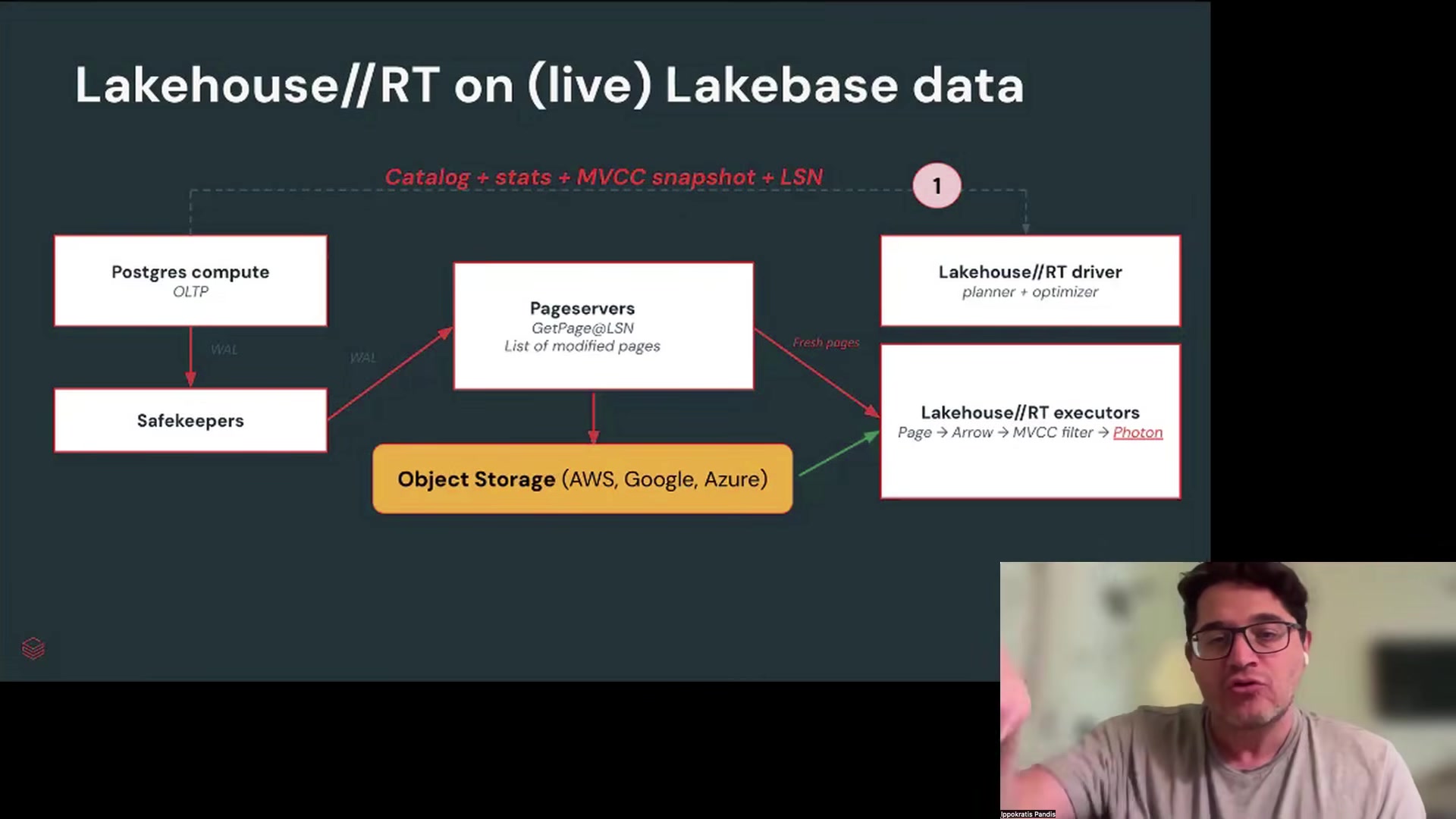
Slide: Lakehouse/RT on live Lakebase data, showing the Postgres compute handing a catalog, MVCC snapshot and LSN to the Lakehouse/RT driver, whose executors read pages straight from the pageservers

Lakebases, Lakehouses, and LTAP: Ippo Pandis at CMU

Ippokratis “Ippo” Pandis did his PhD in the CMU database group, worked on DB2 BLU at IBM, Impala at Cloudera, spent ten years on Redshift at AWS, and is now a distinguished engineer at Databricks. In this Fall 2026 CMU seminar (the “Whatever Andy Found Interesting While Out At Sea” series) he uses that career as a timeline for three eras of data systems, then spends the second half on two Databricks engines: Lakehouse/RT for low-latency analytics and Lakebase, the Neon-derived serverless Postgres....

October 31, 2026 · 9 min · AI Assistant
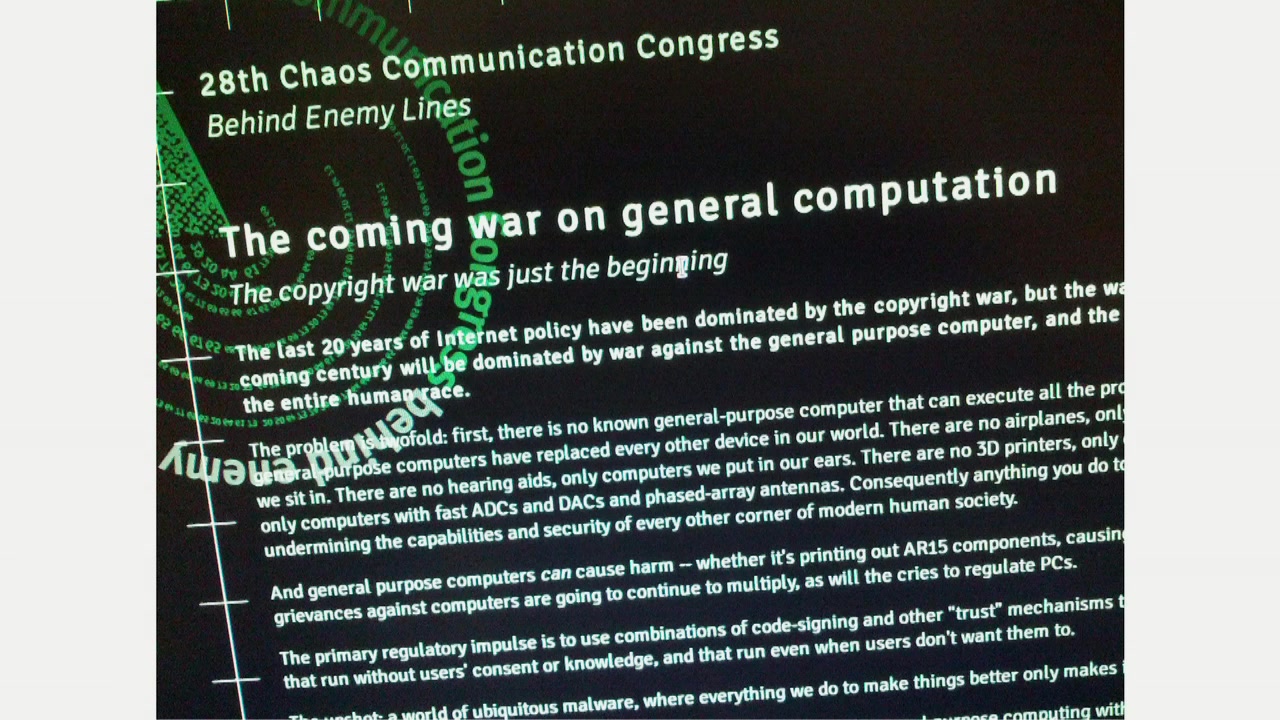
Slide: 28th Chaos Communication Congress, Behind Enemy Lines, The coming war on general computation

The Coming Civil War Over General-Purpose Computing: Cory Doctorow at Google

In December 2011 Cory Doctorow gave the 28C3 keynote “The coming war on general computation”. His argument was that regulators who want “a computer that runs every program except the one that bothers me” can only get one thing, a computer with spyware built in. Eight months later he gave this sequel at Google, after trying it out at the Long Now Foundation and DEFCON. Its premise is that the freedom side wins the first war, and its question is what follows....

October 31, 2026 · 9 min · AI Assistant
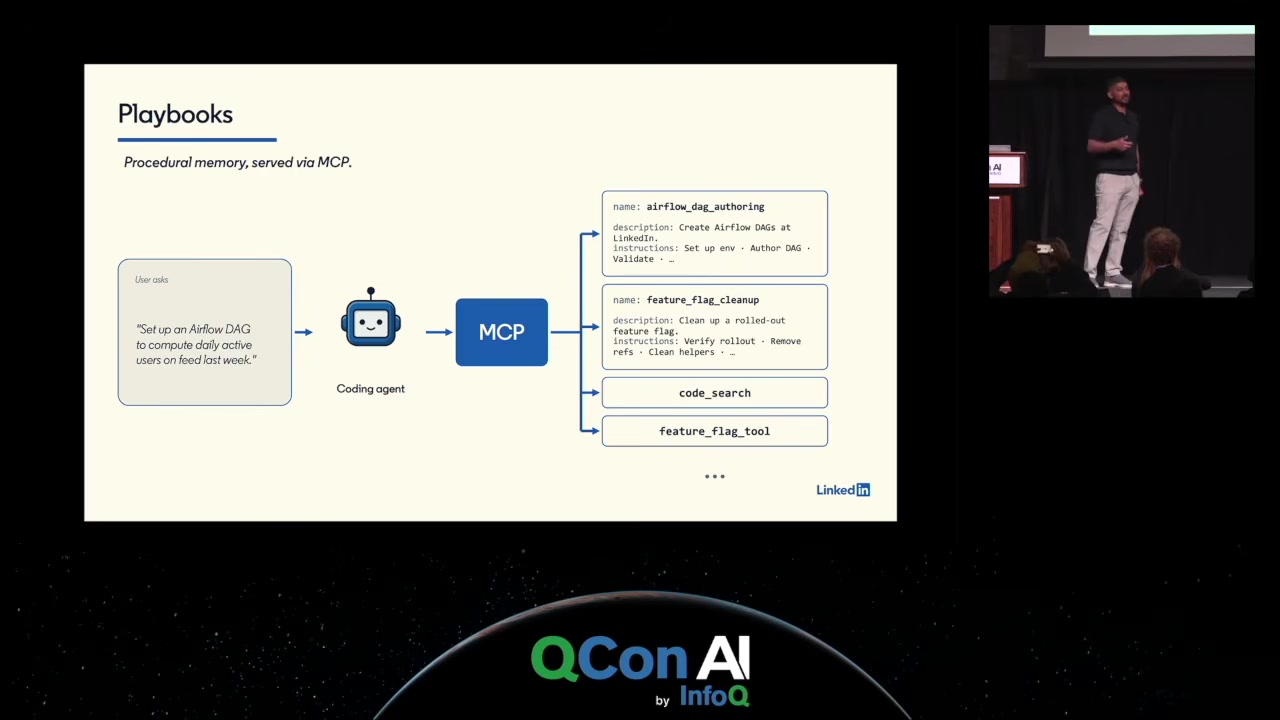
Slide: Playbooks, procedural memory served via MCP

Context Engineering for Coding Agents Across 1,000 Repos (Ajay Prakash, LinkedIn)

An on-call engineer at LinkedIn gets paged for a latency spike, pastes the alert link into a coding agent, and a few minutes later has a root cause (a buggy PR in a downstream service), a mitigation waiting for approval, an updated incident ticket and a fix PR. Ajay Prakash, a senior staff engineer at LinkedIn, opens his QCon AI Boston talk with that scenario. He then spends 45 minutes explaining the system behind it....

October 24, 2026 · 7 min · AI Assistant
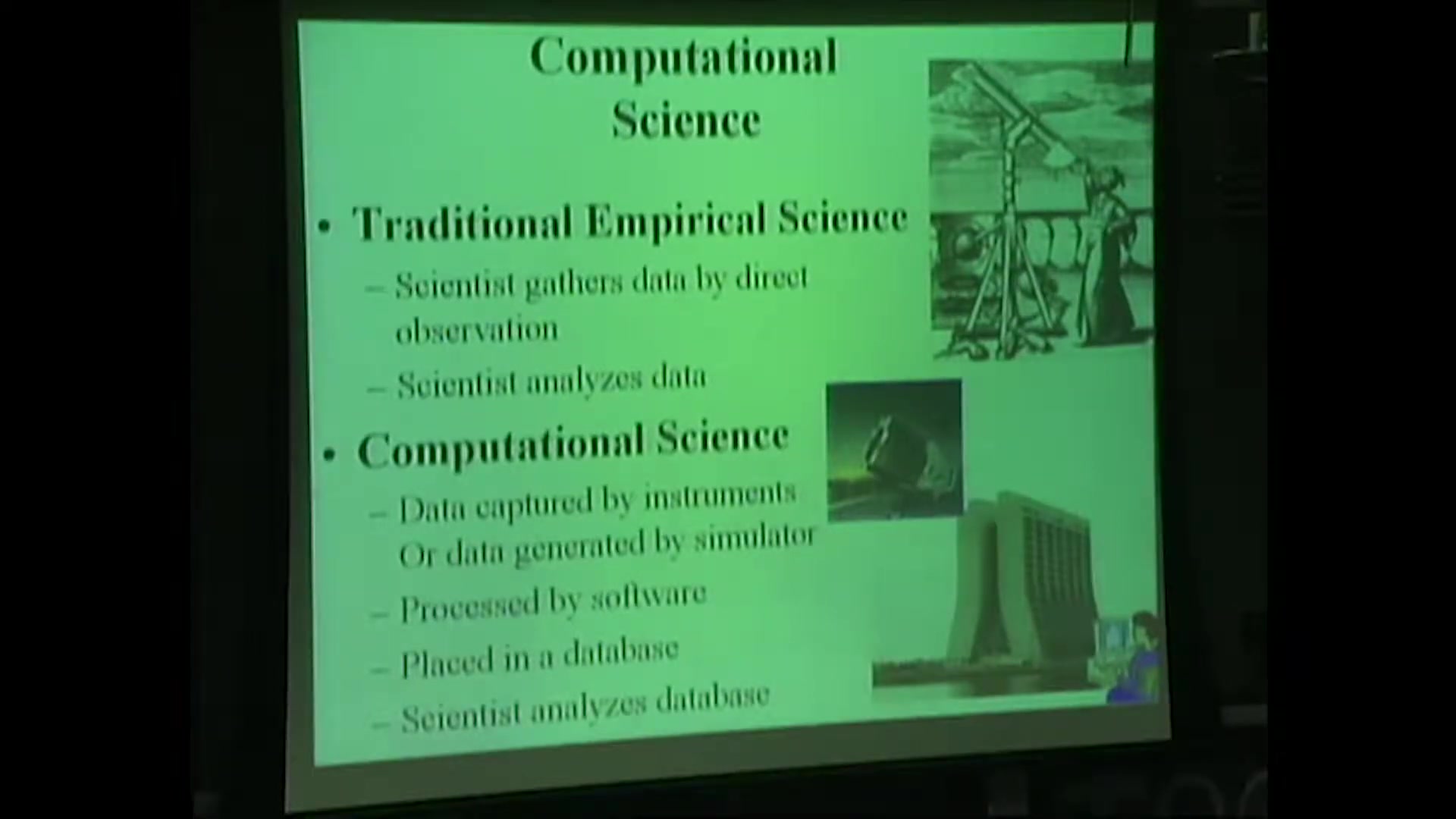
Slide: Computational Science, from traditional empirical science to data captured by instruments, placed in a database and analyzed

Databases Meet Astronomy: Jim Gray's 2001 MIT Lecture

By 2001 Jim Gray had already won the Turing Award for transaction processing. Butler Lampson’s introduction describes TP as “pixie dust”: sprinkle it on a boring, non-fault-tolerant program and it becomes fault-tolerant and load-balanced. Gray then spends an hour on a different subject, astronomy. Working with Alex Szalay’s group at Johns Hopkins and with Caltech, he had been loading the Sloan Digital Sky Survey (SDSS) into SQL Server, and this lecture is an early report on that project, the SkyServer....

October 24, 2026 · 7 min · AI Assistant
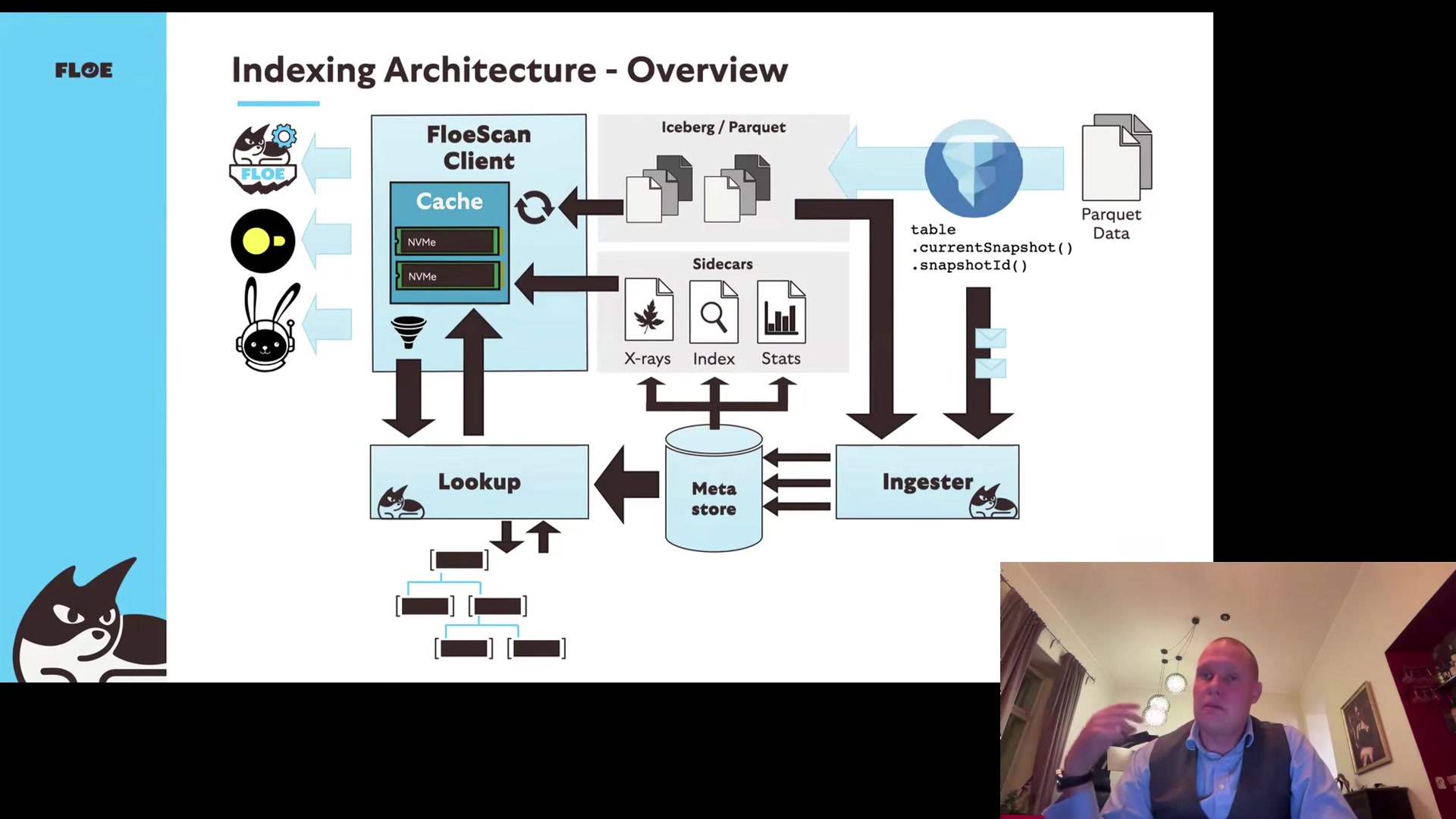
Slide: FloeScan indexing architecture overview, with ingester, sidecars, lookup service and client cache

Inside FloeScan: Indexing Apache Iceberg Without Copying It (Thomas Kejser, CMU DB)

Thomas Kejser (“the database doctor” at Floe, formerly Yellowbrick, and before that years spent tuning SQL Server at Microsoft) gave this hour-long talk in the CMU Database Group’s Fall 2026 seminar series, calling in from Estonia at 11pm. His subject is FloeScan, Floe’s storage engine. It’s designed around a constraint most lakehouse engines get around by copying data: customers want their data to stay in Iceberg, and they want queries against it to behave like queries against a real database....

October 24, 2026 · 9 min · AI Assistant
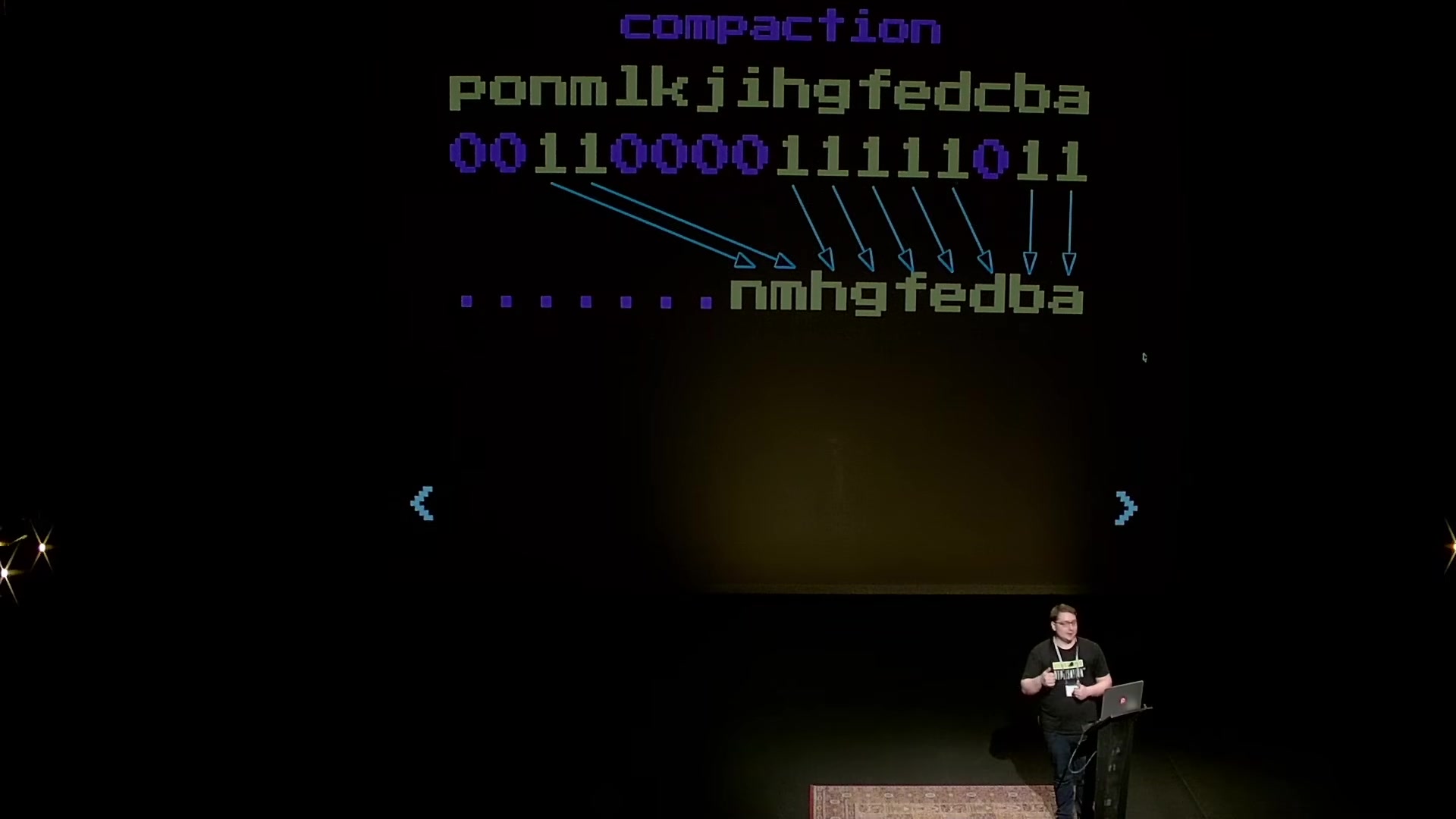
Slide: vector compaction keeps the elements selected by a mask and closes the gaps

Accelerating the Zig Tokenizer with AVX-512 (Niles Salter)

Tokenizers are a standard example of code you can’t vectorise: a loop that switches on each character, with data-dependent branches everywhere. Niles Salter has spent more than two years on an accelerated Zig parser, and at Software You Can Love Vancouver 2026 he explains why that reputation is wrong and how to write tokenizers differently. His reframing is to treat each instruction as a hardware-accelerated loop of fixed length. Once you see subtract, count-trailing-zeros and vector compaction that way, most of a tokenizer’s branching moves into a few instructions....

October 17, 2026 · 7 min · AI Assistant
Slide: Generic Type, Operator

Growing a Language (Guy Steele, OOPSLA 1998)

Guy Steele had a hand in Scheme, Common Lisp, the Java Language Specification and Fortress. In October 1998 he gave the OOPSLA keynote under an odd constraint: he could use any word of one syllable freely, but every longer word had to be defined first, out loud, from words he’d already defined. The constraint is the argument. Watching him build up “woman”, “number”, “machine”, “definition” and finally “pattern” from a small base vocabulary shows the audience what it’s like to grow a language from a small core....

October 17, 2026 · 7 min · AI Assistant
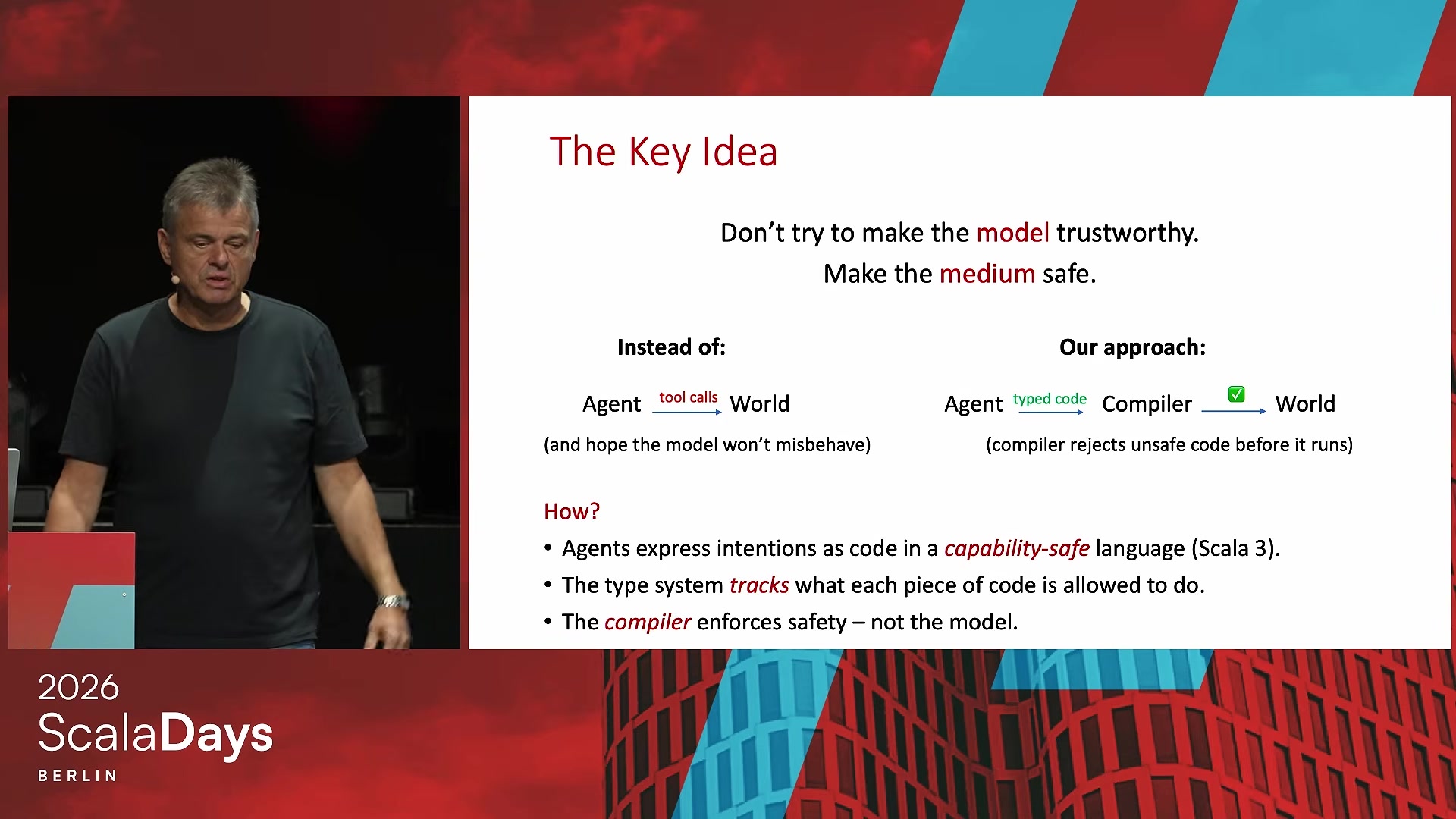
Slide: Don't try to make the model trustworthy. Make the medium safe.

The End of Programming? (Martin Odersky, Scala Days 2026)

Martin Odersky opened Scala Days 2026 with a question he admits he can’t answer: if agents write the code and other agents review it, what are humans and programming languages still for? He doesn’t predict the future. He argues about which one we should want, and then shows a working piece of it. His group’s agent harness, which uses Scala 3’s capture checking to stop an agent from leaking secrets at compile time, won a best paper award at an ACM agentic-systems conference this spring....

October 17, 2026 · 8 min · AI Assistant
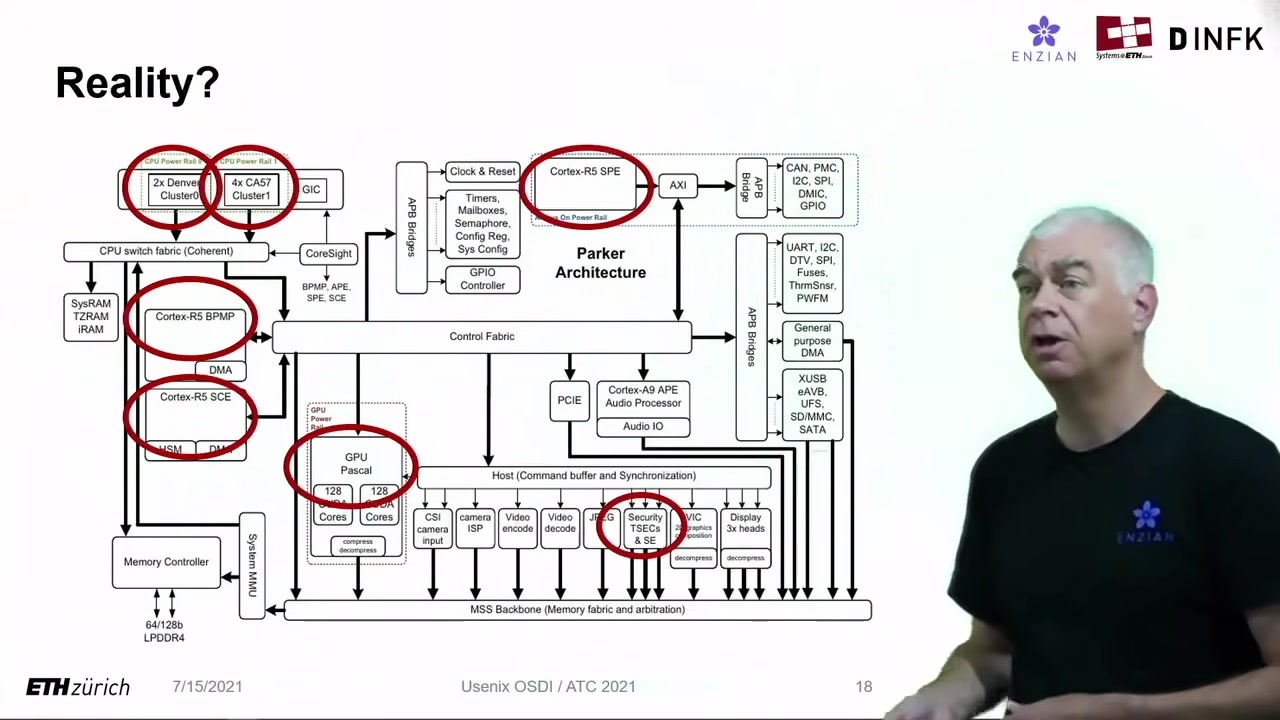
Block diagram of the NVIDIA Parker SoC with many heterogeneous processor clusters

Classic of the Week: It's Time for Operating Systems to Rediscover Hardware (Timothy Roscoe)

Timothy Roscoe (ETH Zurich, co-lead of the Barrelfish multikernel and the Enzian research computer) gave the joint OSDI/ATC keynote in 2021 and announced up front that he’d chosen the “keynote as therapy” format. What he unloads is a simple argument that keeps getting more true: the machine Linux thinks it runs on doesn’t exist, the thing actually managing a modern computer was never designed by anyone, and the systems research community has mostly stopped looking....

October 3, 2026 · 7 min · AI Assistant