Weekly Paper Notes — one of the top picks from the 2026-08-01 CS paper digest. Area: Systems / Networking.
Authors: Evyatar Cohen, Jose Yallouz, Mark Silberstein, Isaac Keslassy (Technion); Alexander Shpiner (NVIDIA); Sylvia Ratnasamy, Isaac Keslassy (UC Berkeley)
arXiv: 2607.26340 · PDF
TL;DR
Mixture-of-Experts models route each token to a small subset of experts, which turns every MoE layer into a highly skewed all-to-all communication phase across the GPU fabric. Every production stack — NCCL, RCCL, DeepEP — schedules those flows with per-NIC round-robin, which is computationally trivial and completely blind to skew. This paper shows that round-robin on skewed MoE traffic produces a previously undocumented failure mode the authors call the MoE exponential incast: as light flows to unpopular experts drain and drop out of the scheduling pool, senders inadvertently synchronise onto the remaining hot receivers, and the aggregate arrival rate at the hottest receiver grows as $N^{t/T}$ — reaching $N \times$ line rate at the end of the epoch. Under a Zipfian model the authors derive a closed-form bound showing that as $N$ scales out, essentially the entire workload volume ends up stranded in switch buffers. The fix is almost embarrassingly simple: normalise the demand matrix $D$ by the maximum of its worst-case row sum and worst-case column sum, and pace each flow at the resulting fraction of line rate. This makes every row and column sum $\le 1$ by construction, so no port can ever be oversubscribed. Simulated on htsim across $64\times64$ to $512\times512$ fat-tree fabrics with real Qwen2/Qwen3-235B routing traces, it consistently beats round-robin with UEC NSCC congestion control on Collective Completion Time while holding near-100% link utilisation.
What problem is the paper actually attacking?
The MoE dispatch phase is the hard part of MoE networking. Each of $N$ GPU NICs simultaneously floods the fabric with up to $N-1$ variable-length flows, and the metric that matters is Collective Completion Time (CCT) — the arrival of the last packet at its receiver. A single straggler flow stalls the entire layer.
There is a well-established academic answer: decompose the demand matrix into collision-free permutations. FAST (NSDI ‘26) uses exact Birkhoff–von Neumann decomposition; Chronos (Renganathan & McKeown, 2025) trades optimality for a faster maximal-matching decomposition; DFS does a dynamic hierarchical variant. These are elegant and they work — on optical circuit switches, where link delays are uniform and timing is tight.
The paper’s critique of that lineage is sharp and, I think, correct. BvN decomposition (1) is computationally expensive enough that real-time rescheduling is a challenge for workloads whose routing matrix changes every layer; (2) breaks under link failures, because a permutation schedule has no graceful degradation path; and (3) cannot be reconciled with distributed congestion control, since permutation scheduling assumes global synchronisation while CCAs assume independent, variable-RTT feedback loops. And crucially, on a packet-switched fabric the full machinery is overkill: flows already have heterogeneous delays depending on whether they cross core switches, so senders and receivers are never truly synchronised, and — the key observation — we have packet buffers, so we don’t need to avoid all conflicts. We only need to avoid incast.
Which leaves everyone in production running round-robin. And the paper’s contribution is showing that round-robin isn’t merely suboptimal on skewed traffic; it has a structural pathology.
The mechanism: exponential incast, then proportional rate allocation
The pathology
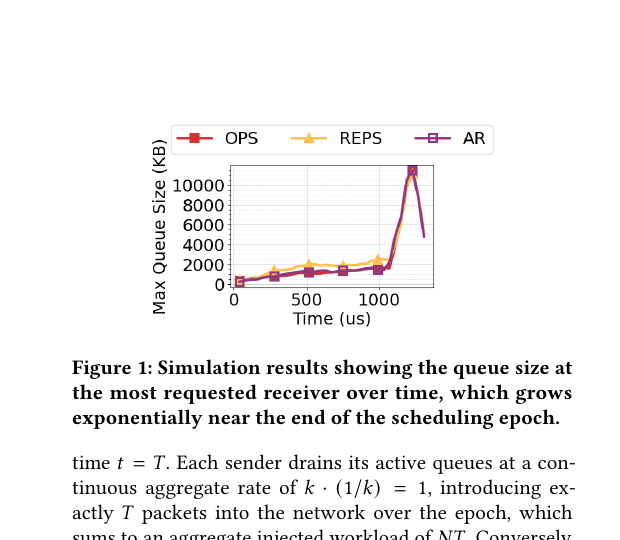
The intuition is worth stating plainly because it’s the kind of thing that seems obvious only in retrospect. Take a sender with one large flow to a hot expert and nine tiny flows to cold experts. Initially round-robin spreads traffic evenly — the hot flow gets 10% of the sender’s bandwidth. But the nine light flows finish quickly and drop out of the rotation, and the hot flow’s share climbs from 1/10 toward 1/1. Because every sender’s queues deplete on roughly the same schedule, their remaining transmissions synchronise, and near the end of the epoch 100% of the fabric’s capacity points at the hot receiver.
The fluid model makes this precise. Under a Zipfian demand with skew $s=1$:
$$D_{ij} = T \cdot \frac{1}{j \cdot \alpha}, \qquad \alpha = \sum_{m=1}^{N} \frac{1}{m} \approx \ln N$$
A round-robin sender with $k$ active destinations drains each at rate $1/k$. Solving for when the rank-$r$ flow depletes gives an exponential decay in the number of active destinations:
$$k(t) = N e^{-\alpha t / T} \approx N^{,1 - t/T}$$
and therefore an arrival rate at the hottest receiver $r_1$ of
$$\lambda_1(t) = \frac{N}{k(t)} = e^{\alpha t/T} \approx N^{,t/T}$$
At $t=0$ the hot receiver sits at exactly line rate. At $t=T$ it sees $\lambda_1(T) = N$ — every sender transmitting to it exclusively.

Integrating residual queues across all saturated receivers up to the boundary $j_{max} = N/\alpha$ yields the bound that should worry anyone building a large cluster:
$$Q_{total}(T) \approx NT\left(1 - \frac{\ln(\ln N) + 1}{\ln N}\right)$$
As $N$ grows, the correction term vanishes and $Q_{total}(T) \to NT$ — nearly 100% of the workload clogged in the fabric, even though bisection bandwidth is theoretically sufficient. The waste isn’t a bandwidth shortage; it’s cold destination links going idle early while hot links queue.
The fix
Given a demand matrix $D$ (diagonals null, since intra-server traffic goes over NVLink), compute a single scalar:
$$M = \max\left(\max_i \sum_j D_{ij},\ \max_j \sum_i D_{ij}\right)$$
and set $R = D/M$. For the paper’s $3\times3$ example with $D$ having a worst-case row and column sum of 4000, $M = 4000$ and $R$ becomes a matrix whose every row sum and column sum is $\le 1$. If each sender $i$ paces its flow to receiver $j$ at exactly $R_{ij}$ of line rate, no port can be oversubscribed — by construction, not by feedback.
That’s the whole algorithm. It is $O(N^2)$ arithmetic over a matrix that already exists: the paper notes that Megatron-LM performs a synchronous metadata handshake exchanging split sizes before dispatch, and veScale/MegaScale derives the traffic matrix analytically under SPMD, so the demand matrix is already known to every GPU before a single payload packet moves. The scheduler is free-riding on coordination that production frameworks already do.
Why this doesn’t break existing infrastructure
The deployment story is the part that makes this more than a theory note. Rate weights are enforced through NVIDIA DOCA Programmable Congestion Control on BlueField DPUs and ConnectX SmartNICs, which gives three things the design needs: fixed hardware rate limiting bound per-flow to the computed $R_{ij}$; reactive ECN-driven throttling as a fallback for unforeseen background traffic; and sub-microsecond memory-mapped register updates.
On scalability, the authors budget two phases. Computing $M$ for an $N \times N$ matrix with $N \le 1000$ runs in near-compute memory in under 10 μs. Writing the rates is the part that would normally kill you — 1,000 separate register writes — so the proposal is to write all rates into a single memory address and have each DOCA PCC flow read its own rate from there when deciding its next pacing decision, a pattern the runtime already supports. Total: under 10 μs for 1,000 concurrent inter-server flows, against MoE token-routing intervals that are orders of magnitude longer. The control plane is effectively free.
The honest caveat, which the paper states outright: “Implementation in a real NIC remains future work.” Everything here is htsim simulation plus a hardware feasibility argument. That’s a real limitation, but the feasibility argument is grounded in a shipping API rather than hypothetical silicon, which is more than most scheduling papers manage.
Results
The simulation setup: htsim, high-radix non-blocking leaf-spine at 800 Gbps, 4,096-byte payloads, groups of 8 servers using NVLink internally (so the scheduled matrix is inter-server only, same structural assumption as FAST). Three load-balancing schemes are evaluated — NVIDIA Spectrum-X adaptive routing, Alibaba-style oblivious packet spraying, and UEC’s REPS — so the results aren’t an artefact of one routing choice. The baseline is round-robin with UEC NSCC, i.e. current best practice.
Real traces. Roughly 80 measured $64\times64$ routing matrices from Qwen2, plus one $128\times128$ matrix from Qwen3-235B. The rate-based scheduler yields consistent CCT reduction at $64\times64$. At $128\times128$ the advantage narrows, and the authors attribute this to having only a single isolated matrix at that scale — a refreshingly candid piece of self-reporting rather than a hand-wave.
Synthetic sensitivity. DeepSeek-V3-parameterised matrices with Zipf $s = 0.25$ and $s = 0.5$, tokens routed to 1/2/4/8 experts, across $64\times64$ up to $512\times512$. The advantage is systematic across every network size and every skew factor tested — the gain doesn’t erode as the fabric scales, which is the property you actually need.
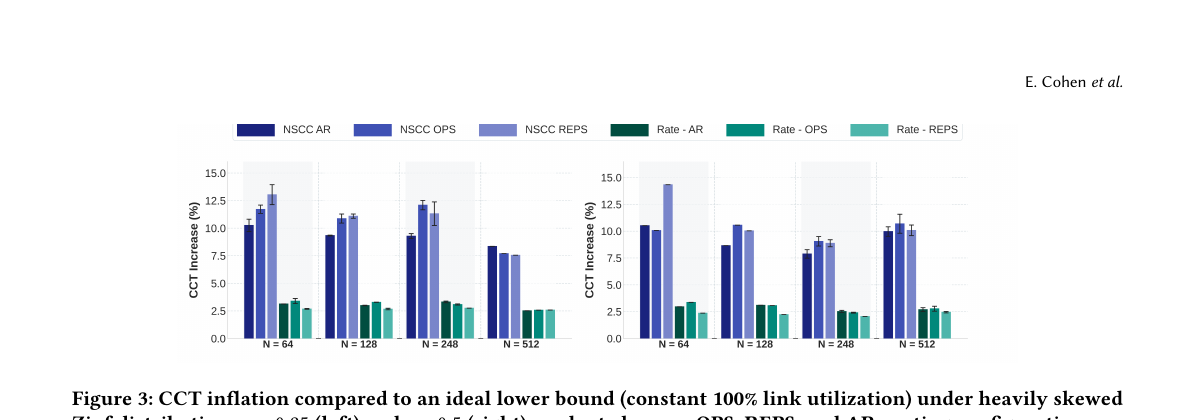
The mechanism check. The most instructive result is the queue-utilisation trade-off. NSCC does prevent catastrophic buffer overflow — it caps queue occupancy successfully. But it does so by over-correcting: reactive throttling drops link utilisation well below 100% for extended intervals, starving the fabric of bandwidth it could have used, and that starvation is what inflates CCT. The rate-based scheduler holds near-perfect utilisation throughout. This is the paper’s thesis in one chart: reactive congestion control cannot distinguish “back off because the buffer is filling” from “back off too much,” while proactive allocation never creates the condition in the first place.
Why this matters
The architectural implication the authors draw is the interesting one. If you pre-normalise the traffic matrix at the application layer against the physical capacity of the bottleneck, the fabric becomes collision-free by design, and the elaborate reactive transport machinery the industry has built — DCQCN, HPCC, UEC NSCC — becomes much less load-bearing for this class of workload. That’s a meaningful amount of silicon and power currently devoted to packet-throttling logic on every NIC and switch.
Two second-order consequences follow. First, heterogeneous clusters become tractable. Because $M$ scales by worst-case demand, the same arithmetic handles a fabric mixing 200 Gbps and 800 Gbps servers, or unbalanced expert placement, without any of the homogeneity assumptions that current distributed platforms lean on to keep the synchronisation barrier from stalling. Second, switch buffers can shrink. On-chip buffer at 1,600 Gbps and beyond is expensive and physically limited by silicon scaling; if proactive pacing keeps normalised ingress rate at or below 1, queue depths stay shallow and future switches can be designed with materially less SRAM.
The obvious follow-up is the one the paper flags: an actual DOCA PCC implementation with measured rather than simulated numbers, and a robustness study under link failures and background traffic — the exact conditions where BvN decomposition falls over and where this scheme’s ECN fallback would need to earn its keep.
Read alongside
- Lei et al., “FAST: An Efficient Scheduler for All-to-All GPU Communication” (NSDI ‘26) — the exact-BvN predecessor, and the source of the NVLink-offload structural assumption this paper reuses.
- Renganathan & McKeown, “Chronos: Prescheduled Circuit Switching for LLM Training” (2025) — the maximal-matching alternative to exact BvN.
- Birkhoff (1946) / von Neumann (1953) — the decomposition theorem underneath the whole scheduling family.
- Bonato et al., “REPS: Recycled Entropy Packet Spraying” (2025) — one of the three load-balancing schemes evaluated, and part of the UEC direction.
- Ultra Ethernet Consortium Specification v1.0.2 (2026) — defines the NSCC baseline this paper measures against.
- Gangidi et al., “RDMA over Ethernet for Distributed Training at Meta Scale” (SIGCOMM ‘24) — production context for why any of this matters at scale.
Links
📄 arXiv abstract · 📄 PDF
Part of the Weekly CS Paper Digest series. Summary written from a close read of the preprint; figures cropped from the arXiv PDF and reproduced here under fair use for educational commentary.