Weekly Paper Notes — the Seminal Paper of the Week for the 2026-11-28 digest. Area: Distributed Computing.
Authors: Miguel Castro and Barbara Liskov (MIT Laboratory for Computer Science) Published: Proceedings of the Third Symposium on Operating Systems Design and Implementation (OSDI ‘99), New Orleans, February 1999, pp. 173–186. USENIX. Extended journal version: “Practical Byzantine Fault Tolerance and Proactive Recovery”, ACM TOCS 20(4), 2002, DOI: 10.1145/571637.571640.
Why the paper still matters #
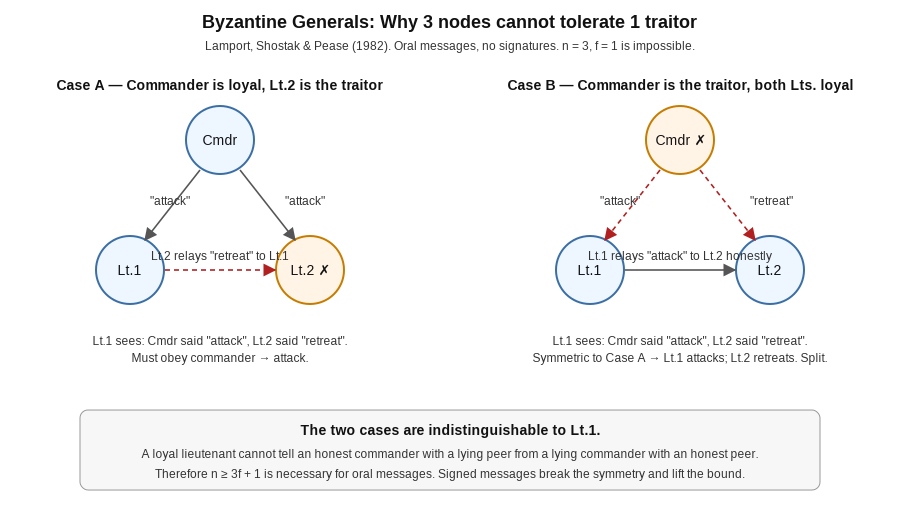
By 1999 Byzantine agreement was a seventeen-year-old theory result. Lamport, Shostak and Pease had shown in 1982 that tolerating f arbitrarily faulty nodes takes 3f + 1 of them, and FLP had shown that no deterministic protocol can guarantee consensus in a fully asynchronous network. What existed in between was either too slow to use or, like Rampart and SecureRing, relied on synchrony for correctness. Castro and Liskov point out what that means against an attacker: delay the honest nodes until they get tagged as faulty and voted out, which is usually easier than breaking into a machine.
The paper’s title makes its claim. PBFT is safe in an asynchronous network with no timing assumptions at all, uses timing only for liveness, and is fast. Their Byzantine-fault-tolerant NFS ran the Andrew benchmark only 3% slower than Digital Unix’s own NFS server. Before this paper, BFT was a theory topic. After it, people built BFT systems. Hyperledger Fabric’s early ordering service, Tendermint, Zyzzyva, Aardvark, BFT-SMaRt, HotStuff and the Diem/Libra consensus all start from it, and this week’s arXiv list still had two papers improving it (more below).
The setup #
The service is a deterministic state machine replicated on n = 3f + 1 replicas. Faulty nodes may do anything, including colluding, but they can’t break the cryptography, and the adversary can’t delay honest nodes forever. The bound is tight. A replica can only wait for n − f replies, since f may never answer. Of those, up to f may come from liars, because the silent ones might have been honest but slow. The honest answers still have to outnumber the lying ones, so n − 2f > f.
Replicas move through numbered views. The primary of view v is replica v mod n, and the rest are backups. A client sends its request to the primary and accepts a result once f + 1 replicas return the same one, since at least one of those must be honest.
The paper is just as direct about what that assumes. Failures must be independent, which against an attacker means different implementations, operating systems, root passwords and administrators on each replica. It suggests N-version programming. This is the assumption most deployments quietly drop.
The three phases #
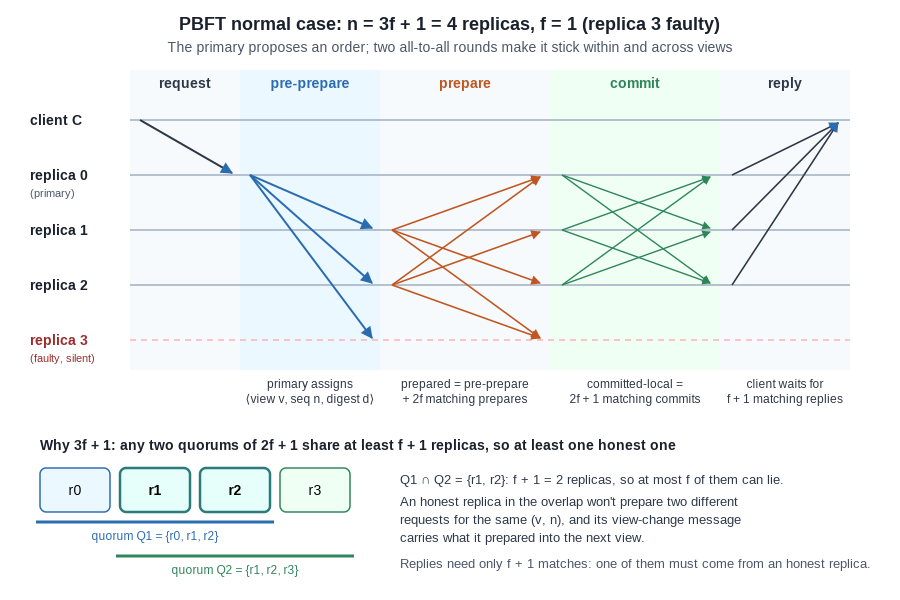
Pre-prepare. The primary assigns the request a sequence number n and multicasts ⟨PRE-PREPARE, v, n, d⟩, where d is the request’s digest. A backup accepts it only if it hasn’t already accepted a different digest for the same (v, n) and if n lies between a low and a high water mark. The water marks stop a faulty primary from burning through the sequence space.
Prepare. Each backup that accepts multicasts ⟨PREPARE, v, n, d, i⟩. A replica is prepared once it has the pre-prepare plus 2f matching prepares from different backups. That gives the first invariant: two honest replicas can’t be prepared for different requests at the same (v, n). Any two sets of 2f + 1 replicas overlap in at least f + 1, so at least one honest replica would have had to vouch for both, and an honest replica never does.
Commit. A prepared replica multicasts ⟨COMMIT, v, n, d, i⟩. Once it holds 2f + 1 matching commits it is committed-local and executes the request after all lower sequence numbers. The second invariant is that a request committed-local at any honest replica is prepared at f + 1 honest replicas. That is what lets the ordering survive a change of primary.
Two phases would order requests inside one view. The third is there for view changes.
View changes, checkpoints and the fast path #
When a backup’s timer expires on a request it can’t execute, it stops accepting normal messages and multicasts VIEW-CHANGE for v + 1. The message carries its last stable checkpoint and, for every request it prepared after that, the pre-prepare plus 2f prepares as proof. The new primary collects 2f of these and sends NEW-VIEW. For each sequence number in the range, it re-proposes the request with the highest-view proof, or a null request where there’s a gap (the same trick Paxos uses). Backups recompute the result themselves rather than trust the new primary. Liveness relies on three rules. The timeout doubles on every failed view change, a replica joins a view change once f + 1 others have asked for one, and a faulty primary can be primary for at most f consecutive views.
Logs would grow forever without garbage collection. Every 100 requests or so, each replica multicasts a CHECKPOINT with a digest of its state. 2f + 1 matching ones make it stable, everything older is discarded, and the water marks slide forward (the paper’s example window is 200).
The performance came from engineering the common case. Public-key signatures are used only for view-change and new-view messages. Everything else carries an authenticator, a vector of MACs with one entry per replica. On a 200 MHz Pentium Pro, an RSA signature took 43 ms to generate and a MAC 10.3 µs. That gap was the main bottleneck the paper’s authors saw in earlier systems. Other optimizations cut round trips. Only one designated replica sends the full result, and the others send digests. Replicas execute tentatively once prepared, which brings latency from five message delays to four. Read-only operations go straight to all replicas and need 2f + 1 matching replies, so they take one round trip.
What the evaluation showed #
The library plus BFS, a Byzantine-fault-tolerant NFS on four replicas, ran the five-phase Andrew benchmark only 3% slower than NFS-std, the kernel NFS V2 server in Digital Unix. With a read-only optimization for lookup, it was 2% faster. That comparison is a bit generous, and the paper says why. NFS-std writes to disk synchronously to meet NFS V2 semantics, while BFS gets durability from replication and writes asynchronously. Against its own unreplicated build (BFS-nr), replication cost 26% on the full benchmark. Against Rampart’s published numbers, PBFT’s latency was more than an order of magnitude lower.
What later work had to fix #
The design held up well, and the later fixes show where it was weakest.
- The primary is a bottleneck and a target. Aardvark (2009) showed that a malicious primary or malicious clients could slow PBFT to a crawl while staying just under the view-change timeout. Its fix was to treat robustness under attack, not peak throughput, as the goal. This week’s DispersedBFT (arXiv:2611.24833) spreads the primary’s dissemination work across the backups with information dispersal and reports 3.4M txn/s on 43 replicas.
- All-to-all messaging doesn’t scale. Prepare and commit are
O(n²)and the view change is worse. Zyzzyva (2007) speculated to skip phases in the fault-free case. HotStuff (2019) made both normal case and view change linear with threshold signatures and a pipelined chain, and Diem/Libra adopted it. - 3f + 1 is expensive. Trusted hardware that stops a replica from equivocating brings the count down to
2f + 1(A2M, MinBFT). This week’s Pearl (arXiv:2611.31468) tests the limits of that idea for fair transaction ordering. It proves that two fair-ordering properties can’t be had with2f + 1TEE-equipped replicas under partial synchrony, then achieves them under synchrony.
The core of PBFT hasn’t been replaced: quorums of 2f + 1 out of 3f + 1, safety that never depends on time, a view change that carries prepared certificates forward, and checkpoints that bound the log. Most BFT papers since change how the messages travel and keep that structure.
Read alongside #
- Lamport, Shostak and Pease, “The Byzantine Generals Problem”, 1982: the problem and the
3f + 1bound (our post). - Lamport, “Paxos Made Simple”, 2001: the crash-fault sibling, with the same view-change structure (our post).
- Castro’s PhD thesis, MIT 2001: the full protocol with proactive recovery and the I/O-automaton proofs.
- Clement et al., “Making Byzantine Fault Tolerant Systems Tolerate Byzantine Faults” (Aardvark), NSDI 2009.
- Yin et al., “HotStuff: BFT Consensus with Linearity and Responsiveness”, PODC 2019.
Links #
📄 USENIX OSDI ‘99 · 📄 PDF (MIT 6.824 mirror) · 📄 TOCS 2002 (DOI)
Part of the Weekly CS Paper Digest series. Written from a reread of the published paper; the diagram is original to this post.