Weekly Paper Notes — one of the top picks from the 2026-11-28 CS paper digest. Area: Distributed Computing / AI Infrastructure.
Authors: Shiqing Fan, Deepak Narayanan, Jimmy Zhang, Jiangfei Duan, Prajwal Singhania, Haoran Zhang, Wanying Wang, Philip Monk, Xuwen Chen, Jared Casper, Jun Yang, Mohammad Shoeybi, Bryan Catanzaro, Vijay Anand Korthikanti (NVIDIA) arXiv: 2611.32057 · PDF · Code (Megatron-LM)
TL;DR #
Training a model with trillions of parameters means picking from a menu of parallelisms: data (DP), tensor (TP), sequence (SP), context (CP), fully sharded data parallelism (FSDP), pipeline (PP) and, for MoEs, expert parallelism (EP). Each one gives up something. DP replicates weights. TP sends activations every layer and only scales inside an NVLink domain. FSDP all-gathers every weight for every microbatch. PP idles GPUs while the pipeline fills and drains.
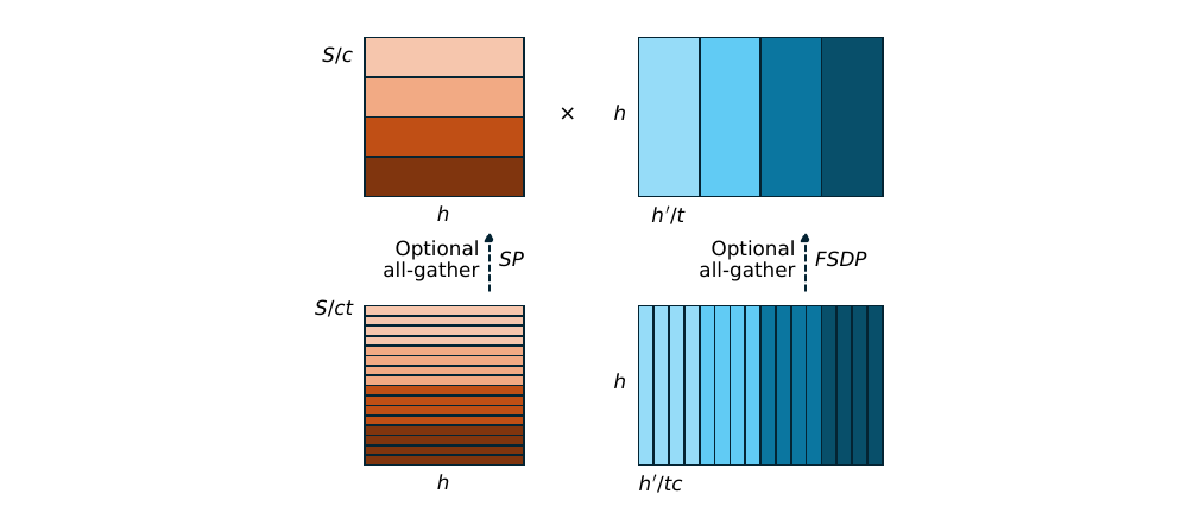
This paper, from the group that wrote Megatron-LM’s TP, PP and SP papers, starts from one observation. A linear layer is a GEMM with two inputs, weights and activations. Each can be partitioned, and each partition can be stored even smaller and all-gathered just before use. Under that view DP, TP, SP, CP and FSDP are five settings of the same two knobs. The authors call the combined scheme generalized tensor parallelism (GTP).
The practical payoff is scheduling. If a weight all-gather is just a preprocessing step on one GEMM input, you can issue and wait on it per GEMM rather than per Transformer block, which is what FSDP implementations do. With that change, an internal 2T-parameter MoE reaches 13.0 model EFLOP/s on 12,288 GB300 GPUs at 98% weak-scaling efficiency with no pipeline parallelism at all. It also beats Megatron-FSDP by 1.05–1.55× and a tuned 3D-parallel recipe by 1.27–1.31×. The implementation is upstream in Megatron-Core.
What problem is the paper actually attacking? #
Two requirements drive large-scale pretraining. Per-GPU memory for weights, optimizer state and activations should shrink roughly in proportion to GPU count, and GPUs should stay busy, which means communication overlaps with compute and the GEMMs stay large enough to run efficiently.
The standard recipe for years has been 3D parallelism: TP inside a node, PP across nodes, DP on top, plus EP for MoE layers. Megatron-LM (Shoeybi et al. 2019; Narayanan et al. 2021) is the reference implementation, and several of the same people are on this paper. The weaknesses are well known. TP’s all-reduce depends on the GEMM that produced it, so overlapping it means chopping the GEMM up. Large TP degrees make each GEMM skinnier and lower arithmetic intensity. PP needs balanced stages and many microbatches to hide its bubble, and the first stage holds activations for as many in-flight microbatches as there are stages.
FSDP and ZeRO-3 took the other route. They shard everything and all-gather weights on demand, which keeps GEMMs large, at the cost of moving 1.5× the parameter volume of DP’s once-per-step gradient sync every microbatch. Implementations like PyTorch FSDP2 and Megatron-FSDP (MFSDP) schedule this through module hooks, usually one per Transformer block.
The authors’ point is that a block-level hook is the wrong unit, and it’s especially wrong for MoE. A block’s first GEMM can’t start until every all-gather in the block has finished. And a module hook can’t see inside a fused operator. In a fused expert MLP the two grouped GEMMs (GFC1, then GFC2) live in one module, so GFC1 sits waiting on GFC2’s weights. Unlike TP’s activation traffic, a parameter all-gather doesn’t depend on any earlier computation. It can be issued whenever you like. What matters is choosing that moment for each GEMM.
The mechanism: one linear layer, two inputs #
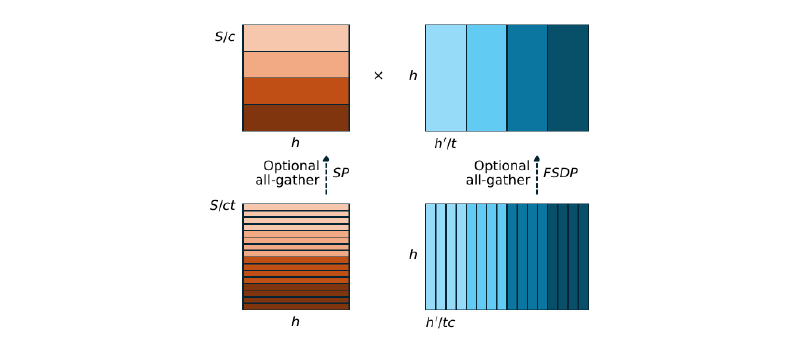
Take a weight W and an activation matrix X with one row per token. TP splits W along a hidden dimension across t GPUs. DP and CP split X along tokens across c GPUs, whole sequences for DP and pieces of sequences for CP. These axes act on different inputs, so a layer spans n = t · c GPUs.
Partitioning alone leaves something replicated. Each TP shard of W is copied across the c GPUs that share it, and each GPU in a t-group holds the same boundary activations. Removing either copy means storing a smaller shard and all-gathering it right before the GEMM. Doing that to activations across the t-group is sequence parallelism. Doing it to weights across the c-group is FSDP.
Weight re-materialization doesn’t need the whole c-group. GTP introduces a weight group of r ≤ c GPUs, each persistently storing 1/(t·r) of a weight. The GTP degree is
p = t × r (TP degree × re-materialization degree)With r = 1 you get TP plus DP. With t = 1, r = c you get FSDP, and 1 < r < c is hybrid sharding (HSDP). The c/r weight groups are replicas that sync gradients once per step. Because the weight group can be placed inside one NVLink domain, the per-microbatch all-gathers stay on NVLink and only the per-step sync crosses the slower network. MoE layers get a separately configured degree, EGTP, for expert weights, and those groups can span NVLink domains.
The communication model makes the tradeoff explicit. Per GPU, for one MLP block of S tokens:
comm(t, c) = γ_W · 4hh′/t · (1 − 1/c) + γ_X · 4Sh/c · (1 − 1/t)with γ_W = 1.5 when weights are re-materialized and γ_X = 1.25 with SP. Minimizing it gives an optimal TP degree of roughly t* = sqrt(1.2 · (h′/s) · (B_t/B_c)), where s is tokens per GPU. Lots of tokens per GPU push t* toward 1, which is FSDP. For MoE, the other useful ratio is GEMM time over all-gather time for one expert, which comes out to 2·s_e·B / (b·(1 − 1/r_e)·F). The weight size cancels, so whether an expert’s all-gather can hide behind its GEMM depends on tokens per expert, not on how big the expert is.
Scheduling all-gathers per GEMM #
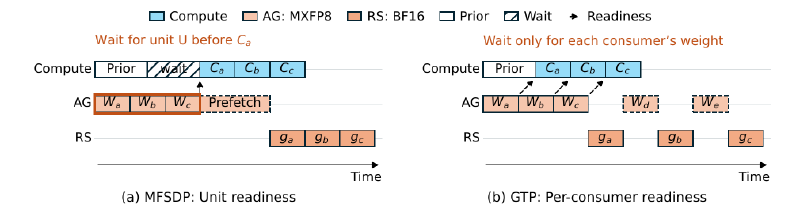
Instead of module hooks, every GEMM that reads a sharded weight asks for it through a consumer interface. Transformer Engine defines it as DistributedWeight, and Megatron-Core implements it as GTPShardedParam. The same operator code runs with or without GTP. The paper then names three scheduling decisions.
C1, when to issue. Dense weights share one prefetch chain with a lookahead of one: consuming W_i prefetches W_{i+1} going forward and W_{i−1} going backward. Since those all-gathers stay on NVLink, a short window is enough, and a short window keeps few views in memory. Expert weights get two separate chains, one for GFC1 and one for GFC2, and each prefetches the matching weights of the next MoE block. That gives the slow cross-domain all-gather a whole block of compute, dense layers and EP exchange to hide behind.
C2, what to wait for. Each all-gather records its own completion event, and a GEMM waits only on that event. GFC1 no longer waits for GFC2.
C3, what to coalesce. The local expert weights feeding one grouped GEMM are all-gathered in one collective, with separate collectives for GFC1 and GFC2. Per-expert all-gathers would be latency-bound, and merging GFC1 and GFC2 would bring back the waiting problem from C2.
In the backward pass the ordering also helps. Wgrad doesn’t read the weight, so a layer can issue the next all-gather before its dgrad and hide it behind both GEMMs, then free the view before wgrad runs.
The rest of the implementation section is the engineering that makes this work at scale. It covers MXFP8 or NVFP4 weight shards that are quantized once per optimizer step and all-gathered in low precision, alignment padding (DSV4-Pro’s 512-row KV projection would pad to 4× its size if sharded 64 ways, so it stays replicated), symmetric NCCL user buffers, full-iteration CUDA graphs, and a Muon implementation that shards Newton–Schulz work by cost.
Results #
At scale. Internal-2T (2T total, 130B active, 512 experts, top-10) trains at 1,060 model TFLOP/s per GPU on 12,288 GB300s, 13.03 EFLOP/s in aggregate, with GTP64, EGTP8, EP64 and no PP. Weak scaling from 4,096 to 12,288 GPUs holds 98.2%. The same model trains with 1M-token sequences on 512 GPUs at 283 GB per GPU using CP128, with throughput falling 30% from the 8K setting. Loss curves for Nemotron-3-Nano over about 1T tokens match a 3D-parallel baseline to a mean absolute difference of 0.0022 nats.
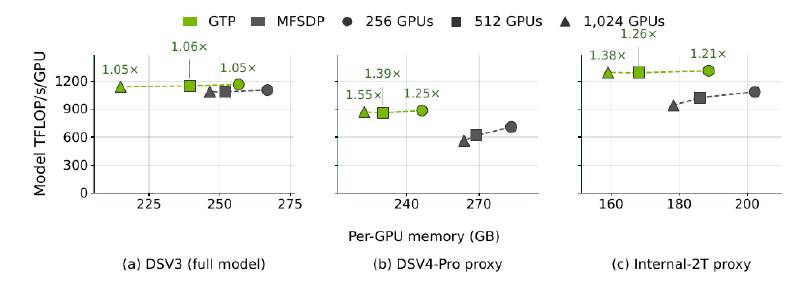
Against FSDP. At 256 GPUs GTP is 1.05× MFSDP on full DSV3, 1.25× on the DSV4-Pro proxy and 1.21× on the Internal-2T proxy, with 4–16% less memory. The gap widens with scale. GTP holds 98% weak-scaling efficiency from 256 to 1,024 GPUs while MFSDP drops to 79% on DSV4-Pro, so at 1,024 GPUs GTP is 1.55× faster. Profiles show why. On DSV4-Pro at 256 GPUs, 20% of GTP’s backward-pass all-gather time is exposed against 80% for MFSDP, and MFSDP’s exposed all-gather time per step swings between 390 and 932 ms at 512 GPUs, almost all of it spent waiting for the slowest GPU in each group to start the collective. DSV3 gains least because it has the most tokens per expert (16,384 against 8,192 and 10,240), so it has more compute to hide communication behind anyway, as the GEMM/all-gather ratio predicts. A matched TorchTitan FSDP2 comparison on the DSV3 proxy is closer, at 1.04× throughput with 16% less memory.
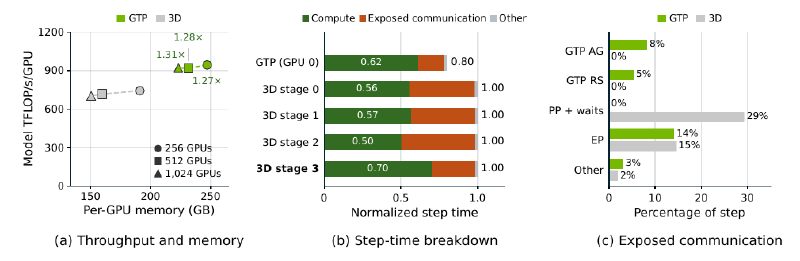
Against pipeline parallelism. On the DSV4-Pro proxy, GTP (GTP64, EGTP4, EP64, MBS2) beats a tuned TP1/PP4/VPP4/EP64 recipe by 1.27–1.31× from 256 to 1,024 GPUs, while using 29–48% more memory at the chosen microbatch sizes. At matched microbatch size GTP uses 11–13% less. The step-time breakdown is the most useful figure in the paper. Per-GPU compute is about the same (2.3 s for GTP, 2.1 s mean per stage for 3D), but the last pipeline stage runs 20% over the mean, and the other stages spend 29% of their step waiting, against an ideal balanced bubble of 4.5%. GTP has no stages to balance. Raising the global batch from 1K to 8K sequences narrows the gap from 26% to 16%, but GTP stays ahead at every batch size measured.
Ablations. Removing C1, C2 or C3 alone costs 12.2%, 15.7% and 8.3% on DSV4-Pro, and 4.4%, 2.7% and 3.4% on Internal-2T. Removing all three costs 19.8% and 5.9%. The losses aren’t additive, and they’re largest on the model with fewer tokens per expert.
Why this matters #
The unification itself isn’t new in spirit. GSPMD and Mesh-TensorFlow already express parallelism as sharding annotations on a device mesh, and the paper says so. The contribution is taking that view seriously in an eager, hand-scheduled framework at 12K-GPU scale and showing where it changes the schedule. Treating the weight all-gather as an operand fetch, the same way SP treats the activation all-gather, turns “which module do I hook” into “which GEMM needs this, and how much compute is between now and then.”
The result most likely to change how people configure jobs is the PP comparison. For a frontier-sized MoE on NVL72-class hardware, the paper reports that dropping pipeline parallelism and sharding weights 64 ways inside an NVLink domain is both simpler and faster, because the real cost of PP at these depths is stage imbalance, not the textbook bubble. Hybrid models with mixed layer types make balancing harder still. Section 6 is honest that this depends on the regime. PP still wins when the global batch is large, the stages balance, and the all-gathers can’t be hidden.
The other thing to take away is Equation 4. Whether sharded experts are cheap comes down to tokens per expert per microbatch. That number sets how much you can shard, how far ahead you must prefetch, and whether cross-domain EGTP is viable, and it’s easy to compute before launching anything.
Read alongside #
- Shoeybi et al., “Megatron-LM” (2019), and Narayanan et al., “Efficient Large-Scale Language Model Training on GPU Clusters Using Megatron-LM” (SC 2021): the TP and interleaved-PP baselines this paper argues past.
- Korthikanti et al., “Reducing Activation Recomputation in Large Transformer Models” (2022): sequence parallelism, the activation-side half of GTP.
- Rajbhandari et al., “ZeRO” (SC 2020), and Zhao et al., “PyTorch FSDP” (VLDB 2023): parameter sharding with module-level scheduling.
- Xu et al., “GSPMD” (2021): the compiler-side version of the same unification.
- Mixture-of-Kittens: MoE Megakernel for NVL72s: our October note on the EP side of the same hardware.
Links #
📄 arXiv abstract · 📄 PDF · 💾 Megatron-LM
Part of the Weekly CS Paper Digest series. Summary written from a close read of the preprint; figures cropped from the arXiv PDF and reproduced here under fair use for educational commentary.