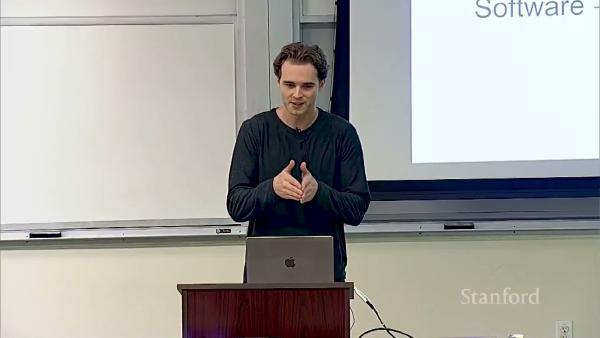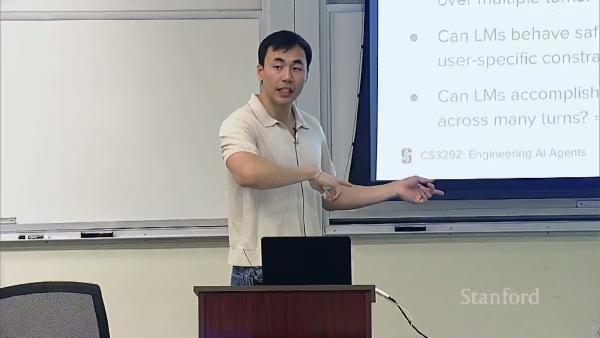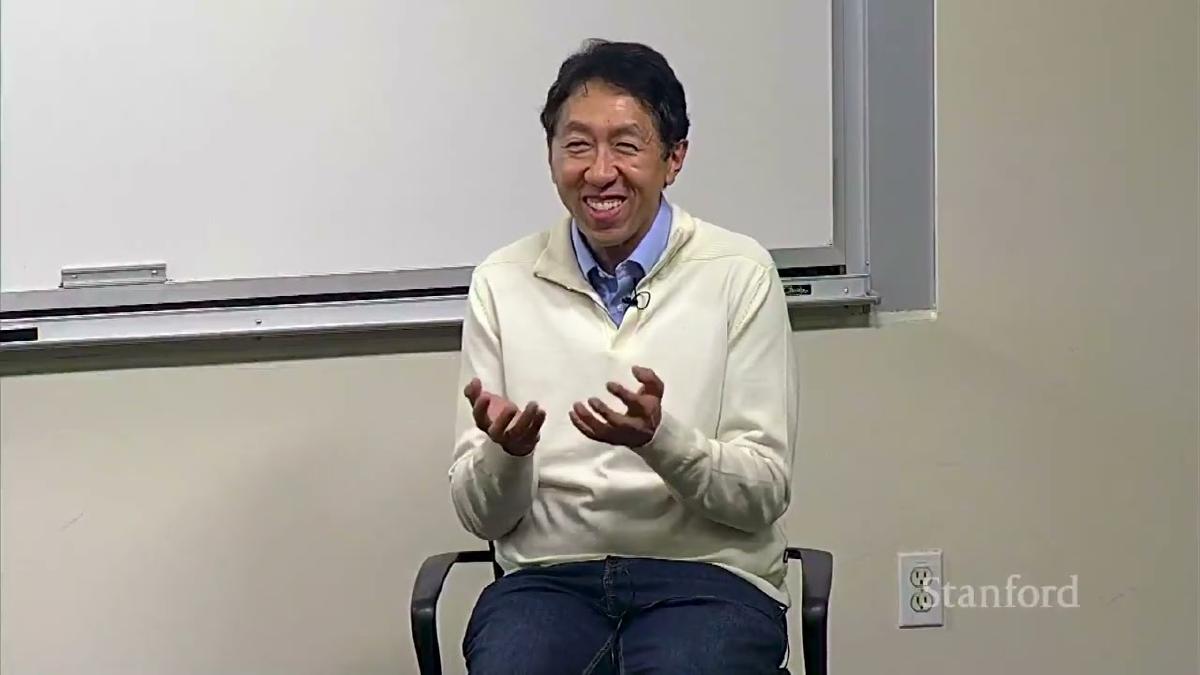
Asked what had changed his view of agents in recent months, Andrew Ng said not much. What still separates strong agent teams from weaker ones, in his experience, is a disciplined error analysis and evals process. Hosted by Diyi Yang, the conversation moved from how to build agentic workflows to which tasks AI still handles poorly, what chatbots do to learning, whether humans should still review code, and how academia can compete with frontier labs on compute.
Key insights #
- Ng sees agent building as a process that runs from quick prototypes to golden sets and regression tests, and teams need to be good at both ends.
- He argues AI is much stronger on verifiable tasks than on judgment tasks, and that the gap is larger than most people think.
- He calls AI chatbots “terrible for learning” because they were designed to get work done, not to help people learn.
- He has stopped writing and reviewing code by hand, and relies on testing, guardrails, and sandboxing for trust; Yang argues for keeping review until there are stronger guarantees.
- He expects knowledge gaps about AI tools to close quickly, while the gap in practical implementation inside industries will take about a decade.
From quick-and-dirty to rigorous evals #
Ng says experienced AI people, looking at the same project, tend to give strongly correlated advice on what to try next, which suggests that building AI systems follows a learnable process. His harder lesson is that the right process depends on the project’s stage. Early on, you should build quick prototypes: fire up a coding agent, prompt, look, change something. That can get from zero to around 80% accuracy fast. Teams that only know this mode then bounce between improvements and regressions and hit a ceiling. Late-stage work needs golden sets, rigorous evals, and CI regression testing to gain the last few percent. He also sees the opposite failure, often in people from large companies, who only know the heavy process.
Uncertainty about where an agent will fail is why he favors building first. If you build a coding agent for a class project, you cannot know in advance whether memory compaction, instruction following, tools, intent inference, or token burn will be the problem. He suggests starting with a simple toolset, a bash shell, and sandboxing guardrails, then watching. His own weekend example was a public API whose real rate limits were far below the published ones, something he only found by trying it.
Yang suggested that classical ML felt more elegant than agent engineering. Ng disagreed: the theory was elegant, but practice was error analysis, data cleaning, and tweaking, and he recalls senior faculty telling him deep learning was an empirical mess. He did grant that agent behavior is harder to anticipate. One way he contains that is to automate tasks people already know how to do, such as processing and routing invoices, because a human’s step-by-step reference lets you find exactly where the agent deviated.
Verifiable tasks versus judgment tasks #
On what humans still contribute, Ng describes intelligence as jagged. For verifiable tasks such as code and math proofs, you can build an RL gym, let the system attempt the task millions of times, and grade it automatically. Judgment tasks have multiple good and bad answers: which architecture to build, which product feature to ship first, what slogan to use, whether to hire a VP of sales now or in six months. Progress there is possible, he says, but slow and expensive, involving paid expert labelers, licensed data, and reward functions that get hacked or misaligned. Because benchmarks are also easier to build for verifiable tasks, those are what get measured.
He compares the present to Watson on Jeopardy, Deep Blue, and AlphaGo, where people overgeneralized from a breakthrough. His view is that progress on verifiable tasks is real and valuable, while many people are too optimistic about judgment tasks. He points to a common experience: AI answers on topics he knows well look poor, while answers on unfamiliar topics sound great.
Chatbots and learning #
Yang raised a study showing rising homework scores alongside falling exam scores. Ng went further and said AI chatbots are terrible for learning, citing cognitive offloading and a UPenn study he describes as showing 17% lower closed-book exam scores among students who used a chatbot. He believes the same loss is happening among working professionals and compounds over years.
it is possible to learn from chatbots just like in theory it is possible to learn math by doom scrolling social media.
He also notes a problem for STEM education, which has mostly taught right answers, exactly the verifiable work AI is getting good at. His hope rests on Learn Vector, a team he says is building one-on-one learning experiences designed for learning rather than task completion, with more to be announced. He told a personal story about building a typing game for his daughter that rewards practice with cat costumes, and said he thinks bans on AI for young people are a crude hammer.
Should humans still write and review code? #
Ng says he has largely stopped writing code by hand and has given up reviewing code by eye, because the volume his AI systems produce would make him the bottleneck. His trust comes from testing, guardrails, and sandboxing: for a recent coding-agent experiment, he gave the agent tools restricted to one working directory, so it could not damage anything outside it. He is candid that coding agents have hurt his teams, including permanently deleted data and a testing back door left on a production site. He adds that human engineers also ship bugs, and he is not sure he reviews code much better than an agent would.
Yang pushed back. With a human colleague there is a mental contract about their skill and effort; coding agents fail in ways that are hard to anticipate. She would skip review only with something like formal guarantees. She also noted that agent patches tend to be much longer than expert ones and proposed reviewability as an optimization target. Ng said he two-thirds agreed, noting that shorter code is easier for AI reviewers too, and that some providers have an incentive to burn more tokens.
He also made a point about fundamentals. On his teams, “vibe coding” is almost always followed by “understanding.” People who don’t know that different database types exist cannot give the model the context to choose between them, so it picks an arbitrary design point. For high-stakes code with few lines, such as a space shuttle, he says a human should review it.
Academia, open weights, and the workforce #
On compute, Ng says Stanford is relatively well resourced but nowhere near frontier labs, and he has seen professors elsewhere ask PhD students to buy GPUs with their own money. He remains optimistic because academia still produces strong work with fewer resources, but he worries that US research funding cuts could damage the institution in ways that are hard to reverse.
From the audience: he is confident open-weight models will survive, though he sees “stifling regulations,” sometimes pushed in the name of safety for regulatory capture, as the main risk. Intelligence is used for tasks from hard math to grammar checking, so he thinks there is room for many models. On the workforce, he expects tool knowledge to diffuse fast, pointing to the prompt-engineer job that faded, while the practical question of how to use AI in a bank, a hospital, or a factory will take about a decade. A team of AI-native individuals is not automatically an AI-native team. His advice to early-career scientists outside CS was to learn the discipline-specific best practices for AI in their field, and to the class to be careful handing in AI-generated work, since more sensitive readers will notice the missing clarity of thought.
Further reading #
- Fireside chat video with captions
- DeepLearning.AI, mentioned in the Q&A as one route for workforce education