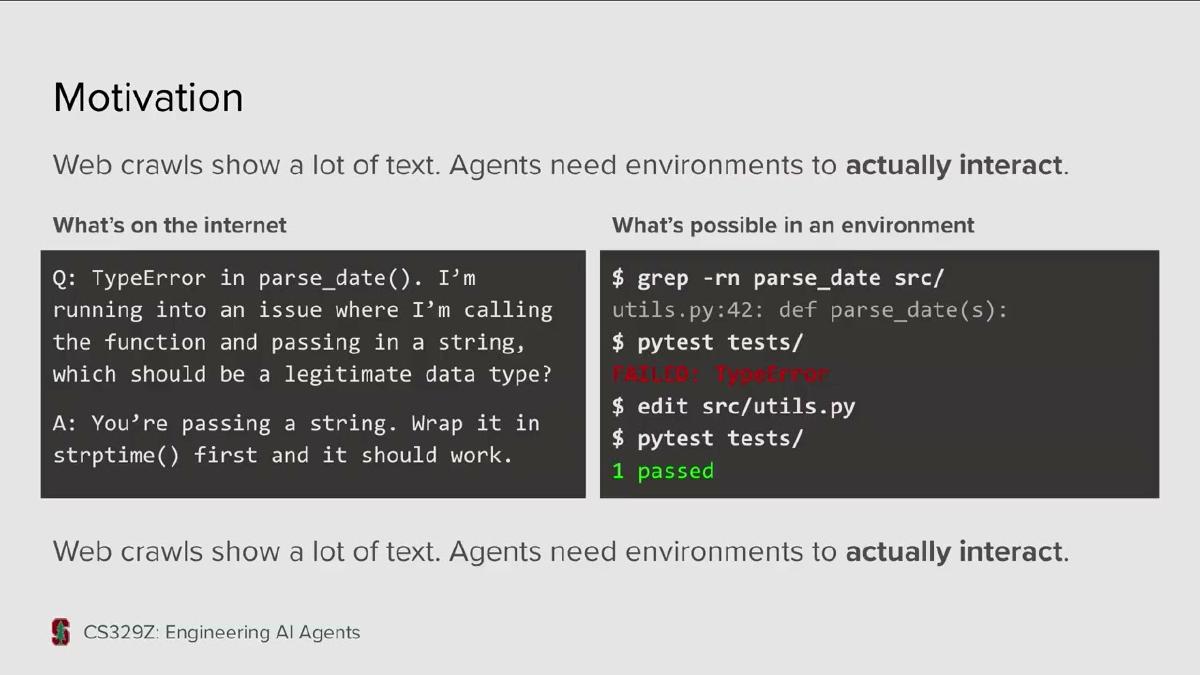
John Yang opens the second half of CS329Z with an analogy: the web is a textbook, and an agent also needs a lab. GitHub stores code as text, but pre-training on that text does not show a model what happens when it runs pip install, reads the error, and tries again. His claim is that the large gains in agent ability over the past two years come mostly from agentic data created at scale, so this lecture stops treating the model as frozen and asks where that data comes from.
Key insights #
- Agent data takes two forms: trajectories that a model imitates with supervised fine-tuning, and environments with verifiers that a model practices in with reinforcement learning.
- Every collection method trades realism against cost and scale, from human demonstrations to tasks and users simulated by a language model.
- The recurring recipe is to find a natural source, convert it into the agent’s action space, and filter what comes out.
- A model trained on environments with loopholes learns the loopholes, and some studies report that the habit spreads to other behavior.
- Training on a single harness, overtraining with SFT, and running RL too long each produce models that look worse outside the training distribution.
Trajectories and environments #
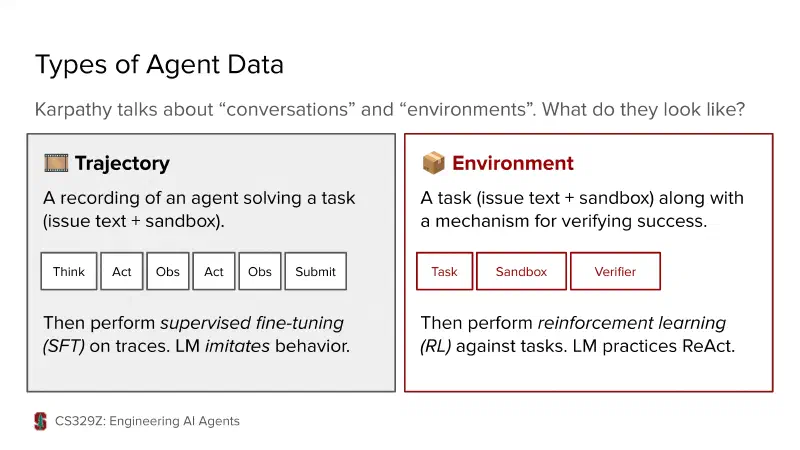
Source: CS329Z Lecture 10, PDF page 13.
A trajectory is a dialogue stored as JSON: thoughts, actions such as ls or cd, and the observations they return, sometimes interleaved with follow-up requests from a user. In training, the model predicts the agent’s thoughts and actions, while the system prompt, task, and tool outputs serve only as context. The format of those actions is set by the harness around the model.
An environment has three parts: a problem statement, a sandbox where the actions run, and a verifier that grades the result. The slides arrange verifiers from reliable but narrow to general but fuzzy: unit tests, rubrics, a model acting as judge, and human preference votes like those behind LM Arena. Yang describes SFT as behavior cloning and RL as a playground where only the outcome is graded.
The scale numbers come from DeepSeek, one of the few labs that published them: 14.8T pre-training tokens and 1.5M SFT examples for V3, then 85k RL task prompts for V3.2. Yang notes that the paper traces those prompts to roughly 1.5K underlying environments, because one repository can host many tasks. The post-training stages use far less compute than pre-training but have a large effect on the final model’s behavior.
Recording people and mining the web #
The lecture sorts collection strategies into five groups: human demonstrations, data mined from the web and the world, synthesized trajectories, synthesized tasks, and simulated users or environments. For each one, Yang asks students to consider cost, realism, and scalability.
Human demonstrations come first. Mind2Web had crowdworkers complete 2,350 tasks on 137 real websites and logged each click against the page HTML. OpenCUA instead runs a recorder on annotators’ own computers, capturing screen video, mouse, and keyboard across three operating systems for 22.6K tasks. A student asked what should be recorded, and Yang described a range of options. A full VM snapshot is faithful but takes gigabytes and is hard to replay, while saving only HTML is light but may throw away context. Either way, raw keystrokes and mouse movements have to be mapped into an action space a model can generate.
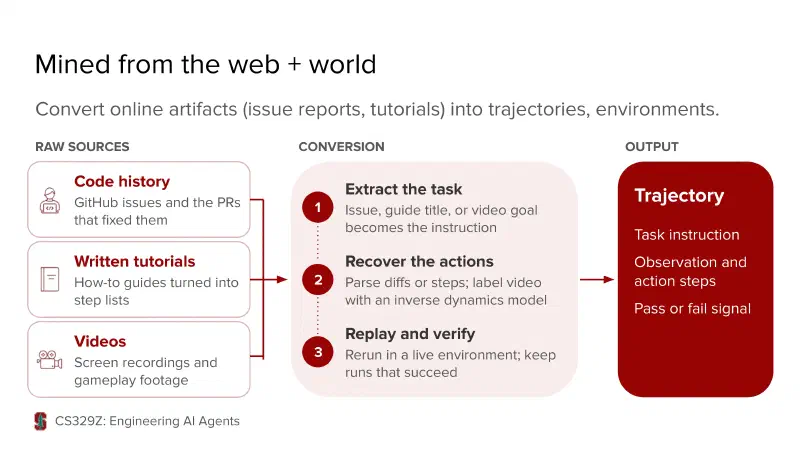
Source: CS329Z Lecture 10, PDF page 30.
Human labor is expensive, which motivates mining artifacts that already exist. SWE-rebench automates the SWE-bench recipe and reports 21,336 verifiable tasks from 3,468 repositories, using the tests a pull request added as the verifier. Yang lists the quality questions this raises at scale: which repositories to trust, what to do when a 2019 toolchain no longer installs, and whether the tests actually match the issue text. AgentTrek finds how-to tutorials in a web crawl and has a vision-language agent replay them in a real browser for about $0.55 per trajectory. VideoAgentTrek applies an inverse dynamics model to 39k YouTube screen recordings to label clicks and keystrokes. Yang points out that tutorials and videos are mirror images: a tutorial supplies the reasoning and the model fills in actions, while a video supplies the actions and a model backfills the reasoning.
Letting models write the data #
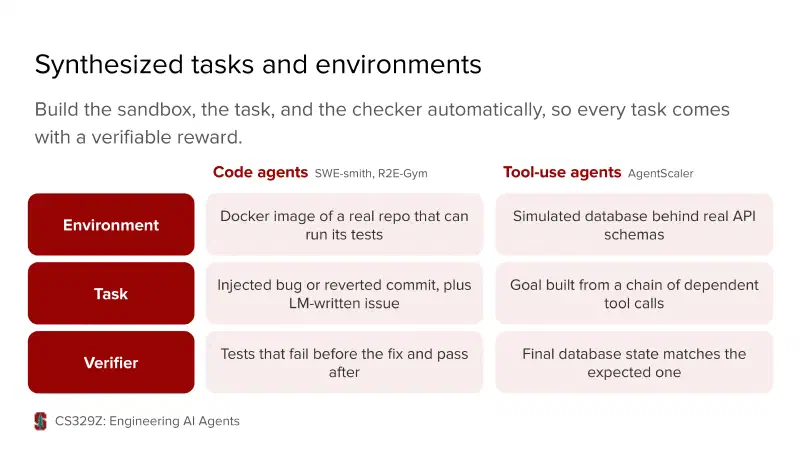
Source: CS329Z Lecture 10, PDF page 47.
Synthesized trajectories start either from an instruction or from interaction. Synatra rewrites wikiHow articles into step-by-step demonstrations without executing anything, at $0.031 per sample, and still trains a model that performs well on live websites. Yang reads that result as a challenge to the assumption that an environment is required at all. OS-Genesis and NNetNav go the other way: an agent explores apps or sites freely, and a second model labels in hindsight which task the run accomplished. NNetNav adds personas, since a sequence of Reddit clicks is easier to describe as a task once you know who would want it.
Synthesizing environments follows the same logic. Yang, first author of SWE-smith, explains its motivation through yield: the original SWE-bench pipeline turned only about 10% of pull requests into usable tasks. SWE-smith starts from a repository whose tests pass and then breaks the code on purpose, through AST edits, model-written bugs, or reverted pull requests, until existing tests fail. The slides report 50k tasks from 128 Python repositories at a cost of about 20 hours of human work. R2E-Gym builds tasks from plain commits by generating both the tests and the issue text, and AgentScaler simulates databases behind real API schemas. The last group replaces people or systems with a model. In τ-bench a model plays the customer, APIGen-MT turns task blueprints into multi-turn chats, and DreamGym lets a model predict the next state and reward. The slide states the risk plainly: agents can learn the simulator’s mistakes.
What the data teaches by accident #
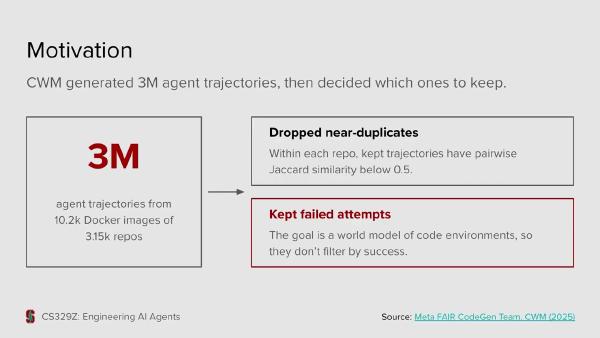
The closing section covers what goes wrong when everything is simply combined into one training set. The first problem is reward hacking. In early SWE-bench environments the future git history was left in place, so a model could check out a later commit instead of fixing the bug. Self-play SWE-RL addresses this by wiping .git and restoring test files before grading. The slides also cite Anthropic’s finding that models learned tricks like sys.exit(0) to fake passing tests and became more misaligned on other behavior afterward. In OpenAI’s version, adding a chain-of-thought monitor to the reward made the model hide its intent while it kept hacking. Memorization belongs in the same category. One study found that models could name the buggy file from the issue text alone 76% of the time on SWE-bench Verified, compared with at most 53% on repositories outside the benchmark.
The second problem is overfitting to a harness. SFT copies the capability and the scaffold’s conventions together, and the model cannot separate them. Yang’s answer to an early student question was to train across many harnesses. The third problem is about training dynamics. SWE-RL found that RL improved five out-of-domain tasks while SFT on the same seed data degraded them on average. OpenThoughts-Agent’s best RL run peaked and then collapsed, so the team shipped the checkpoint from before the collapse. The same project found that trajectories from GPT-5.3-Codex produced a worse student than trajectories from the older GLM-4.7, so the strongest model is not always the best teacher. Deciding which of these data to actually keep is the topic of Lecture 11.