John Yang opens the evaluation half of the course with the question the earlier lectures left open: prompts, memory, optimizers, and training data all promise improvement, but improvement on what? His answer is that an agent benchmark has two parts, a task formulation and an evaluation protocol. I find it easiest to remember as a 4-tuple: a request (the problem statement), an environment the agent acts in, stopping criteria that end a rollout, and a scorer that grades the result. Leave any one of them unspecified and two teams reporting “+5 on X” may be measuring different things.
Key insights #
- Agent benchmarks take a task plus an environment as input, run many action-observation turns, and grade a trajectory and a changed environment rather than a single text response.
- The evaluation protocol (attempts, termination, model settings, harness, tools, internet access, aggregation) has to be fixed and published, or scores from different systems cannot be compared.
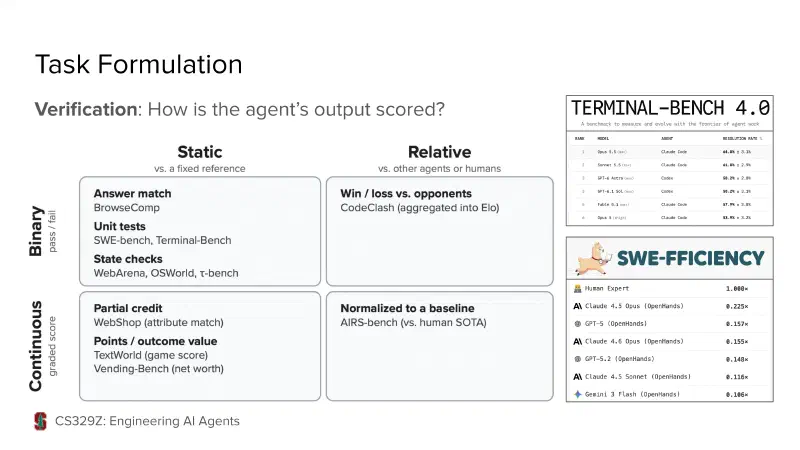
- Verifiers vary along two axes: binary versus continuous reward, and static reference versus relative comparison against other systems.
- Good benchmarks are challenging, natural, discriminative, easy to run, easy to verify, interpretable, and durable, and these properties pull against each other.
- A trustworthy score is fair, reproducible, transparent about variance and cost, and honest about the test set.
From response = LM(prompt) to trajectories #
The lecture starts with history. Early NLP had many small task-specific datasets, and researchers built custom systems for each. Yang points to T5 as a unifying moment: Raffel and colleagues recast these tasks as one formulation, given a prompt the model generates a response. Bundles followed (GLUE, SuperGLUE, MMLU, HELM), then harder families. Exam benchmarks climbed from MMLU to MMLU-Pro, GPQA, and Humanity’s Last Exam, and Yang notes that their curation shifted from scraping textbook questions to paying experts to write them. Chat benchmarks such as Chatbot Arena use win rates and Elo; because a model’s score depends on its opponents, he argues these are harder to saturate than static sets. Safety benchmarks like HarmBench and AIR-Bench test behavior (does the model refuse?) more than capability.
MMLU-Pro already shows that chain-of-thought versus direct answering changes scores, so authors must say how a benchmark should be run.
The slides define an agent benchmark as one that asks a system to accomplish a task by acting in an environment over many steps, then grades what it accomplished. The input is a task and an environment, the interaction is many turns, and the output is a trajectory plus a changed environment.
Task formulation and evaluation protocol #
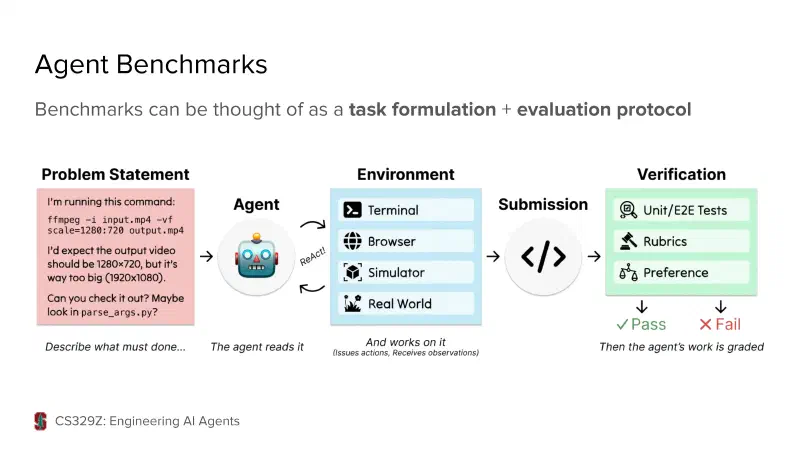
Source: CS329Z Lecture 12, PDF page 33.
The task formulation covers the request, the environment, and the scorer. Problem statements range from prescriptive to open-ended. WebShop asks for a product matching explicit constraints. A SWE-bench issue describes a problem without dictating the fix. CodeClash and Vending-Bench have no correct solution at all, only a competitive or economic outcome. Environments raise their own choices: a Docker sandbox or a bare machine, a live website with its non-determinism or a simulated clone, a text game, or a robotics simulator. Yang ties each choice to cost and to how easily others can reproduce the setup.
The evaluation protocol holds the agent-specific parameters that are not part of the task. How many attempts per task, and how are multiple runs aggregated? How does a rollout end: a turn cap, a wall-clock limit, a dollar budget, or the agent deciding it is done? Yang’s example is a fine-tuning task where the agent waits hours on a training job; whether a busy cluster’s delay counts against the agent’s time budget changes the result. Stopping criteria belong in the protocol for exactly this reason.
The harness question came up in Q&A. SWE-bench began as a retrieve-then-edit workflow using BM25 and only later became an agentic benchmark once systems like SWE-agent dropped the model into a terminal. Today the SWE-bench and Terminal-Bench leaderboards accept different harnesses, and the same model can score differently under Claude Code, OpenCode, or mini-SWE-agent. Yang’s view is that tying a harness to the benchmark is the designer’s call, as long as it is communicated.
Scorers and case studies #
Source: CS329Z Lecture 12, PDF page 36.
Yang lays out verification as a grid. Binary rewards give 1 for success and 0 for failure. SWE-Efficiency, his continuous example, asks the agent to speed up code; if the expert achieves a 50x speedup and the agent 20x, the designer can award 0.4 instead of zero. Static scorers compare against a fixed reference, while relative scorers rank systems against each other.
The case studies show how each element evolved. TextWorld kept everything in text, and ALFWorld played household tasks as text games mirroring a 3D simulator. WebShop simulated Amazon with stripped-down pages because raw HTML confused models of the time. WebArena self-hosted several real sites. τ-bench added an LLM-simulated user and grades the final database state instead of an answer. Terminal-Bench generalized SWE-bench’s terminal-plus-tests setup beyond GitHub issues with hand-authored tasks. OSWorld required tasks that span terminal, browser, and other applications, so the full computer is actually needed. CodeClash, Yang’s own work, swaps unit tests for multi-round tournaments.
What makes a benchmark good #
The slides list seven properties and warn that they conflict. A task should be challenging, yet Yang notes that squashing 200 GitHub issues into one environment makes it harder without making it more natural. He critiques his own CodeClash on the same grounds: its arenas are programming games, and it is fair to ask why anyone should care which model writes the better Battlesnake bot. Discriminative means scores spread out; he compares this to GRPO, which learns only when some rollouts succeed and some fail.
Easy to run is about people. A multi-step Postgres-and-ports setup means nobody hill-climbs your benchmark, and he says early SWE-bench saw little use for months because verification was slow to run. Interpretable means a paper, a site, a repository, and ideally a trajectory viewer. Durable means resisting contamination and reward hacking: SWE-bench Pro added a private split, DeepSWE used expert-written tasks, and SWE-rebench and LiveCodeBench refresh their task pools after model training cutoffs. The lifecycle slide summarizes the pattern as propose, adapt, saturate, replace.
He also warns about “benchmaxing,” where heavy post-training on one domain inflates a score while the model gets worse elsewhere. His example is a coding model that wraps code in superfluous try/except blocks, which suppresses errors so that it runs while hiding real failures.
What makes a score trustworthy #
Source: CS329Z Lecture 12, PDF page 67.
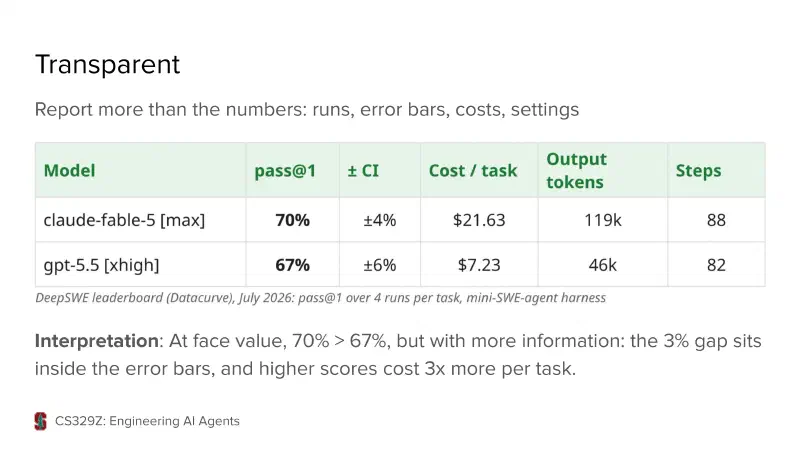
The final section moves from task design to reporting. A fair score follows the benchmark’s harness, budgets, model settings, attempts, and resource access, or states how it deviated. A reproducible score pins the model snapshot, harness, dataset, and image versions. A transparent score reports runs, error bars, cost, and excluded tasks; the slide’s example shows 70% beating 67% at face value, but the gap sits inside the error bars and the higher score costs three times as much per task. An honest score never tunes on the test set, never reports the luckiest of ten runs as pass@1, and comes from the system that actually ships. The slides cite a 2015 ImageNet team disqualified for submitting to the test set too many times.